











-
Medicinal plant cultivation prioritizes both biomass yield and the content/stability of specific bioactive compounds (e.g., alkaloids, flavonoids, terpenes, polysaccharides), presenting distinct challenges compared with conventional crops.
Regional specificity: ecological and genetic basis
-
According to The Pharmacopoeia of the People's Republic of China (ChP), Daodi medicinal materials refer to Chinese medicinal materials cultivated in specific geographical regions with stable superior quality and significant clinical efficacy. Their formation results from genotype × environment interactions: Specific genotypes drive bioactive compound synthesis under unique habitat conditions (temperature, humidity, soil, altitude). Climate factors shape bioactive compounds' distribution by influencing key enzyme activities in secondary metabolism[1]. Maintaining regional specificity quality thus requires a holistic understanding of the interplay among genetics, environment, and the soil ecosystem.
Continuous cropping obstacles: microbial imbalance
-
Long-term monoculture leads to soil microecological imbalance and autotoxin accumulation, severely constraining sustainable cultivation. In Panax ginseng, continuous cropping drastically alters the soil's microbial structure: The bacteria–fungi ratio (B/F) decreases from 33.1 to 1.8 after 4 years[2]. Root-secreted autotoxins chemotactically attract pathogens, increasing Ilyonectria robusta infection rates 2.5-fold. After 4 years of cropping, ginseng yield decreases by 30%–50% and saponin content by 11.4%−40.5%. Panax notoginseng also faces severe soil-borne diseases[3]. The core obstacle is the vicious cycle of biotic/abiotic stresses triggered by soil dysbiosis. Addressing these soil health issues is therefore a prerequisite for stable and high-quality medicinal plant production.
Ecological risks of intensive cultivation
-
The global medicinal plant market is expected to grow. However, excessive intensification poses ecological risks. Long-term fertilization increases heavy metal (Cd, Pb, Zn) concentrations and mobility in the topsoil. Nitrogen fertilizers exacerbate Cd/Pb/Zn leaching; manure increases Cd accumulation by 40%; soil acidification further activates metals' bioavailability[4]. In greenhouse systems, high nitrogen (> 500 kg/ha) elevates soil electrical conductivity (EC) to 4.2 dS/m, causing salinization and inhibiting colonization by (arbuscular mycorrhizal fungi) colonization by ~75%[5]. Balancing yield demands with ecological protection is thus a core challenge. Consequently, sustainable strategies that mitigate these risks while supporting productivity are urgently needed.
Application basis and key advantages of microbial inoculants
Agricultural benefits: relevance to medicinal plants
-
The application of microbial inoculants in agriculture is relatively mature, demonstrating benefits beyond yield enhancement[6]. Their function include phosphorus and potassium solubilization, phytohormone production that stimulates root growth, and the production of siderophores for iron acquisition[7]. Furthermore, certain microbes act as biocontrol agents, suppressing pathogens through competition and antibiosis, and inducing systemic resistance[8]. These multifaceted mechanisms, which enhance nutrient availability, promote plant vigor, and protect against stress, are directly transferable and particularly valuable for medicinal plant cultivation, where both biomass and secondary metabolite quality are paramount.
Yield–quality synergy: mechanisms and examples
-
Medicinal plant cultivation prioritizes the content/stability of bioactive compounds, differing from conventional crops' focus on biomass/yield. This imposes stricter requirements: Regulated quality standards mandate identity, purity, and content testing, and chemical inputs are restricted to avoid interfering with secondary metabolism or residue risks. Biological control is thus one of the preferred strategies. Microbial inoculants offer unique synergistic advantages for simultaneously enhancing yield and quality through multiple mechanisms: (1) Improving nutrient uptake (e.g., N fixation, P solubilization), directly increasing biomass. For example, arbuscular AMF + phosphate-solubilizing bacteria (PSB) increased Withania somnifera and Adhatoda vasica biomass by 1.56-fold and 2-fold, respectively[9]. (2) Specifically activating secondary metabolic pathways to regulate bioactive compound synthesis. For example, specific inoculants enhance tanshinones in Salvia miltiorrhiza and increase protein/polysaccharide/polyphenol in W. somnifera[10]. (3) Mitigating abiotic and biotic stresses, such as drought or pathogen attack, which can otherwise compromise both yield and quality. Even in degraded soils, mixed inoculants can optimize resource allocation (e.g., via leaf C/N, C/P regulation) for synergistic yield–quality[10].
Economic value: enhancing profitability and market access
-
The improvements translate directly into economic value. The higher accumulation of premium bioactive compounds in S. miltiorrhiza induced by AMF inoculation[11] enables higher economic benefits per unit of area. Increased bioactive compound content directly translates to higher quality grades and enables premium pricing, thereby enhancing profitability per unit of area. Moreover, by reducing reliance on chemical fertilizers and pesticides, inoculants lower the input costs and mitigate the risks of chemical residues, ensuring compliance with strict quality standards[12]. Thus, the economic benefits are multifaceted, encompassing higher product value, reduced input costs, and improved market access. The significant effects of various microbial inoculants on yield, quality, and stress resistance in key medicinal plants are systematically summarized in Table 1.
Table 1. Effects of microbial inoculants on the growth and metabolism of medicinal plants.
Microbial category Medicinal plant Microbial inoculant(s) Documented effects (key outcomes on yield/quality/stress) Arbuscular mycorrhizal fungi (AMF) Salvia miltiorrhiza Glomus mosseae Under optimized conditions: Tanshinone IIA 0.252% (significant increase) Ginkgo biloba Glomus mosseae Leaf area +28.1%; dry weight +59.2%; flavonoid glycosides increased Perilla frutescens Glomus mosseae Leaf phenolic content +15%; root rot resistance +76.8% Plant growth-promoting rhizobacteria (PGPR) Calendula officinalis Bacillus subtilis Vanillin content in petals +50% Glycyrrhiza uralensis Bacillus cereus Activated jasmonic acid (JA) signaling; increased sodium dismutase (SOD)/catalase (CAT); enhanced glycyrrhizin Cyclocarya paliurus Bacillus megaterium + Pseudomonas fluorescens Flavonoids and polysaccharides accumulation promoted Mentha piperita Bacillus subtilis Essential oil content enhanced (via improved P uptake and terpenoid synthesis) Lonicera japonica Bacillus subtilis + Pseudomonas fluorescens Chlorogenic acid content increased synergistically Catharanthus roseus Azotobacter + Bacillus + Pseudomonas Alkaloids +30%; N, P, K uptake efficiency improved Lonicera japonica Bacillus subtilis (alone) Chlorogenic acid +18%; HQT gene expression upregulated Mentha piperita Pseudomonas fluorescens + Bacillus subtilis Volatile organic compounds (VOCs) and phenolic content synergistically increased Cicer arietinum Rhizobium spp. + phosphate-solubilizing bacteria (PSB) Pod yield +39.5%; soil-available P +2.3-fold Eleusine coracana Azospirillum + Azotobacter Plant dry weight +30%–40%; N uptake +28%; P uptake +35% Other beneficial fungi Salvia miltiorrhiza Phoma herbarum D603 Tanshinone IIA increased to 6.5× control Panax ginseng Trichoderma harzianum T22 Suppressed Rhizoctonia solani by 90%; disease incidence –65%; promoted ginsenosides Catharanthus roseus Aspergillus niger extract Upregulated ABC transporters via JA signaling; enhanced alkaloid vacuolar sequestration Microbial consortia/combined inoculants Adhatoda vasica AMF (Acaulospora scrobiculata, Glomus funneliformis and Acaulospora) + PSB + azotobacter Biomass increased by > 2-fold Panax notoginseng Trichoderma spp. + composite inoculants (e.g., effective microorganisms [EM]) Seedling emergence +35%; yield +25%; disease incidence reduced > 50%; enriched beneficial bacteria Lonicera japonica Bacillus subtilis + gibberellin (GA3) Chlorogenic acid content +40% Withania somnifera AMF (Acaulospora scrobiculata, Glomus funneliformis and Acaulospora) + PSB + Azotobacter Biomass +1.56-fold; polyphenols +266.23% Salvia miltiorrhiza Glomus spp. + Rhizopus spp. Root biomass +65.1%; phenolic acids +27%; tanshinones +34% Others (Actinobacteria, rare earth elements) Salvia miltiorrhiza Actinomyces bovis + Streptomyces spp. Root-knot nematode infection –50%; soilborne pathogens inhibited Salvia miltiorrhiza PGPR + praseodymium (rare earth) Tanshinone content +40% (at 100 μM Pr) Panax ginseng Rhizobium panacihumi DCY116T Root biomass +25%; saponin content significantly enhanced Ecological value: promoting sustainability
-
Inoculants are key to achieving green cultivation in several ways. First, for reducing chemical inputs, biofungicides (e.g., Trichoderma spp.) suppress pathogens via competition, antibiosis (e.g., chitinases), and induced systemic resistance (ISR), reducing fungicide use, minimizing residues/pollution, and protecting biodiversity[13]. Second, in terms of improving nutrient use efficiency, plant growth-promoting rhizobacteria (PGPR) and AMF enable stable yields with 20%–50% reduced chemical fertilizer application[14]. Furthermore, inoculants address specific soil problems and ensure safety. For example, specific actinomycetes reduce infection rates and suppress soilborne pathogens (e.g., root-knot nematodes), alleviating continuous cropping obstacles[15]. PGPR immobilize heavy metals (Cd, Pb) via adsorption, redox, and precipitation, reducing plant uptake and ensuring the material's safety[16]. Thus, inoculants are core for transitioning medicinal plant cultivation towards environmental friendliness and resource efficiency.
-
The multifaceted mechanisms through which microbial inoculants promote plant growth and the biosynthesis of medicinal compounds are illustrated in Fig. 1, encompassing nutritional, hormonal, defensive, and biosynthetic pathways, which are detailed in the following subsections.
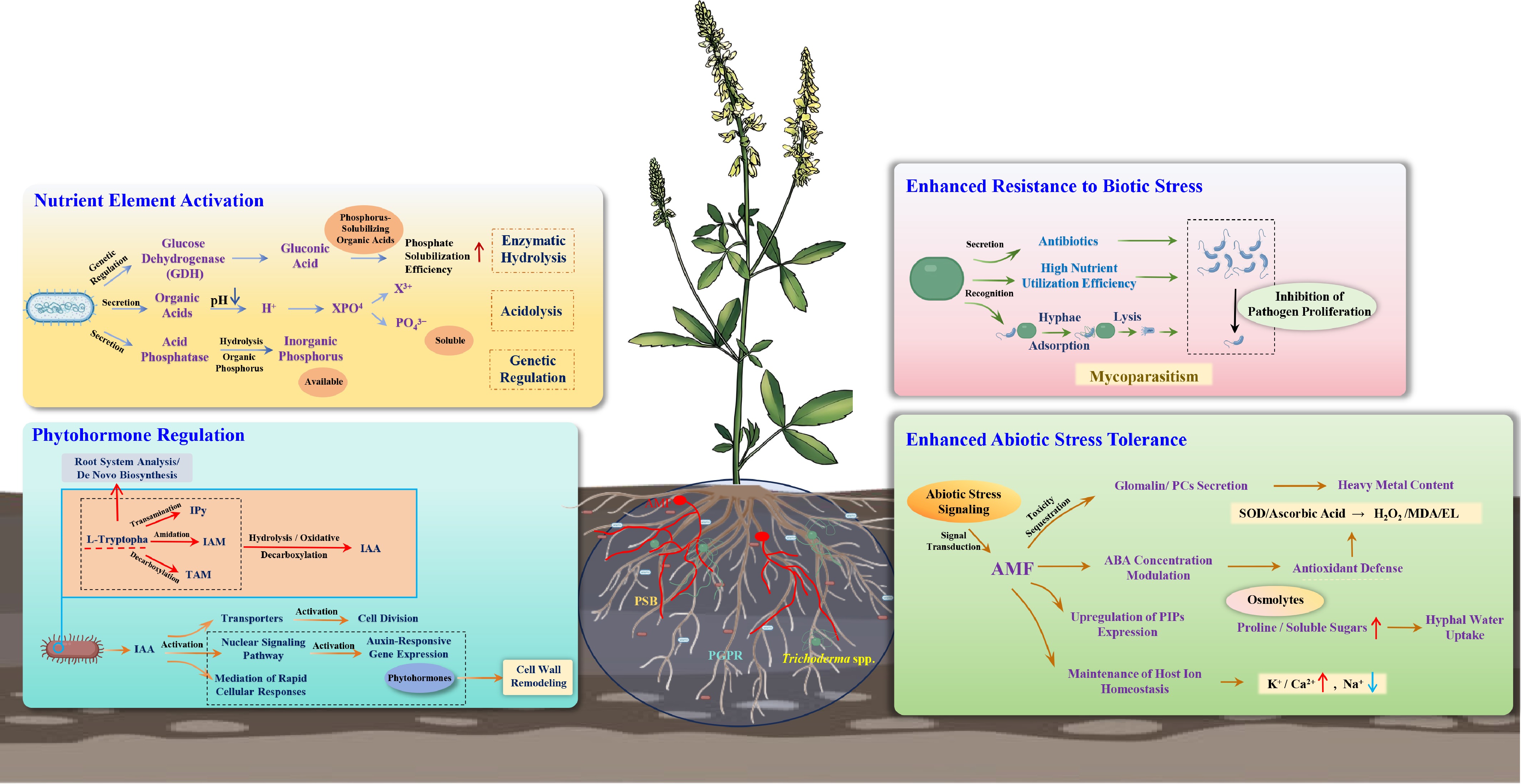
Figure 1.
Mechanisms of microbial inoculant action in medicinal plants. A simplified schematic illustrating key processes such as phytohormone synthesis (e.g., IAA), nutrient solubilization (e.g., phosphorus), antagonism against pathogens, abiotic stress mitigation, and activation of plants' secondary metabolite biosynthesis pathways.
Nutritional and hormonal regulation
Molecular pathways of nutrient activation
-
The activation of essential nutrients by soil microorganisms, such as phosphorus (P), potassium (K), nitrogen (N), and micronutrients, are governed by distinct molecular mechanisms. P-solubilizing bacteria (PSB) activate insoluble P via (1) acidolysis, which involves secreting organic acids (gluconic, acetic) to lower pH and dissociate metal phosphates; (2) enzymolysis, which involves aecreting acid phosphatases (e.g., phytase) to hydrolyze organic P; and (3) genetic regulation, in which key genes (e.g., pqq, gdh) regulate organic acid production (e.g., via glucose dehydrogenase)[17]. For example, Bacillus spp. dissolve tricalcium phosphate (30−50 μg/mL capacity) and Pseudomonas spp. dynamically adjust their secretion[18].
For K mobilization, K-solubilizing bacteria (KSB) such as Priestia megaterium and Peribacillus frigoritolerans secrete organic acids (citric, oxalic, tartaric acid) that dissolve K-bearing minerals (e.g., feldspar, mica), releasing soluble K+ into the soil solution[19]. At the molecular level, KSB strains use multiple mechanisms[20], including organic acid-mediated acidolysis; biofilm formation on mineral surfaces, which concentrates organic acids and facilitates mineral weathering; and synthesis of mineral binding proteins (e.g., elongation factor Tu [EF-Tu], enolase) that specifically attach to potassium feldspar and promote K+ release. Genome sequencing of the high efficiency KSB strain Priestia megaterium NK851 has revealed abundant genes related to K decomposition and intracellular K+ transport[20]. Moreover, these KSB strains often coexpress genes for siderophore production and indole acetic acid (IAA) synthesis, thereby synergistically enhancing nutrient availability and root development.
Beyond bacteria, symbiotic fungi also play a critical role in nutrient activation. Under low-K stress, Rhizophagus intraradices significantly enhances the uptake of not only P but also K and N in crops such as wheat (Triticum aestivum L.) through upregulating the expression of root K+ transporter genes[21]. Thus, the molecular basis of microbial nutrient activation encompasses a coordinated multi-nutrient framework (P, K, N) mediated by organic acid secretion, biofilm formation, mineral-binding proteins, and the upregulation of transporter gene expression.
Hormonal remodeling of root architecture
-
Approximately 80% of PGPR synthesize IAA, primarily via tryptophan-dependent pathways (indole-3-pyruvic acid [IPyA], indole-3-acetamide [IAM])[22]. Root-secreted L-tryptophan is a key precursor. Bacterial IAA exhibits concentration-dependent effects: Low concentrations (0.1−10 μM) promote primary root elongation/root hair proliferation; high concentrations (> 20 μM) inhibit primary roots but stimulate laterals. This involves crosstalk with ethylene signaling; PGPR-secreted 1-aminocyclopropane-1-carboxylic acid (ACC) deaminase degrades ethylene precursor ACC, alleviating inhibition by high IAA[22].
Beyond modulating IAA concentration and ethylene balance, IAA itself directly remodels the root architecture through well-established signaling pathways. IAA acts by inducing transporters (AUX1/LAX3) for polar auxin transport; activating nuclear signaling through IAA binding to SCF-TIR1/AFB triggers Aux/IAA degradation, releasing auxin response factors (ARF) transcription factors (e.g., ARF7/ARF19) to activate lateral root genes (e.g., LBD16); and possibly by rapid atypical signaling. The synergistic action of ACC deaminase further refines this hormonal regulation. By reducing stress-induced ethylene levels, ACC deaminase permits auxin-driven lateral root organogenesis to proceed without ethylene-mediated antagonism, thereby optimizing the root system's architecture for improved water and nutrient acquisition under both optimal and stress conditions[23]. Thus, microbial inoculants remodel the root architecture through an integrated hormonal regulatory network centered on IAA signaling and ethylene modulation, with ACC deaminase activity serving as a key coordinator that fine-tunes the balance between these two phytohormones.
Synergistic defense against stresses
Pathogen antagonism
-
Beneficial microbes suppress pathogens via several mechanims. The first is nutrient/space competition, which involves depleting key resources (C, P, Fe). Trichoderma spp. utilize soluble P faster than pathogens, thus antagonizing Fusarium oxysporum and Rhizoctonia solani[24]. Rapid hyphal growth (1.5−12.8× the pathogens' rate) occupies niches and forms barriers. Second, antibiosis and mycoparasitism operate by secreting antibiotics (e.g., gliotoxin, viridin) that inhibit pathogens up to 100%, secreting chitinases/β-1,3-glucanases to degrade pathogens' cell walls, and mitogen-activated protein kinase (MAPK) signaling activates mycoparasitism, with the hyphae coiling around or penetrating pathogens[25]. Field efficacy is significant: T. harzianum T22 inhibits R. solani by 90%, reducing disease incidence by 65% and promoting ginsenosides; T. virens reduces anthracnose incidence by 58%[26].
Stress adaptation
-
Microbial inoculants enhance plants' tolerance to diverse abiotic stresses through multiple mechanisms, with different microbial taxa exhibiting distinct but often complementary strategies. AMF enhance tolerance to drought, salinity, and heavy metal stresses. Under drought, AMF improve water use efficiency (WUE) by regulating abscisic acid (ABA) signaling, upregulating aquaporins (PIPs), utilizing hyphal water absorption, and inducing osmoprotectants (proline, sugars)[26]. For salinity, AMF promote K+, Ca2+, and Mg2+ uptake while inhibiting Na+ influx, maintain the K+/Na+ ratio, alleviate photosynthetic inhibition, and induce sodium dismutase (SOD)/ascorbic acid to scavenge reactive oxygen species (ROS) (reducing H2O2 by 40%−60%)[27]. For heavy metal stress, AMF use multiple detoxification strategies, including metal immobilization, metal chelation via phytochelatins, and vacuolar sequestration, thereby reducing oxidative damage[28].
Beyond AMF, PGPR confer stress tolerance through distinct molecular pathways. Bacillus subtilis GB03 enhances salt tolerance in Arabidopsis thaliana via tissue-specific regulation of the sodium transporter HKT1. Under salt stress, GB03 simultaneously downregulates HKT1 expression in the roots (reducing Na+ import) and upregulates it in the shoots (facilitating Na+ recirculation), resulting in lower total Na+ accumulation throughout the plant[29]. Additionally, PGPR-based biofertilizers containing ACC deaminase-producing strains mitigate drought, salinity, and heat stress by limiting stress-induced ethylene levels, thereby reducing photosynthetic damage and preserving carboxylation capacity[30,31].
Collectively, the stress-adaptive benefits of microbial inoculants span multiple microbial taxa, each contributing unique mechanisms ranging from aquaporin regulation and ion transporter modulation to siderophore-mediated metal chelation and glomalin-based immobilization. The synergistic application of diverse microbial inoculants thus offers a comprehensive strategy for enhancing medicinal plants' resilience under the complex stress conditions commonly encountered in ecological cultivation systems.
Activation of medicinal ingredient synthesis pathways
-
Inoculants (e.g., PGPR, endophytes) promote the accumulation of bioactive compounds by inducing defense responses and activating secondary metabolism. The core mechanism involves the recognition of microbe-associated molecular patterns (MAMPs) by plant pattern recognition receptors (PRRs), which triggers MAPK cascades and calcium signaling, leading to jasmonic acid (JA) biosynthesis[32,33]. (3R,7S)-jasmonoyl-L-isoleucine (JA-Ile) is perceived by the COI1-JAZ coreceptor complex, triggering the jasmonate zim domain (JAZ) repressor's ubiquitination and proteasomal degradation, which releases MYC2 transcription factors to activate downstream biosynthetic genes (e.g., terpene synthases, phenylalanine ammonia-lyase)[34]. Empirical evidence confirms this pathway: Fungal inducers upregulate HMGR/CYP450 via JA signaling in ginseng, increasing its saponin content[35].
Emerging regulatory mechanisms have also been revealed. Beyond the classical JA cascade, recent studies have identified additional layers of regulation. Noncoding RNAs (ncRNAs) fine-tune secondary metabolism at the post-transcriptional level. For instance, in Salvia miltiorrhiza, miR396b targets the transcription factors involved in tanshinone biosynthesis[36]. Microbial volatile organic compounds (VOCs) such as 2,3-butanediol represent a novel signaling mode, modulating JA/ethylene (ET) signaling pathways, thereby enhancing induced systemic resistance and accumulation of secondary metabolites[37,38].
Collectively, microbial inoculants activate the syntehsis of medicinal ingredients through a multilayered network involving MAMP-triggered signaling, JA-dependent transcriptional reprogramming, ncRNA regulation, and VOC-mediated signaling.
-
The efficacy of microbial inoculants is highly organ-dependent, dictated by the primary physiological functions and sites of secondary metabolite accumulation in the roots/rhizomes, leaves, and flowers/fruits (Table 2).
Table 2. Comparative analysis of microbial inoculants' functions across medicinal plants' organs (roots, rhizomes, leaves, flowers, and fruits).
Category Representative plants Major active compounds Preferred microbial inoculant types Core mechanisms of action Representative case studies Roots/rhizomes Ginseng (Panax ginseng) Ginsenosides (triterpenoid saponins), phenolic compounds, polysaccharides Rhizobium panacihumi Rhizobia increase proline accumulation (osmoregulation), total phenolic content (antioxidants), and total soluble sugars (osmoprotection), while reducing aluminum-induced ROS levels. Upregulates antioxidant genes (PgAPX, PgCAT) and a proline synthesis gene (PgP5CS), enhancing ROS scavenging and cytoprotection. Rhizobium panacihumi DCY116T isolated from ginseng cultivation soil enhances aluminum resistance (500 μM Al) in 2-year-old ginseng seedlings by reducing oxidative stress and promoting growth biomarkers. Codonopsis (Codonopsis pilosula) Lobetyolin, polysaccharides Bacillus amyloliquefaciens B. amyloliquefaciens regulates auxin (IAA) biosynthesis and transport while inhibiting stress-related hormones like ABA and enhancing cell expansion and nutrient uptake. Improves photosynthetic efficiency, chlorophyll synthesis, and N/P assimilation, alleviating oxidative stress and ion toxicity under abiotic stresses (e.g., salinity). Inoculation of Bacillus amyloliquefaciens GB03 in Codonopsis pilosula significantly improves plant growth metrics (e.g., biomass, root length, chlorophyll content) and doubles lobetyolin accumulation. GB03 also enhances stress resistance (e.g., salt tolerance) and photosynthetic efficiency. Leaf Basil (Ocimum basilicum) Linalool, methyl chavicol (estragole), eugenol, α-terpineol Bacillus spp., Azotobacter, Azospirillum PGPR strains primarily enhance basil's growth and essential oil production by improving nutrient availability (e.g., N fixation by Azotobacter/Azospirillum, P solubilization by Bacillus), producing plant growth-promoting hormones (e.g., auxins, gibberellins), and modulating plants' physiological processes, collectively stimulating plant development and secondary metabolite biosynthesis. Coinoculation of Azotobacter, Azospirillum lipoferum, and Bacillus circulans in an ecological cropping system significantly increased basil's plant biomass (fresh/dry weight), essential oil yield, and plant height compared with uninoculated controls or single-strain applications. Hyptis (Hyptis suaveolens) β-Caryophyllene, caryophyllene oxide Bacillus amyloliquefaciens SQR9 B. amyloliquefaciens SQR9 mitigates ion toxicity by modulating sodium transporters (e.g., HKT1) to reduce Na+ accumulation in tissues. Enhances antioxidant activity (e.g., peroxidase/catalase), osmoregulation (proline/soluble sugar accumulation), and hormonal balance (e.g., reduced ethylene stress) to alleviate oxidative damage and maintain cellular integrity under osmotic stress. Inoculation of PGPR (B. amyloliquefaciens SQR9) in Hyptis suaveolens under salt stress (up to 105 mM NaCl) significantly enhanced essential oil content and physiological resilience (e.g., biomass, chlorophyll levels) compared with uninoculated plants. Peppermint (Mentha piperita) Menthol, menthone, pulegone, 1,8-cineole, linalool Pseudomonas spp. PGPR strains induce systemic resistance in mint by modulating hormone signaling pathways (e.g., jasmonates, salicylates) and increasing the density of glandular trichomes (specialized structures for monoterpene synthesis and storage). This interaction enhances photosynthetic efficiency and carbon allocation to secondary metabolism, promoting phenolic and terpenoid production, potentially via volatile or nonvolatile bacterial elicitors, even without direct pathogen attack. Inoculation of peppermint with PGPR strains (single or combined) significantly increased volatile organic compound (VOC) emissions (~3-fold) and elevated total phenolic content in leaves, with the highest induction observed in coinoculated plants (e.g., Pseudomonas WCS417r + SJ04). Fruit/flower Stevia (Stevia rebaudiana) Steviol glycosides IAA-producing PGPR strains IAA produced by PGPR acts as a phytohormone (auxin), directly stimulating plant growth by enhancing root elongation, root hair development, and nutrient uptake. This facilitates improved water and mineral absorption, increasing biomass and overall plant vigor. Bacteria primarily synthesize IAA via tryptophan-dependent pathways, utilizing root exudates as precursors, establishing a mutualistic plant–microbe relationship. IAA-producing PGPR isolated from the Stevia rebaudiana rhizosphere were optimized for IAA production (varying pH, temperature, carbon, nitrogen sources). Application of these optimized strains to stevia plants significantly increased root and shoot biomass. Tangerine peel (Citri reticulatae pericarpium) Flavonoids (e.g., nobiletin, tangeretin), volatile oils (e.g., limonene, γ-terpinene) Burkholderia spp., Streptomyces spp. Burkholderia and Streptomyces activate the plant innate immune system by secreting microbe-associated molecular patterns (MAMPs) (e.g., lipopolysaccharides, flagellin), triggering JA/ethylene (ET) signaling pathways and upregulating antioxidant enzymes (e.g., SOD, peroxidase [POD]) expression, significantly enhancing plants' tolerance to drought and salt stress. Secondary metabolites produced by Streptomyces (e.g., actinomycin) directly inhibit soil pathogens, whereas regulating plant stomatal closure reduces water loss and enhances water retention. Specific beneficial microbes (e.g., Burkholderia, Streptomyces) were inoculated during the cultivation of tangerine peel to optimize growth and medicinal quality. These microbes improved environmental stress tolerance (e.g., drought/salinity) and stimulated the synthesis of active compounds like flavonoids through microecological interactions. Root/rhizome types: targeted regulation of underground organs
-
For medicinal plants where the roots or rhizomes serve as the harvested organs (e.g., ginseng, S. miltiorrhiza), the primary goal of inoculation is to enhance both belowground biomass and the accumulation of root-specific bioactive compounds. PGPR achieve this through a combination of direct promotion of root growth and targeted activation of root-specific secondary metabolic pathways. For instance, Rhizobium panacihumi DCY116T increased ginseng root biomass by 25% while simultaneously upregulating the genes involved in ginsenoside biosynthesis, thereby enhancing the saponin content[39]. Similarly, co-inoculation with nitrogen-fixing bacteria, Bacillus, and Pseudomonas increased the root alkaloid content in Catharanthus roseus by 30%, accompanied by improved nutrient uptake[40]. These examples demonstrate that inoculants' effects on root-type medicinal plants yield outcomes that are directly measurable in the harvested root organ.
Leaf types: enhancement of photosynthetic efficiency and foliar defense
-
In leaf-harvested medicinal plants (e.g., Ginkgo, Perilla), microbial inoculants enhance yield and quality primarily by improving photosynthetic efficiency and activating foliar defense mechanism. Diverse microbial inoculants have demonstrated efficacy in leaf-harvested medicinal plants. AMF such as Glomus mosseae inoculation in Ginkgo biloba increased leaf area by 28%, dry weight by 59%, and flavonoid glycosides content by enhancing photosynthetic pigment efficiency[41]. PGPR can increase chlorophyll content, photosynthetic efficiency, and secondary metabolite accumulation in medicinal plants[42]. Perilla frutescens, characterized by high rosmarinic acid and total flavonoid contents, is amenable to such microbial elicitation[43]. Collectively, microbial inoculants, such as AMF and PGPR, can effectively enhance photosynthetic capacity and foliar defense in leaf-harvested medicinal plants.
Flower/fruit types: pathogen suppression and reproductive-stage metabolic activation
-
For medicinal plants where flowers or fruits are the harvested organs (e.g., honeysuckle, chrysanthemum), the application of Bacillus species offers dual benefits: Suppression of floral pathogens and activation of reproductive-stage secondary metabolism. Bacillus subtilis secretes antimicrobial lipopeptides that antagonize fungal pathogens such as Alternaria while simultaneously upregulating phenylpropanoid pathway genes (HQT, C4H, 4CL) to promote the accumulation of flower-specific compounds like chlorogenic acid[44]. In chamomile, B. subtilis combined with cyanobacteria increased essential oil yield by 35% while enhancing powdery mildew resistance via induced peroxidase (POD) activity[45]. Thus, for flower- or fruit-type medicinal plants, inoculants exert organ-specific effects by integrating pathogen suppression with targeted activation of reproductive-stage metabolic pathways.
Targeted application scenario breakthroughs
Microbial community reconstruction in continuous cropping soils
-
Continuous cropping obstacles in medicinal plants primarily stem from microbial dysbiosis and autotoxin accumulation. In P. notoginseng, phenolic acid autotoxins (e.g., vanillic acid) accumulate, promoting pathogens and inhibiting beneficial microbes, ultimately shifting the soil to a fungal-dominated state[46]. Microbial inoculants alleviate this problem through two synergistic mechanisms. First, they reshape the microbial community. Application of Trichoderma inoculants and composite microbial agents significantly increases the abundance of beneficial bacteria (e.g., Sphingomonas) in the P. notoginseng rhizosphere, reduces the proportion of harmful fungi, and increases soil actinomycetes' diversity, thereby restoring a beneficial bacteria-dominated microecological balance. Denaturing gradient gel electrophoresis (DGGE) and quantitative polymerase chain reaction (qPCR) analyses confirm that inoculant treatment increases the gene copy numbers of beneficial bacterial genesby over 40% and reduces pathogens by 30%–50%[47]. Second, they degrade autotoxins. Functional microorganisms in inoculants (e.g., Pseudomonas spp.) efficiently degrade phenolic acids. For instance, treatment with the ZZMZ microbial agent for 28 days degraded over 50% of total phenolic acids (e.g., vanillic acid, ferulic acid) in the rhizosphere of Rehmannia glutinosa[8]. Crucially, inoculants often act indirectly by improving the rhizosphere microenvironment rather than completely eliminating autotoxins[46,47].
Field trials validate this efficacy: EM and Trichoderma treatments increased the seedling emergence rate by 35% and yield by 25% in continuous-cropped Panax notoginseng while significantly reducing disease incidence by over 50%[47]. Collectively, these results demonstrate that microbial inoculants, through the synergistic action of community reconstruction and autotoxin reduction, serve as a key biological strategies for overcoming continuous cropping obstacles in medicinal plants.
Simulation and reinforcement of regional specificity microecology
-
The quality of regional specificity medicinal materials is closely linked to the unique microbe–plant interactions in their production regions. For instance, the rhizosphere microbiome of Panax ginseng cultivated in its traditional production region (Jilin Province, China) exhibits a distinct microbial community structure enriched with beneficial taxa positively correlated with ginsenoside content[48]. Inoculation with these region-specific microbial consortia has been shown to enhance ginsenoside accumulation by upregulating key biosynthetic genes (PgSS, PgSE) in ginseng roots[49]. Similarly, for Astragalus membranaceus, the quality superiority of materials from the Gansu region has been linked to the enrichment of specific rhizosphere bacteria that enhance the biosynthesis of calycosin-7-glucoside[50].
The core mechanism underlying these region-specific effects lies in the ability of specific growth-promoting microbes to upregulate key biosynthetic genes in the target secondary metabolic pathways. In the Salvia miltiorrhiza rhizosphere, for example, Pseudomonas spp. and Cladosporium spp. can upregulate the expression of key genes in the tanshinone synthesis pathway (SmAACT, SmCMK, DXS, CYP76AH1), thereby promoting the accumulation of active ingredients[51]. A typical example is the seed endophytic fungus Phoma herbarum D603. Its cocultivation with S. miltiorrhiza activatedthe HMGR and CPS genes, increasing tanshinone IIA content to 6.5 times that of the control group[52]. Thus, microbial inoculants can effectively simulate or reinforce the inherent microecological advantages of specific regions, thereby consolidating the quality of these medicinal materials.
Synergistic mechanism of inoculants and organic fertilizers in organic systems
-
In organic cultivation systems, the combination of microbial inoculants with organic fertilizer offers a promising strategy to balance yield and quality while reducing chemical inputs. Multiple case studies across different medicinal plants support this synergistic approach. For ashwagandha (Withania somnifera) and Malabar nut (Adhatoda vasica), AMF inoculation combined with PSB increased ashwagandha biomass by 1.56-fold and total alkaloid content by 266.23%; whereas a ternary inoculation of AMF + PSB + nitrogen-fixing bacteria (Azotobacter) increased Malabar nuts' polyphenol content by 29.6%, achieving over 98% of the yield obtained with chemical fertilizer treatment, effectively reducing fertilizer dependence[53]. The key mechanism involves inoculants activating the JA signaling pathway via induced systemic resistance (ISR), promoting the accumulation of terpenoid indole alkaloids (TIAs)[54]. In chamomile, inoculation with Bacillus subtilis Co1-6 and Paenibacillus polymyxa Mc5Re-14 significantly increased flavonoid glycoside content (e.g., apigenin-7-O-glucoside), raised the proportion of active ingredients in the essential oil by 22%−35%, and maintained fresh flower yield similar to the chemical fertilizer treatment[55]. This quality improvement stems from inoculants' regulation of the rhizosphere microbiome, suppressing pathogens (e.g., Fusarium) and promoting the synthesis of beneficial plant–microbe interaction-related metabolites[55]. These diverse cases collectively indicate that microbial inoculants, when integrated with organic fertilizers, serve as effective tools for achieving high-value organic production across a range of medicinal plant species.
-
The efficacy of microbial inoculants is governed by a complex interplay of factors related to the inoculant itself, the environment, and the host plant, as overviewed in Fig. 2.
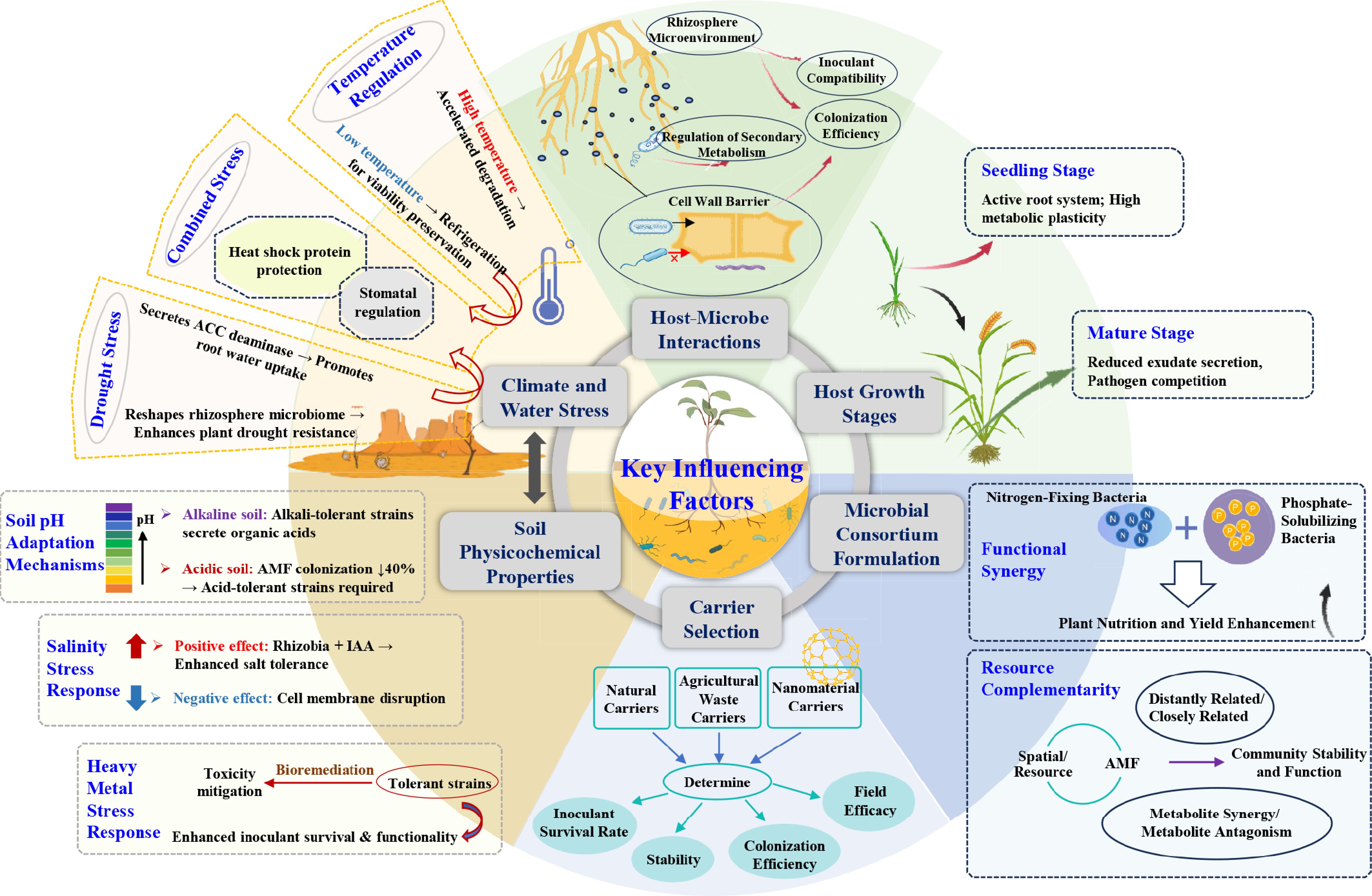
Figure 2.
Key factors influencing the efficacy of microbial inoculants. Conceptual model showing the interconnections among the inoculants' formulation and carriers, environmental stresses (e.g., climate, soil properties), and the hosts' plant properties (e.g., genetics, developmental stage).
Inoculant design and carrier optimization
Functional synergistic microbial consortia formulation
-
Optimizing inoculant efficacy requires attention to microbial strains' compatibility, i.e., integrating two or more microorganisms with mutualistic symbiotic relationships. Functionally synergistic formulation is a core aspect. For example, combining nitrogen-fixing bacteria with PSB significantly improves plant nutrition and yield through dual nitrogen and phosphorus activation (e.g., increasing chickpea [Cicer arietinum] pod yield by 39.5%)[56]. Cross-functional synergy (e.g., growth promoters + pathogen suppressors + root promoters) can form a multidimensional efficacy network, increasing biomass by over 50%, or simultaneously achieving disease control and metabolic promotion[57].
Resource-complementary formulation focuses on ecological niche differentiation, which is particularly suitable for AMF combinations. The diversity of AMF community structure directly affects the host's resource utilization efficiency. For example, inoculating Salvia miltiorrhiza with a combination of Glomus (promoting phosphorus) and Rhizopus (drought-tolerant) increased root biomass by 65.1%, total phenolic acid by 27%, and tanshinone content by 34%[11]. Taxonomic distance is crucial: Distantly related (cross-genus) AMF combinations (e.g., five species inoculated in cucumber [Cucumis sativus]) reduce competition through resource utilization and spatial complementarity, enhancing the community's stability and function (e.g., soil phosphorus utilization efficiency increased to 1.8 times that of single strains). In contrast, combinations within the same family may lead to reduced efficacy because of competition[11,58]. Metabolic exchange among microbes determines a formulation's success (synergy or antagonism). For instance, Trichoderma harzianum VOCs may inhibit spore germination in Glomus intraradices, whereas Pseudomonas siderophores can alleviate this inhibition[59]. Positive interactions enhance efficacy; for example, coapplication of Pseudomonas fluorescens and Bacillus subtilis increased peppermint volatiles and phenolic content[54]. Therefore, formulation design requires an assessment of the strains' compatibility.
Protective and efficacy-enhancing mechanisms of carrier materials
-
Carrier materials directly impact inoculants' survival rate, stability, colonization efficiency, and field efficacy. Their protective capacity depends on physicochemical properties (porosity, pH, nutrients) and environmental adaptability (storage temperature, soil conditions)[60]. Ideal carriers need to be biodegradable, nontoxic, and low-cost; have a near-neutral pH; and possess good water absorption and buffering capacity[60,61]. Natural solid carriers like sodium alginate significantly prolong microbial survival time (maintaining high viability after 8 weeks of storage) through high biocompatibility and encapsulation protection, whereas the addition of humic acid can improve oxygen permeability and enhance bacterial activity[62].
Agricultural waste carriers (e.g., bagasse, farmyard manure) are significant because of their low cost and sustainability value. The high porosity and rich nutrients of bagasse help maintain microbial viability under refrigeration; farmyard manure, which has high organic carbon and a near-neutral pH, can maintain a high density of PSB at room temperature and promote plants' phosphorus uptake[63]. Nanomaterial carriers (e.g., nano-hydroxyapatite) physically isolate stress and enhance strains' activity through high-porosity structures[64]. Liquid inoculants optimized with additives (e.g., trehalose, glycerol, polyvinylpyrrolidone [PVP]) can overcome storage bottlenecks, protecting cell membranes or enhancing adhesion[61,63]. Key carrier characteristics (porosity, nutrients, pH) and environmental compatibility directly determine microbial survival and efficacy. For example, bagasse is suitable for refrigeration, and sodium alginate requires 4 °C for long-term storage[65]. Optimizing the carriers (especially agricultural waste) can improve plants' performance and reduce costs[65].
Dynamic regulation by environmental factors
-
The efficacy of microbial inoculants is highly dependent on the dynamic regulation of environmental factors, which affect their rhizosphere colonization, survival, metabolic activity, and functional expression, ultimately determining the growth-promoting effect[66].
Colonization constraints by soil physicochemical factors
-
Soil physicochemical properties (pH, salinity, calcareous content, etc.) are core factors regulating inoculant colonization and functional performance. Soil pH directly determines microbial activity[67,68]. Acidic soils (pH < 7) significantly inhibit spore germination and hyphal extension in AMF, leading to a reduction in colonization efficiency and nutrient absorption capacity compared with neutral soils. Alkaline soils (pH > 9) cause osmotic stress and phosphorus fixation problems, although alkali-tolerant strains can secrete organic acids to activate nutrients and enhance adaptability. Saline stress has a dual effect on inoculants, with high-salt environments damaging cell membranes and reducing survival rates. However, specific strains (e.g., rhizobia combined with urea compost) can improve growth in barley (Hordeum vulgare) by producing IAA and cytokinins. Pseudomonas aeruginosa and Bacillus spp. secrete exopolysaccharides (EPSs) to form an ionic barrier, inhibiting Na+ uptake and antioxidant enzyme activity[69]. In calcareous soils, low iron solubility often causes plant chlorosis. Strains like Trichoderma asperellum T34 secrete siderophores to chelate iron ions, significantly improving iron's bioavailability[70].
Heavy metal pollution poses a severe challenge to microbial inoculants, but specific tolerant strains can mitigate toxicity through bioremediation mechanisms. In copper-contaminated soil, microbial inoculants combined with microalgae can adsorb and precipitate Cu2+, reducing copper uptake in S. miltiorrhiza by 25.37% while increasing root biomass and antioxidant enzyme activity[71]. For cadmium contamination, PGPR convert heavy metals into less toxic forms through biosorption and redox reactions[16]. Notably, heavy metals damage microbial cells' membrane structures. Therefore, inoculant screening must prioritize tolerant strains (e.g., those carrying heavy metal resistance genes) and be combined with organic amendments (biochar, humic acid) for synergistic effects. These amendments significantly enhance inoculants' survival and functional expression by passivating heavy metals and improving the soil microenvironment[72].
Inoculant adaptability under climate stress
-
Climate factors, especially drought and temperature fluctuations, significantly regulate inoculants' survival and function by altering soil moisture status and the microbial community's structure. Drought stress causes water shortage and ion imbalance, inhibiting inoculant metabolic activity. However, drought-tolerant strains can maintain activity through multiple mechanisms: PGPR produce ACC deaminase to degrade the ethylene precursor ACC, lowering the ET concentration to promote root development and water absorption while secreting osmoregulators (e.g., compatible solutes) to maintain cell water potential[69]. Notably, drought reshapes the rhizosphere microbiome's composition (e.g., increasing the abundance of monoderms). These microbes enhance metabolite exchange via ATP-binding cassette (ABC) transporters, indirectly improving plant drought resistance. Therefore, screening adaptive strains with these drought-tolerance mechanisms should be prioritized in inoculant development[73].
Temperature is a core regulatory factor directly determining inoculants' metabolic state: High temperatures accelerate microbial decay, whereas low temperatures (e.g., 4 °C refrigeration) effectively maintain inoculants' stability (e.g., Klebsiella and Citrobacter freundii survive significantly longer under refrigeration than at room temperature)[74]. This indicates that the transport and storage of inoculants require strict optimization of temperature control to ensure field efficacy[69]. Facing the compounded stresses exacerbated by climate warming (e.g., drought accompanied by high temperature), microbial biostimulants can protect cellular structures by producing heat shock proteins or assist plants in regulating stomatal closure to alleviate heat damage, providing key technical support for coping with extreme climates[75].
In summary, water and temperature stresses profoundly affect inoculants' efficacy by reshaping microbial communities and their metabolic networks. This means that future inoculant design should integrate climate adaptation strategies, including selecting broad-spectrum stress-resistant strains and optimizing formulation processes.
Differential responses based on host genetic background
Cultivar dependence: the rhizosphere's microecology and metabolic networks
-
The differential responses of medicinal plant cultivars to the same microbial inoculant primarily stem from genetic background-driven physiological and biochemical traits. Host cultivars shape unique rhizosphere microecologies through the composition of root exudates (e.g., organic acids, flavonoids). For instance, Astragalus membranaceus and Glycyrrhiza uralensis exhibit differences in secreted sugars and organic acids when the same bacterial strain is applied, leading to divergent colonization patterns: The A. membranaceus rhizosphere is enriched in Firmicutes and Prevotella, whereas G. uralensis favors Bacteroidetes and Bacteroides[76,77]. Additionally, cultivar-specific cell wall components (e.g., lignified walls in high-fiber cannabis [Cannabis sativa] inhibit fungal colonization), whereas the parenchyma in high-medicinal cultivars facilitates endophyte peneration[78] and immune response intensity (e.g., antibacterial saponins in G. glabra inhibit bacterial inoculants) further determine inoculants' compatibility[79].
The induction of medicinal active ingredients by inoculants also exhibits cultivar dependence, regulated by the host's metabolic enzyme profile and gene promoter specificity[80]. A typical example is the comparison between Astragalus polysaccharides (APSs) and Glycyrrhiza polysaccharides (GPSs). APSs significantly enhance the expression of the astragaloside synthesis gene PgPR-10.3, whereas GPS induces the same gene at only 60% efficiency; conversely, GPS specifically activates the glycyrrhizin synthesis gene GA3ox, whereas APS has no significant effect[81,82]. Thus, inoculants' efficacy is strongly coupled to the host's inherent genetic and metabolic background.
Developmental stage window: metabolic plasticity at the seedling stage
-
The response of medicinal plants to inoculants exhibits significant dependence on the developmental stage, with the seedling stage being the optimal window for intervention. At this stage, highly active roots systems secrete abundant organic carbon sources that serve as both nutrients and colonization signals for rhizobacteria. For example, inoculation of Salvia miltiorrhiza seedlings with Bacillus subtilis significantly enhanced root biomass and tanshinone accumulation[83]. Similarly, seedling-stage inoculation of Astragalus membranaceus with Rhizobium strains resulted in superior nodulation and flavonoid content[84].
The pronounced efficacy stems from the high metabolic plasticity of seedlings. Transcriptomic analyses reveal that upon microbial elicitation, key biosynthetic genes in the tanshinone pathway such as HMGR, PAL, and PMK are significantly upregulated in S. miltiorrhiza seedlings[85]. Moreover, during early growth, plants allocate a greater proportion of photosynthates to the roots, resulting in higher rhizodeposition that supports larger and compositionally distinct microbial communities[86]. This positive feedback loop, in which enhanced microbial colonization promotes root development and secondary metabolism, which, in turn, supports further microbial activity, is most effectively established when initiated during the seedling stages.
-
Current microbial inoculants face three core challenges in agricultural application: Low colonization stability, unclear synergistic mechanisms, and a lack of standardized evaluation systems. First, microbial consortia exhibit insufficient colonization stability in complex soil environments (the survival rate is often below 20%), particularly struggling to maintain stable function under long-term field conditions (e.g., synthetic communities are stable for only about 2 weeks). This is primarily caused by variations in the soil's physicochemical properties and interference from native microbial competition[87]. Second, existing research often focuses on single strains, lacking in-depth analyses of synergistic mechanisms at the microbial community level (e.g., how metabolic interactions between strains affect overall function)[88]. Furthermore, the absence of standardized evaluation systems leads to poor comparability of inoculants' efficacy across different laboratories. This is manifested in inconsistent methods used for detecting active ingredients, and soil metagenomics studies often neglect to set up untreated control groups, making it difficult to effectively distinguish treatment effects from environmental interference[89].
Solution pathways: synthetic communities, interaction omics, and field optimization
-
To address the abovementioned challenges, breakthroughs can be achieved through the synergistic development of synthetic microbial communities (SynComs), plant–microbe interaction omics research, and optimizing field management.
Design of SynComs
-
For addressing the challenges in current microbial inoculant application, constructing SynComs has become a key strategy. Its core lies in a customized design based on the principle of functional complementarity, integrating strains with different core functions (e.g., nitrogen fixation, disease resistance, growth promotion) to build synergistic microbial alliances. A typical example is combining the proteobacterium Sphingomonas with the actinobacterium Methylobacterium. This design not only integrates multiple beneficial functions but, more critically, leverages metabolic functional redundancy within the microbial community. This means different strains can perform similar or complementary metabolic tasks, significantly enhancing the entire community's resistance to environmental fluctuations and stability. The advantage of SynComs is also reflected in interaction synergy among their members. Through resource exchange (e.g., carbon sources, vitamins, siderophores) across species and signal coordination mechanisms like quorum sensing, the colonization efficiency and persistence of the community in the rhizosphere are significantly improved. Experiments prove that colonization efficiency can be over 30% higher than single-strain formulations[90]. This "design-assembly" SynCom strategy provides an important direction for developing efficient and stable next-generation microbial inoculants.
Recent studies have demonstrated the successful application of SynComs in medicinal plants. For instance, a synthetic community comprising Stenotrophomonas sp., Rhizobium sp., Ochrobactrum sp., and Advenella sp., was applied to A. mongholicus to control root rot disease[91]. This SynCom significantly enhanced plant biomass and reduced disease incidence by 42.7% compared with the control. In P. ginseng, a SynCom consisting of Paenibacillus polymyxa and Bacillus cereus, selected for their capacity for pathogen suppression and growth promotion, effectively improved ginseng's yield, ginsenoside accumulation, disease prevention, and pesticide degradation[92]. These examples confirm that SynComs, through interspecies cooperation, can achieve more stable colonization and superior efficacy in medicinal plants.
Deepening plant–microbe interaction omics research
-
To address the need for deeper mechanistic understanding, integrating multiomics approaches with controllable simulation platforms is essential. Deeply analyzing the interaction mechanisms within the rhizosphere's microbial networks requires combining metagenomics with a genetic analysis of the host. For example, genome-wide assosicaton studies on microbes in the maize (Zea mays) phyllosphere successfully identified 23 hub genes that significantly shape the composition of beneficial microbiota by regulating the host's immune signaling pathways[93]. To further quantify the fine-grained metabolic interactions between microbes and plants, the EcoFAB system (ecosystem fabrication) can be utilized to precisely simulate the rhizosphere microenvironment, enabling dynamic monitoring and quantitative analyses of the interaction processes[94]. This research strategy integrating omics analysis with controllable microenvironment simulation provides new perspectives for precise regulation of the rhizosphere's microbiome.
On this basis, deeper multiomics integration, including transcriptomics, metabolomics, and microbiome analysis, can systematically elucidate the molecular mechanisms by which inoculants regulate secondary metabolic pathways and stress resistance in medicinal plants, through constructing integrated regulatory network models of gene expression, active ingredients, and the microbiome's structure. This integration strategy can precisely identify the key regulatory nodes (e.g., key genes or metabolic hubs) and guide the design of SynComs with clear functions and synergistic efficacy (e.g., combinations optimized for nitrogen fixation and growth promotion).
Inoculant + organic fertilizer coapplication model and standardization
-
The inoculant + organic fertilizer co-application model should be vigorously promoted. Here, organic matter acts as a carrier buffering environmental stress and providing carbon sources to enhance microbial colonization, and adding humus can also increase inoculants' survival rate by 30%. It optimizes the microbial habitat by regulating soil pH and pore structure[94]. Additionally, there is an urgent need to establish unified evaluation standards. Integrating key physicochemical parameters like soil C/N ratio with multiomics data can build a comprehensive cross-platform framework for assessing in inoculants, improving research comparability and application reliability.
Emerging breakthrough directions
-
To further overcome the application bottlenecks of microbial inoculants, the convergence of synthetic biology, smart delivery systems, and eco-economic assessment is imperative.
Synthetic biology and strain engineering
-
There is a need to apply clustered regularly interspaced short palindromic repeats (CRISPR)-CRISPR-associated protein 9 (Cas9) gene editing, genome streamlining, and other techniques to directionally engineer functional strains, enhancing their ability to promote the synthesis of medicinal active ingredients. Utilizing biotechnological means like adaptive evolution or gene editing can significantly enhance the colonization ability of engineered strains in complex field environments[95].
Smart delivery systems and integration with the Internet of Things
-
Developing smart responsive delivery systems (e.g., pH-responsive nanocarriers) and integrating them with Internet of Things (IoT) sensing networks can achieve dynamic monitoring of the rhizosphere microenvironment and precise, on-demand release of inoculants[96]. The Smart-MIP (microbial- and sensor-based integrated precision) approach, combining precision design with smart delivery and real-time feedback, enhances microbial colonization efficiency and functional stability in the rhizosphere[97].
Lifecycle assessment and carbon trading linkage
-
In the eco-economic dimension, promoting the large-scale application of microbial inoculants requires integrating lifecycle assessment models to quantify their carbon emission reduction benefits (e.g., reduced emissions from fertilizer production, enhanced soil carbon sequestration) and comprehensive economic benefits (e.g., yield premiums, reduced pesticide inputs)[98]. This would provide solid data support for policy formulation and industry promotion. Simultaneously, linking with carbon markets could transform the agricultural carbon sinks generated by inoculant application (e.g., increased soil organic carbon, reduced N2O emissions) into economic returns for growers[99]. This establishes a closed loop of green benefits and economic returns that synergistically drives technological innovation and policy incentives.
Conclusions and outlook: pathways for green transition
-
Microbial inoculants, acting through the tripartite growth-promoting mechanism of hormone regulation, nutrient activation, and resistance induction, have become core tools for achieving green and sustainable cultivation of medicinal plants. Future research needs to focus on three core research directions: (1) Deepen multi-omics integration to enhance the precision of data integration, develop efficient algorithms to deeply analyze the complex spatiotemporal dynamic interaction networks between microbes and plants, and precisely identify regulatory hubs; (2) optimize engineered strains by enhancing their functions (e.g., active ingredient synthesis, stress resistance) while prioritizing the improvement of their biosafety and adaptability in complex field environments, including long-term monitoring of nontarget effects on the native soil microflora (e.g., disruption of the community structure, horizontal gene transfer risks); and (3) break through smart carrier bottlenecks by focusing on resolving the biocompatibility issues of smart responsive carriers (e.g., nanomaterials) and improving the response of response sensitivity and delivery accuracy to changes in the rhizosphere's microenvironment (e.g., pH, specific metabolites). Additionally, future research should systematically evaluate key application parameters such as inoculant dosage, carrier selection (e.g., organic vs. clay-based carriers for different soil textures), and regional adaptability (e.g., performance under arid vs. acidic soil conditions) to guide field-specific recommendations.
Building a complete industrial chain of laboratory-based precision screening, field-based pilot verification, and regional-scale application will systematically propel medicinal plant cultivation towards the comprehensive goals of high and stable yield, superior and controllable medicinal efficacy components, and eco-environmental friendliness. To address the current lack of unified evaluation standards, we propose a multitiered framework (soil parameters, inoculant characterization, common controls, and standardized reporting) to improve cross-study comparability and facilitate meta-analyses.
-
The authors confirm their contributions to the paper as follows: conducted the data search: Duan J, Kang M; designed and wrote the paper: Liu F, Xu Y. All authors reviewed the results and approved the final version of the manuscript.
-
Data sharing is not applicable to this article, as no datasets were generated or analyzed during the current study.
-
This work was supported by the Young Talent Promotion Project by the Ecological Society of China, the Yunnan Revitalization Talent Support Program, the Scientific Research Fund Project of the Yunnan Provincial Department of Education (2025Y0029), and the Graduate Student Research Innovation Project of Yunnan University (KC-24248854).
-
The authors declare that they have no conflict of interest.
- Copyright: © 2026 by the author(s). Published by Maximum Academic Press, Fayetteville, GA. This article is an open access article distributed under Creative Commons Attribution License (CC BY 4.0), visit https://creativecommons.org/licenses/by/4.0/.
-
About this article
Cite this article
Duan J, Kang M, Liu F, Xu Y. 2026. Harnessing microbial inoculants for sustainable medicinal plant cultivation. Medicinal Plant Biology 5: e015 doi: 10.48130/mpb-0026-0010 

Harnessing microbial inoculants for sustainable medicinal plant cultivation
- Received: 06 January 2026
- Revised: 28 April 2026
- Accepted: 30 April 2026
- Published online: 30 June 2026
Abstract: Medicinal plant cultivation confronts distinct challenges, including soil degradation from continuous cropping, diminished regional specificity, and heavy metal contamination, all of which compromise both biomass yield and accumulation of bioactive compounds. Microbial inoculants represent a sustainable strategy to enhance medicinal plants' productivity and quality through improved nutrient uptake and stress tolerance, alongside promotion of secondary metabolite biosynthesis. This review systematically examines the mechanisms through which microbial inoculants regulate plant development, enhance stress resistance, and stimulate bioactive compound synthesis. We emphasize organ-specific application approaches tailored to root, leaf, and flower/fruit medicinal species, and explore advances in alleviating continuous cropping obstacles and reinforcing region-specific microecosystems. Key factors affecting inoculant performance are also identified, including the microbial consortium's composition, carrier materials, soil characteristics, and host genetics. Though significant progress has been made, challenges related to colonization stability and mechanistic clarity persist. Future prospects involve developing synthetic microbial communities, integrating multi-omics technologies, and designing smart delivery systems to advance ecological cultivation practices. This review highlights the potential of microbial inoculants in supporting sustainable production of high-quality medicinal plants while minimizing environmental footprints.