










-
Root systems are recognized as important phenotypic targets for trait selection in modern agricultural research and breeding. They function as the main channels for water and nutrient uptake and provide critical physical support, particularly resulting from increased grain yield. Root system architecture (RSA) influences crop water and nutrient uptake and often exhibits adaptive responses—known as plasticity—to varying soil conditions[1,2]. Despite the recognized importance of root systems, their study in modern crop research and breeding has been relatively understudied.
RSA is a major factor influencing drought resistance and productivity by regulating water-use efficiency (WUE). Root phenotype analysis under field conditions is challenging, costly, and time-consuming, often requiring destructive sampling of root systems at specific time points. Compared with the aboveground traits, progress in identifying the main genes that regulate the root system structure has been slower[3]. The limitations of conventional destructive methods have constrained a comprehensive and dynamic assessment of RSA. This underscores the need for advanced in situ root phenotyping techniques, which offer advantages such as non-destructive, continuous temporal monitoring—a fundamental capability for capturing root system dynamics and plasticity over time. Integrating these approaches is critical for elucidating the genetic and physiological mechanisms underlying RSA traits. The challenges in phenotyping root traits have contributed to the slow progress in incorporating the genetic improvement of RSA into plant breeding[4,5]. The root system phenotype exhibits a strong correlation with drought stress response, and modulating the RSA—for instance, by increasing the rooting depth[6]—enhances drought resistance (Fig. 1).
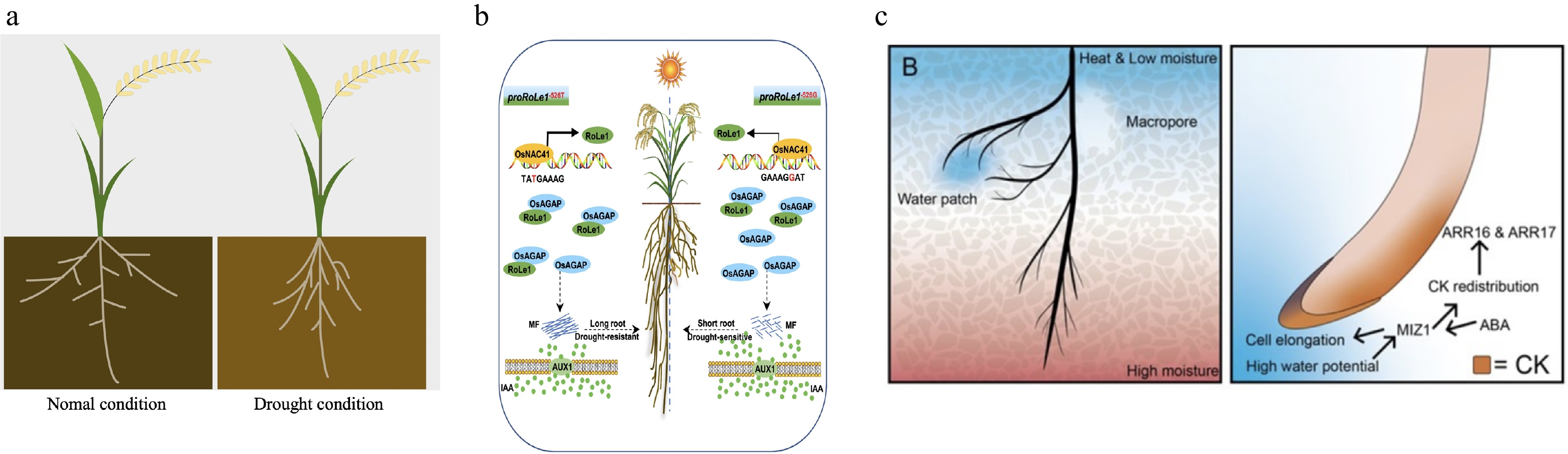
Figure 1.
The root system phenotype exhibits a strong correlation with drought stress response. (a) Comparison of RSA between normal and drought conditions, showing enhanced lateral root development under stress[7]. (b) Correlation between the root length under drought and the drought resistance index in rice; longer roots are associated with greater drought tolerance[8]. (c) Model of a drought-adaptation strategy: root hydrotropism, illustrating how roots sense wet soil patches and grow toward them by adjusting the internal hormones (ABA, CK) and genes (MIZ1)[9].
To overcome the abovementioned challenges, future crop breeding programs should integrate both aboveground and underground traits to enhance adaptability to target environments and management practices. This suggests that increasing emphasis should be placed on root traits in breeding efforts, to develop crop varieties capable of more efficient soil resource utilization and better adaptation to diverse environmental conditions, thereby contributing to drought-resistant crop breeding. Therefore, a systematic review of in situ root phenotyping technologies, their applications, and the associated challenges is warranted to advance this field and facilitate the translation of scientific insights into breeding practice. Fig. 2 presents a "collection–modeling–application" framework for in situ root phenotyping, covering the key stages from image acquisition to data analysis for breeding.
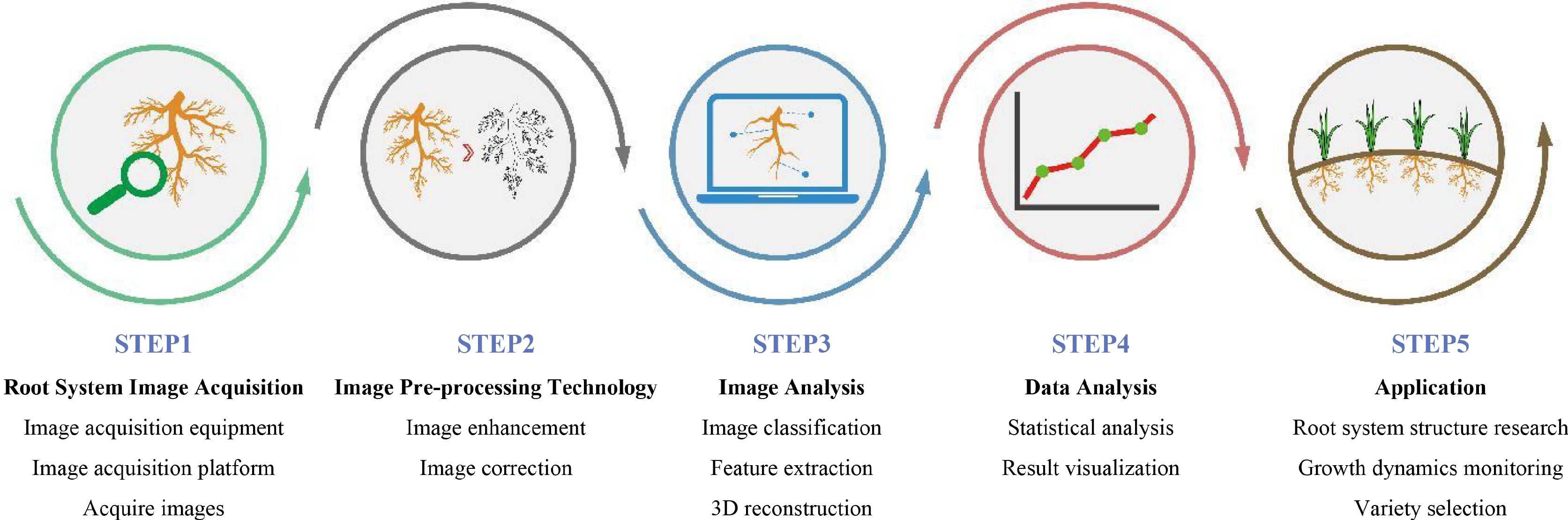
Figure 2.
Technical framework for in situ root research: acquisition, processing, analysis, interpretation, and application.
-
Over the years, research methodologies for studying root systems have progressed from early destructive morphological observations to the current integration of in situ image acquisition and artificial intelligence technologies. This progression has facilitated an in-depth analysis of root system functions and physiology, providing important tools for crop improvement and ecological studies. The primary methods for acquiring root system images encompass laboratory-based, field-destructive, and in situ field approaches. Fig. 3 illustrates the evolution of root phenotyping, from manual observation to AI-driven automation, highlighting this progression.
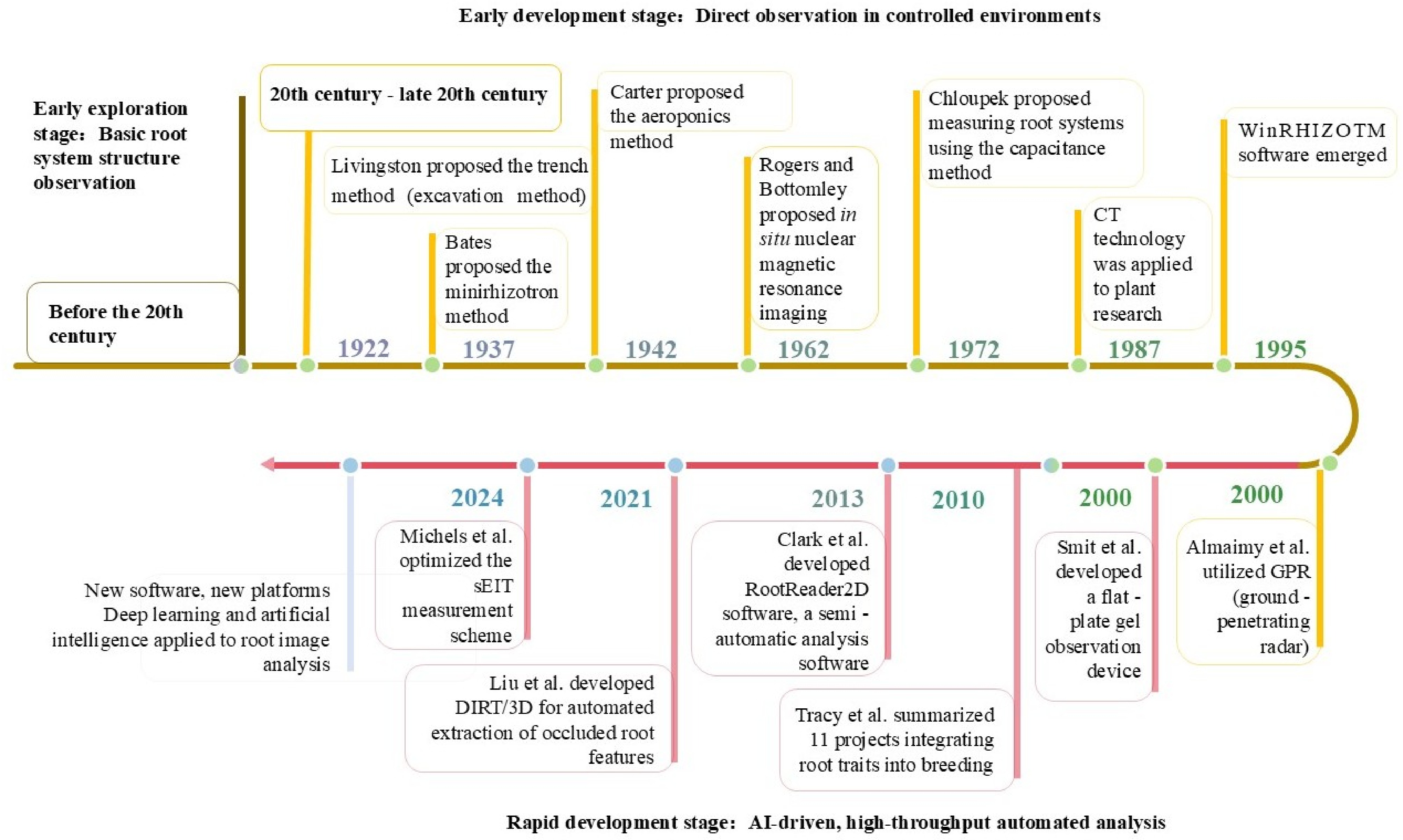
Figure 3.
Evolution of root phenotyping technologies from manual observation to AI-driven automation.
Field-destructive methods
-
The core method: Soil cores are retrieved using a double-bladed soil auger. After processing, the root length is measured. The advantage lies in the reliable root length density values it provides. Nonetheless, it is time-consuming and labor-intensive, and there is a risk of underestimating the actual root density[10]. The core-breakage method: This method involves breaking the roots within the soil core. It is relatively quick and requires low labor intensity.
However, the data obtained are relatively less accurate, calibration is cumbersome, and the method is prone to inaccuracies in sandy soil. The monolith method: In this approach, individual soil blocks are cut to measure the root length. It enables the acquisition of detailed data, yet it is time-consuming and causes damage to both the soil and root systems[10]. The trench method: Trenches are excavated to expose the root systems. While this method allows for precise measurements, it is highly time-consuming and labor-intensive, making it less suitable for field breeding experiments[11]. The shovelomics: Standardized excavation and cleaning are performed, followed by analysis in the field or laboratory. It serves as a rapid phenotyping tool, facilitating the selection of plants with shallow root systems. Nonetheless, its excavation depth is constrained[11,12]. Manual measurement of large root systems is highly time-consuming and often fails to capture the entire root system[13].
Although these destructive methods can yield detailed root system information, they are limited by drawbacks such as damage and high time and labor requirements. Given their intensive resource requirements, these methods are generally not well-suited for the rapid acquisition of large-scale root system data. Therefore, careful consideration is required when choosing these methods for practical applications. It is crucial to recognize, however, that these traditional methods have established foundational knowledge and continue to serve as important validation benchmarks. Their role in relation to emerging in situ techniques warrants further discussion.
Laboratory methods
-
3D laser scanning and transparent gel system: This non-destructive method enables in situ reconstruction and dynamic simulation of root system adaptation to the environment, facilitating research on crop root growth[14]. Its advantages include in situ and dynamic monitoring. However, it involves high costs, stringent equipment requirements, and difficult data processing, and is sensitive to the environment. Hydroponic system and water displacement method: The hydroponic system allows for controlling nutrients and the environment and is relatively simple to operate, making it suitable for short-term research.
The water displacement method also allows for simple and rapid measurement of the root volume[15]. However, a limitation of this method is that it cannot simulate soil structure and is not suitable for long-term or large-scale studies. Magnetic resonance imaging (MRI): MRI is non-radioactive, with high contrast and high resolution, and can dynamically monitor root growth and the status of nutrients and water[16]. However, it is costly, the equipment is complex, and measurements can be affected by soil metal particles and bubbles. X-ray micro-computed tomography (mCT): mCT has rapid imaging and high resolution, which is beneficial for studying root morphology and distribution[17,18]. Spectral electrical impedance tomography (sEIT) technology with an optimized measurement scheme is used for quantitative phenotyping analysis of crop root systems[19]. For the hyperspectral imaging of underground plant root systems, the spectral characteristics can reflect the root systems' physical, physiological, and chemical properties. Root box method: This method provides a complete view of the root systems, enabling long-term monitoring of their growth, morphology, and function[20]. In situ root system cultivation and analysis: Composed of acrylic plates and scanners, this system uses soil as the substrate to simulate the field growth environment. It enables the acquisition of high-resolution root system images and meets the needs for long-term dynamic root system imaging[21].
In situ field methods
-
Rhizotron technology and EnRoot system: This method can measure the root system density without disturbing the soil and enables long-term monitoring of the same root segment[22−24]. Its advantages include being non-destructive and allowing for long-term tracking. However, its field of view is constrained, and it can only observe the roots around the tube. Minirhizotron technology: It involves relatively low costs, is relatively simple to operate, offers high adaptability, and enables continuous monitoring.
Conversely, it has a narrow field of view, is inconvenient to install, may interfere with the root system, and the data is difficult to interpret[25,26]. Laser scanning technology: This method can render accurate 3D root system images, is non-destructive, and dynamically monitors the root system, providing abundant data. Nonetheless, the equipment is expensive, has many limitations, involves complex data processing, and is highly sensitive to environmental conditions. Capacitance method: This method uses electrical impedance imaging, and is low-cost, fast, and suitable for high-throughput experiments. It can monitor the root system in opaque media[27,28]. Its limitations include low spatial resolution, sensitivity to soil conditions, and difficulty in distinguishing the root system from soil. Positron emission tomography (PET)/computed tomography (CT) scanning and combined technology: This technology can monitor the physiological activities and precise structures of the root system in real time[29], and the combined use can also complement each other's advantages[30]. Nonetheless, the equipment is costly, has a complex operation, and involves radioactive isotopes. Pipeline robots and new sensors: These technologies have been used for dynamic monitoring of root growth, root information extraction, soil moisture monitoring, and battery life tests[31]. A critical perspective in advancing root phenotyping lies in recognizing the complementary, rather than competitive, relationship between in situ and destructive methodologies. The most robust experimental designs will strategically integrate both. For instance, continuous temporal data on root dynamics captured by minirhizotrons can be systematically validated and enriched by spatially precise, quantitative measurements obtained through destructive soil coring at key phenological stages. This synergistic approach enhances the reliability of in situ observations and contextualizes point-in-time measurements within a developmental continuum, thereby yielding a more comprehensive and mechanistically sound analysis of RSA and its functional implications for crop improvement.
Each method has advantages and limitations, and the choice of method depends on the specific research requirements and conditions. In situ methods also face challenges, including high equipment costs, limited throughput, and soil occlusion issues; importantly, these methods complement rather than replace traditional destructive approaches, with destructive methods providing accurate reference data for validating in situ measurements and in situ methods capturing temporal dynamics. Deep learning enhances data analysis but does not overcome these inherent physical limitations.
Existing single root system measurement technologies have certain limitations, such as constraints for in situ soil growth studies, long-term ecological research, spatial resolution, installation disturbance, data processing complexity, and three-dimensional imaging capability. Future root system image acquisition is expected to move toward greater intelligence, automation, and non-destructiveness, with a focus on in situ and three-dimensional imaging. In greenhouses, robotic systems can automatically acquire images. For example, environmental monitoring robots combined with high-precision sensors can render root system images and environmental data in real time, enabling real-time monitoring throughout the entire growth cycle and recording root system growth. In the fields, non-destructive acquisition technologies will be upgraded. Future integration of the minirhizotron method with technologies such as electrical resistance tomography (ERT) and ground-penetrating radar (GPR) could enhance field monitoring capabilities for root systems. Concurrently, artificial intelligence and machine learning can be employed to efficiently analyze images, extract characteristic root system parameters, and contribute to crop research and the development of precision agriculture. Overcoming the current limitations in cost, scalability, and data interpretation is crucial for applying in situ phenotyping effectively in breeding programs.
-
With the development of digital technology, image processing has become an important aspect of multiple research areas in medical and biological sciences[32−34]. In agricultural image analysis, large-scale, balanced, and well-annotated image datasets are essential for visual recognition tasks such as image classification, segmentation, object detection, and localization. These datasets are critical for developing high-performance models, yet they are difficult to obtain under real-world conditions. This scarcity of high-quality data has driven the evolution of root image analysis tools, which have progressed from manual quantification through semi-automated software to the current era of artificial intelligence.
Root system analysis plays a fundamental role in advancing academic research and enhancing agricultural applications. Historically, manual measurement of root phenotypes has been constrained by low throughput, environmental variability, and human-induced inaccuracies[35]. The introduction of robot-assisted and computer vision tools has led to innovation, improving experimental throughput and efficiency[36]. However, the imaging and analysis of large root systems still face challenges such as high equipment costs, size limitations, and stringent lighting requirements[37]. The following overview of representative software not only lists their functionalities but also examines their positioning within this evolutionary trajectory, highlighting key trade-offs between automation, accuracy, accessibility, and robustness.
Machine learning image segmentation tools on different software platforms have different characteristics. WinRHIZO has a simple operation process and can quickly obtain parameters through scanning, making it suitable for large-scale basic research. Nonetheless, its automation is insufficient for processing high-frequency data, and manual adjustment is still required for complex images[15]. The semi-automatic image analysis tool SmartRoot combines vector representation and tracking algorithms, enabling detailed analysis of limited root samples[38]. RootNav, the first-generation semi-automatic analysis tool, provides an intuitive interface and handles intersecting root systems, yet requires manual intervention[39]. IJ_Rhizo, based on the open-source ImageJ macro, provides detailed root information but has a steep learning curve for non-programmers[40]. These early semi-automated tools mark an important transitional phase away from fully manual methods. However, their core limitation is the significant dependency on expert user input for correction and parameter tuning, which fundamentally limits the throughput and introduces subjectivity. MyROOT focuses on the semi-automatic quantification of the root length of seedlings on agar plates. It is highly specialized for this purpose, but its operation lacks intelligence. Additional calibration is required when dealing with non-model plants, and its universality is limited[41]. EZ-RHIZO has a user-friendly interface and enables rapid measurement. Its semi-automation can reduce human biases. Nonetheless, frequent manual intervention is needed in the case of complex root systems, and the technical fineness is insufficient[42]. GiA Roots is a semi-automated software tool with user-assisted algorithms for extracting various phenotypes, though it requires user intervention under variable image quality[43]. DIRT, an online high-throughput platform, facilitates team collaboration and data sharing but has a steep learning curve[44]. The CREAMD-COFE process enables high-throughput analysis but is highly dependent on image quality and requires parameter adjustment across environments[45].
Collectively, the semi-automated software paradigm is constrained by three limitations: (i) heavy reliance on expert-driven manual intervention and parameter tuning, which restricts the throughput and introduces subjectivity; (ii) poor adaptability to variable imaging conditions, often requiring recalibration across datasets; (iii) limited accuracy in resolving complex root architectures, particularly fine roots and dense overlaps. These persistent challenges highlight the need for a more robust and scalable analytical framework, motivating the shift toward deep learning-based approaches.
The rise of deep learning and automation
-
To overcome the limitations of semi-automated tools, the field has transitioned to a deep learning paradigm. By autonomously learning the hierarchical features from image data, this approach considerably reduces dependence on manual feature extraction and expert intervention, marking a shift from user-assisted software to automated systems. Consequently, it enables more stable and scalable processing of complex and variable root architectures. These challenges underscore the need for data-driven, deep learning-based approaches. The RhizoNet workflow enables semantic segmentation of plant root system scans based on deep learning[46]. A new X-ray CT method, RSApaddy3D, enables automated, non-destructive 3D imaging of rice roots in paddy fields for high-throughput phenotyping[47]. RhizoVision Explorer enables non-destructive scanning and analysis of root samples, integrates multi-source images for 3D reconstruction, and is compatible with CNN algorithms. However, it requires substantial processing time and operator expertise[48]. NMRooting enables non-destructive 3D root model extraction from MRI data and comparison with traditional methods, though it requires specialized equipment and expertise[49]. RootReader3D and PET/CT use customized systems and software for 2D-to-3D root reconstruction and automated analysis, enabling real-time monitoring of root physiology. The technology is novel, but it strongly depends on specific imaging equipment[50]. ROOTPAINTER quickly trains deep learning models for bioimage analysis to extract root traits[51]. The RhizoPot platform integrates multiple functions, has a low cost and high throughput, and uses DeepLabv3+ to process images, enabling accurate semantic segmentation. However, its adaptability under complex conditions requires further improvement[52]. A recently developed platform, HTPRootSlides, addresses similar challenges through an automated S-shaped circulation mechanism and YOLO11-based segmentation, achieving 89.56% accuracy in root isolation[53]. PlantCV v2 is open-source and community-driven, with significant upgrades in organization and functions. It incorporates machine learning and supports the analysis of complex images, conforming to the trend of efficient analysis[54]. RootNav 2.0 conducts fully automatic analysis based on deep learning. Compared with the first generation, it has made all-round improvements in accuracy, speed, and adaptability, keeping up with the trend of intelligent technology[55]. VRoot enables high-precision 3D RSA reconstruction from soil column scans[56], while RootEx specializes in barley root phenotyping with robust performance under challenging conditions including background noise and root overlap[57]. This new generation of AI-powered tools marks a decisive move from user-assisted software to automated prediction systems. Their success is closely tied to the very data scarcity problem noted at the outset, creating a synergistic cycle where improved models generate better annotations, which in turn fuel further model development. The central challenge now is less about pure automation and more about ecological validity—ensuring these powerful models generalize reliably from controlled imaging environments to the heterogeneous conditions of the field. Fig. 4a illustrates several root system image acquisition techniques, while Fig. 4b presents corresponding root segmentation images.
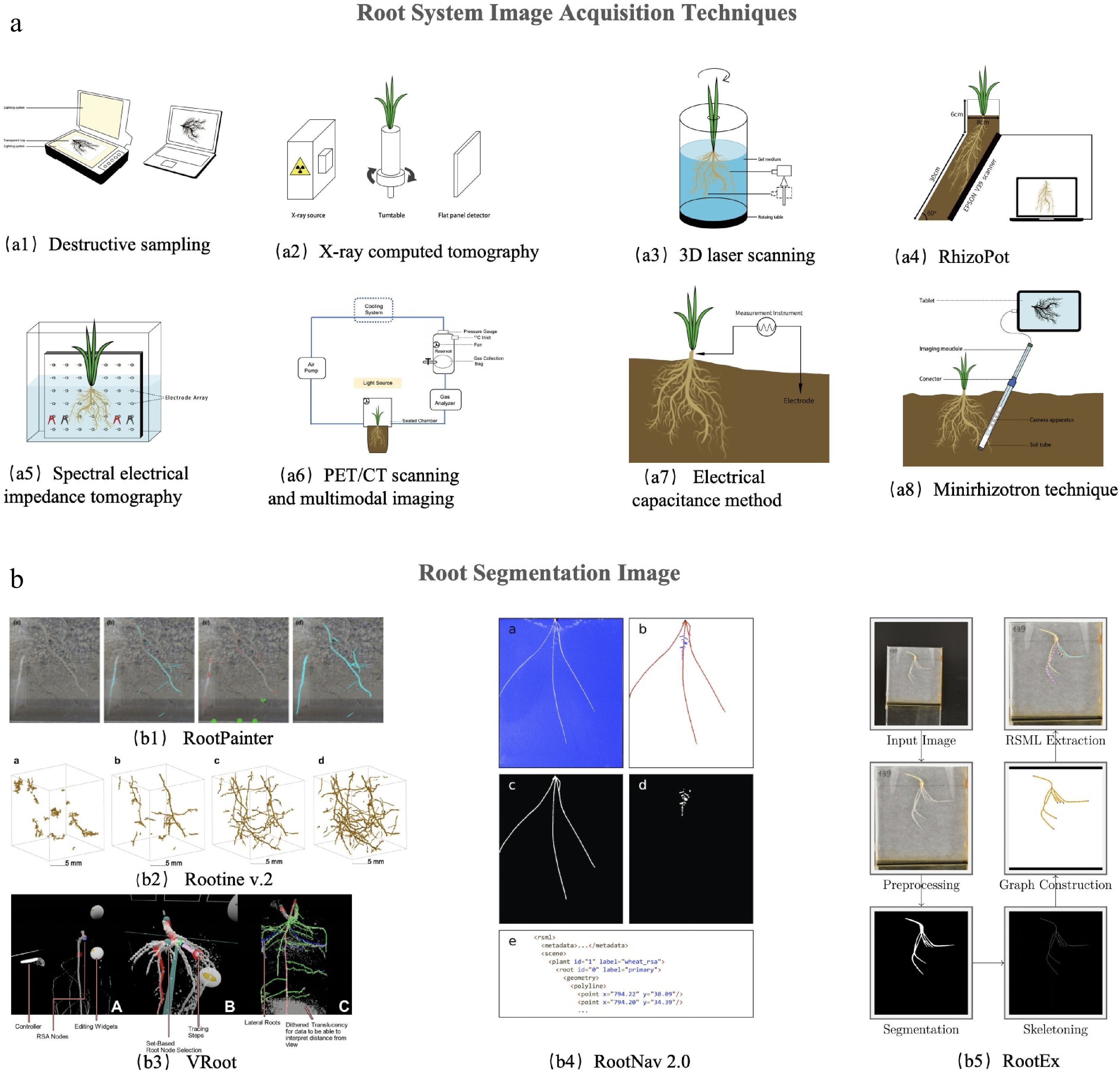
Figure 4.
Root system images. (a) Root system image acquisition techniques: (a1) destructive sampling; (a2) X-ray computed tomography;[18] (a3) 3D laser scanning[14]; (a4) RhizoPot[21]; (a5) spectral electrical impedance tomography[19]; (a6) PET/CT scanning and multimodal imaging[29]; (a7) electrical capacitance method[27]; and (a8) minirhizotron technique[24]. (b) Root segmentation images: (b1) RootPainter[51]; (b2) Rootine v.2[58]; (b3) VRoot[56]; (b4) RootNav 2.0[55]; and (b5) RootEx[57].
Current limitations and future directions
-
A synthesis of the comparative landscape of these tools reveals a series of trade-offs that define the current technological bottlenecks. Existing root system analysis software face several shortcomings. Traditional root system image analysis methods are often characterized by a low degree of automation and significant reliance on manual operation. The entire analysis process is cumbersome and time-consuming. Substantial time and effort are required, which not only reduces the efficiency but also introduces errors due to subjective judgment. Some software entail high hardware costs and require professional knowledge for analysis; the adaptability of some platforms requires further validation; some are limited to specific operating systems. In addition, traditional methods typically rely on fixed thresholds. Nonetheless, due to the variability in the environments and characteristics of different root system samples, fixed thresholds struggle to adapt to various situations. This limits their generalizability across scenarios, hindering their ability to meet the diverse and precise demands of modern research and agricultural practice. Therefore, a promising future direction for root system phenotyping involves the development of hybrid pipelines that strategically combine high-throughput imaging, robust AI models trained on diverse datasets, and domain-specific validation to bridge the gap between analytical precision and agricultural relevance.
-
Deep learning has been widely applied in agricultural analysis and related fields in research[59]. In early applications, its use was in plant phenotype analysis, pest and disease monitoring, and the selection of superior varieties[60,61]. When trained on large amounts of data, these techniques can provide reliable analysis results[62]. The application of deep-learning techniques has improved the prediction accuracy and robustness of models[63]. Promising results were achieved in multiple fields when deep convolutional neural network (DCNN) was combined with transfer learning[64]. The improved YOLOv8 algorithm integrates new residual blocks, DenseNet layers, the Hard-Swish activation function, and the PANet network, contributing to simultaneous gains in detection accuracy and speed[65]. Effective classification of plant diseases at multiple granularities has been enabled by the fusion of multi-level deep information features[66]. These advances in above-ground plant analysis provide a basis for applying deep learning to the more challenging domain of root systems.
Significant progress has been made in plant phenotype analysis and the monitoring and classification of plant diseases and pests through deep learning. Currently, its application is being expanded to RSA analysis[67], which provides critical phenotypic data for optimizing the root traits in plant breeding. Compared with the above-ground parts of plants, the acquisition of root system images is more difficult due to their complex backgrounds and diverse morphologies. With its powerful data processing and feature learning capabilities, deep learning addresses these challenges and facilitates the accurate analysis of root system images. However, the transition is not straightforward. The inherent complexity of root images, such as soil occlusion and low contrast, necessitates specialized network architectures and training strategies beyond those used for standard object recognition.
Different root system acquisition methods result in significant differences in the features of the collected root system images. Therefore, accounting for these differences requires different image processing methods.
Advances in model architectures and applications
-
In recent years, significant progress has been made by deep learning technology in the field of plant root system image segmentation, providing new solutions to the challenges faced by traditional methods. Generative adversarial networks (GANs) have demonstrated effectiveness in agricultural image enhancement. Realistic images can be generated by learning data representations, significantly reducing the workload of image collection and annotation, and thus improving the performance of models. Nonetheless, the instability of the GAN training process and its dependence on a large amount of data remain urgent issues to be addressed[68]. This marks an evolution from applying general-purpose networks to designing specialized architectures for root imagery.
For X-ray CT image segmentation, combining convolutional neural networks (CNNs) with support vector machines (SVMs) and transfer learning enables effective root-soil segmentation under low-contrast conditions while reducing the annotation demand[69]. The Multi-Level Multi-Resolution encoder-decoder network further addresses the challenge of distinguishing roots from soil in CT images[70]. ResNet-18 combined with random forest classification has increased automation and reduced human error, yet it remains constrained by computational resource requirements and its limited capability in predicting complex root system characteristics[71]. Therefore, a balance must be struck between model complexity, computational expense, and generalization ability.
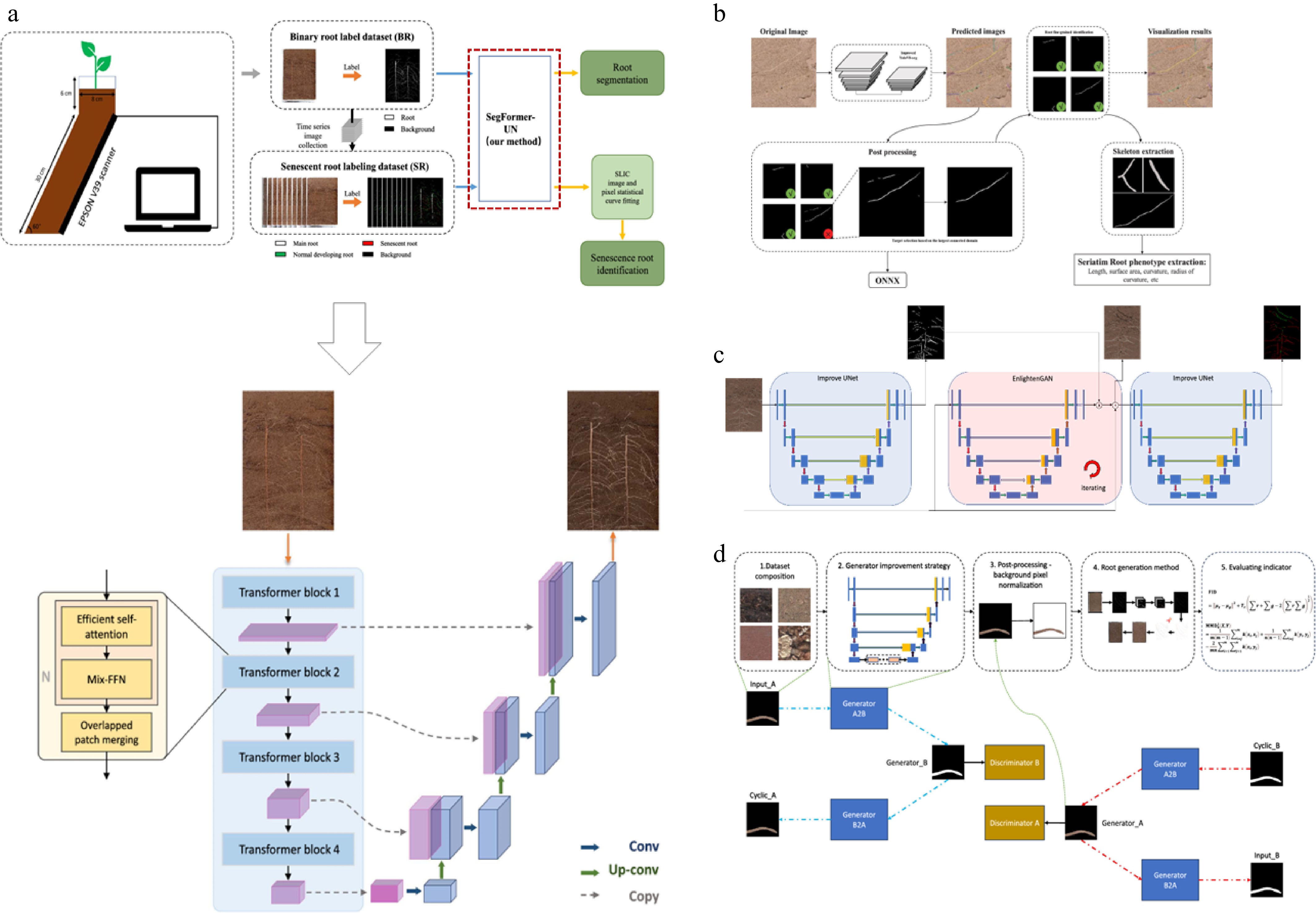
For root system phenotyping, SegRoot incorporates ResNet Block and Position Sensitive Attention to enhance feature extraction and segmentation accuracy[72], while OCRNet enables segmentation in real soil without preset thresholds[73]. A CNN-based framework has been developed for estimating the root length, diameter, and color from in situ minirhizotron images[74]. An improved UNet with transfer learning, incorporating multi-scale feature extraction and data augmentation, has been applied to cotton root segmentation[75]. Furthermore, integrating an enhanced UNet with EnlightenGAN helps in achieving in situ root image segmentation and 3D reconstruction with improved accuracy and completeness[76]. The modified YoloV8seg network, combined with post-processing methods, enables fine-grained root image segmentation and detailed phenotypic analysis[21].
Enhanced DeepLabv3+ demonstrates markedly improved segmentation accuracy for cotton root images compared to conventional methods[77], while U-Net variants incorporating EfficientNet and SE-ResNeXt-101 encoders further enhance the generalization ability[78]. Multi-model fusion strategies, such as P-T-U-Net combining SegNet, U-Net, and Mask R-CNN, have demonstrated strong performance in complex root system structures[79]. Consequently, the current frontier is defined by diversified strategies. Enhanced precision is achieved through attention mechanisms and advanced encoders, processing speed is improved by real-time architectures like YOLO, and comprehensive analysis from segmentation to 3D reconstruction is enabled by multi-model fusion or integrated pipelines.
Current limitations and future perspective
-
Although deep learning has contributed to advances in root system image analysis, several challenges remain. The opacity of soil particles and their similarity in color to root systems make it difficult to achieve precise separation in automatic segmentation. Traditional methods rely heavily on manual operations and are error-prone. While deep learning can automatically analyze complex images, improvements are still required in fine-grained recognition, segmentation of complex root system structures, and determining the corresponding relationships between parameters and specific root system structures. In addition, the acquisition of long-term time-series data and model validation are also key directions for future research. Therefore, the key challenge lies in shifting from pure algorithmic accuracy to ecological validity and practical utility.
Currently, architectures such as CNNs[80], fully convolutional neural networks (FCNNs)[81], and DCNNs have become the mainstream methods for root system segmentation. Continuous improvement of model performance is pursued by researchers through various innovative methods. The SegRoot network has achieved high-throughput root system image segmentation[77], and encoder-decoder structures have enabled three-dimensional super-resolution segmentation of root system MRI. The introduction of attention mechanisms has improved segmentation accuracy for fine roots and root hairs[82], while weakly supervised learning methods have reduced the demand for data annotation.
To provide a clearer comparison of the performance of various mainstream models in root phenotyping tasks, Table 1 summarizes and analyzes their core advantages, typical tasks, data requirements, and main limitations.
Table 1. Comparative analysis of mainstream deep learning models for root phenotyping tasks.
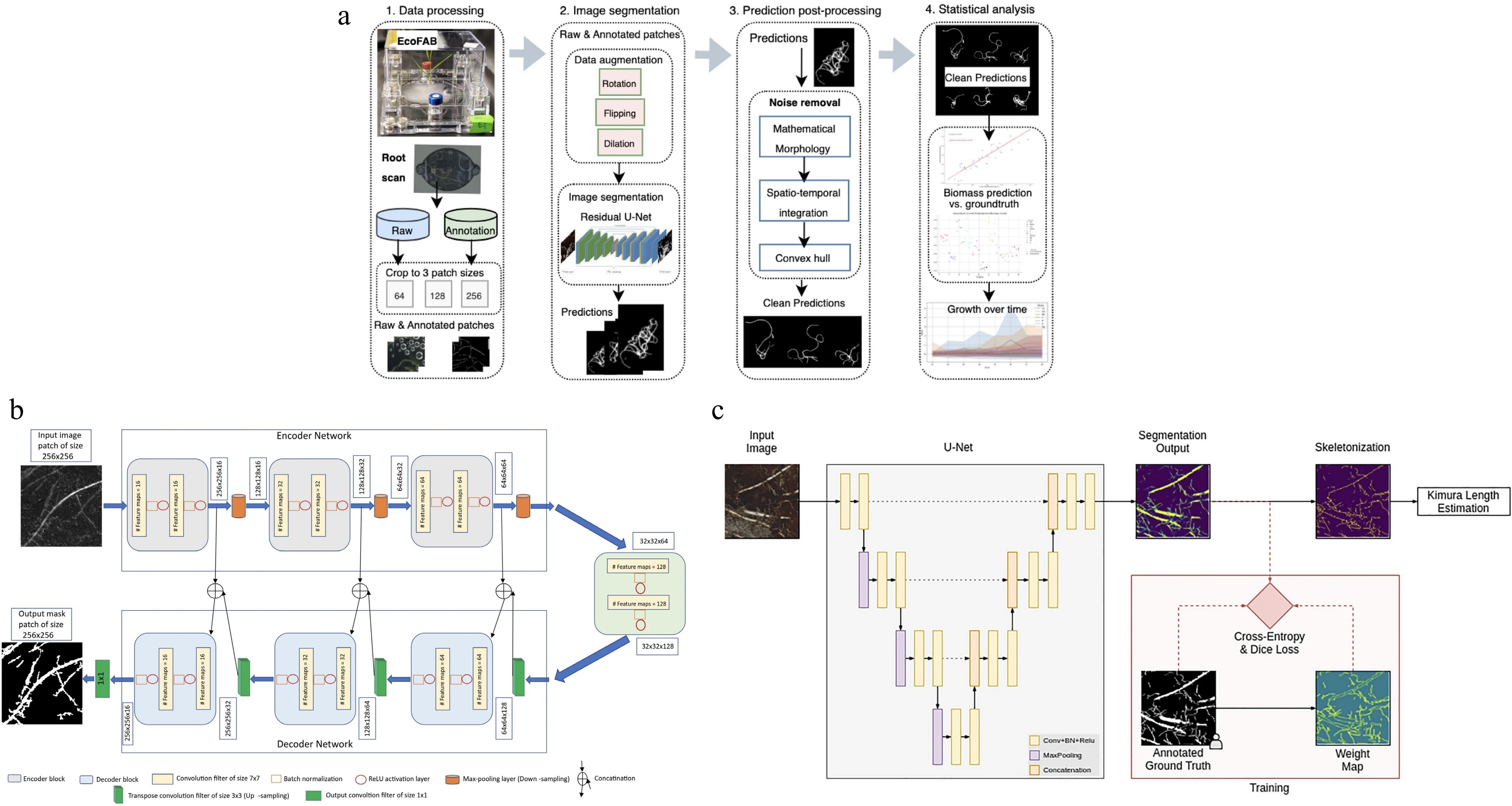
Model category / example Core advantages Typical root phenotyping tasks Main limitations Basic CNN / SVM Combined Models[69,80] Simple structure, stable training, moderate computational needs. Root/soil binary segmentation, preliminary feature extraction. Limited feature learning; struggles with complex structures (e.g., fine root overlap); moderate generalization. Encoder-Decoder Architectures (U-Net & Variants)[75,78] Excellent pixel-level prediction, multi-context fusion, proven in medical imaging. High-precision semantic segmentation, 2D/3D reconstruction. High dependency on annotation quality; complex; heavy for edge deployment. Attention-Enhanced Models (e.g., PSA U-Net)[72,82] Focus on key regions (root tips, branches); boosts accuracy for fine structures. Fine-grained segmentation, trait quantification (e.g., root hair density). Complex design; overfitting risk; requires task-specific tuning. Real-time Architectures (YOLO Series)[21,65] Extremely fast inference, suitable for video/large batches. In situ dynamic monitoring, high-throughput detection. Pixel-level accuracy lower than dedicated segmentation networks; may miss very fine roots. Generative Adversarial Networks (GAN/cGAN)[68,76] Generate synthetic data for augmentation; address class imbalance. Data augmentation, handling root-background imbalance, enhancing low-quality images. Hard to converge; mode collapse risk; potential bias in generated data. Multi-Model Fusion/Ensemble Strategies[79] Combine model strengths; improve robustness and accuracy for complex scenes. Comprehensive analysis in complex soil (integrated segmentation, classification, counting). Highest system complexity; difficult integration design; highest cost and deployment difficulty. Consequently, the research frontier now emphasizes diversified architectural strategies. Attention mechanisms and advanced encoders play a key role in achieving higher segmentation precision. Simultaneously, real-time architectures help address processing speed requirements, while integrated pipelines support comprehensive phenotypic analysis from segmentation to three-dimensional reconstruction. Fig. 5 shows root segmentation based on deep learning.
Strategies to address the bottlenecks in data, computational efficiency, and generalizability—such as algorithmic optimization, multi-modal data fusion, and lightweight deployment—are recognized as key directions. The model advancements and existing limitations reviewed in this section lay the groundwork for the discussion of future research directions. In summary, deep learning has driven significant progress in root image analysis through continuous architectural innovations. However, the field's advancement remains constrained by core challenges such as data scarcity, limited model generalizability, high computational costs, and difficulties in translating laboratory findings to field applications.
-
In the field of root system research, two-dimensional root system images have historically provided crucial support for basic cognition. Nonetheless, their planar perspective provides limited insights into the complex structures and spatial distributions of root systems. Advances in imaging technologies, algorithmic refinement, and computing power have driven the evolution of root system imaging from 2D to 3D[85]. Cutting-edge approaches, such as multi-modal data fusion and DCNNs, are increasingly being used to overcome the challenges associated with segmenting complex backgrounds and accurately restoring morphological features. They offer the potential to reshape the entire picture of the spatial architecture of root systems, injecting new impetus into plant physiology, ecology, breeding, and cultivation.
Three-dimensional imaging technologies, such as X-ray computed tomography (CT) and nuclear magnetic resonance imaging (NMRI), have been applied in root system research. Beyond hardware advancements, progress in 3D reconstruction algorithms—including point cloud-based networks (e.g., PointNet++, PVCNN) and volumetric segmentation models (e.g., 3D U-Net)—has further enhanced the ability to accurately model complex RSAs[86]. However, due to their low cost, wide field of view, and high resolution, two-dimensional imaging technologies remain effective transitional tools in root system research[87]. A semi-automated 3D imaging and phenotypic analysis process has been developed for rice root systems, enabling the identification of quantitative trait loci (QTLs) and facilitating fine phenotypic analysis[88]. 3D images of root systems can be captured using a 3D laser scanner and a gel matrix system, with structural reconstruction achieved through methods such as the Hough transform and Ball-B splines[14]. The Rootine v.2 algorithm enables root segmentation and 3D model construction from X-ray CT images[58]. In data processing and model construction, following CT scans of root systems, imaging software is used to process the data for visualization. Nonetheless, a rapid, non-invasive, and in situ 3D observation method is still lacking[89]. L-Systems are utilized to describe and simulate root system growth structure[90]. When analyzing RSA data in batches, the process is hindered by differences in data structures across platforms, complicating result comparison[91]. Existing root system structure models are often complex and parameter-intensive, complicating their integration into large-scale crop models. Newer general models have demonstrated improved universality and mechanistic integration. A CNN classifier combined with simple spatial carving enables three-dimensional quantification of root traits in rice seedlings[92]. The RootForce tool enables semi-automatic segmentation from X-ray CT images across different root systems and soil conditions, though lateral root identification requires further optimization[93]. Multi-source data fusion combining the structures from motion and inertial measurement unit data enables 3D root system reconstruction, though cumulative errors remain a challenge[94]. Ground penetrating radar (GPR) is employed for mapping tree root systems, with advanced data processing methods enabling 3D reconstruction and feature extraction[95]. Four-dimensional root system data of wheat seedlings are acquired using MRI time-series analysis via NMRooting software[96]. In deep learning-assisted analysis, the VGG16 deep learning network is applied to CT image analysis. Porosity is utilized as an abstract value in "surrogate learning" for neural network training, which helps understand the soil microstructure. Nonetheless, future optimization may involve the adoption of higher-resolution micro-CT technology[97]. DIRT/3D enables automated feature extraction of highly occluded root systems through 3D scanning and algorithmic reconstruction[98]. In three-dimensional research related to soil, soil samples are scanned to construct 3D pore space models, facilitating the study of relationships between soil, root systems, and microorganisms[99]. Refraction-contrast X-ray micro-CT is employed to obtain images at different resolutions, with three-dimensional models generated through algorithmic processing[100].
Currently, progress has been made in the application of three-dimensional reconstruction in root system research. Nonetheless, there is a lack of real-time and continuous field collection technologies. Most existing methods involve discrete sampling, making it difficult to obtain complete growth information of root systems. The demand for high-throughput data acquisition remains unmet. Traditional processes are often cumbersome, requiring substantial manual labor and characterized by slow output rates. Data limitations also contribute to poor model accuracy and universality, making it difficult for them to support scientific research and production decision-making. Moreover, the challenges related to imaging technology, data processing, and model complexity must be continuously addressed to advance the root system research framework.
Therefore, the primary goal of advancing three-dimensional reconstruction is to significantly improve root system phenotyping. By transcending the constraints of two-dimensional analysis, 3D techniques now allow for the precise quantification of structural phenotypes, which are crucial for understanding water and nutrient uptake as well as stress responses. The translation of these high-definition phenotypic datasets into insights that can inform genetic breeding represents an important step.
-
Building on the accurate phenotypic parameters enabled by 3D reconstruction, the identification and selection of root system traits for breeding constitute a critical task. RSA is critical for crop production, and root system research has important implications for genetic breeding[101−103]. Dynamic relationships exist among root system growth, water and solute transport, and root-soil interactions[104]. Root systems exhibit growth adjustments and plasticity under varying environmental conditions and abiotic stresses[9,105]. Root system phenotypes are closely associated with drought resistance, and the corresponding phenotypic indices can be derived[106].
RSA plays an important role in drought resistance and productivity by regulating WUE. Studies demonstrate that spatiotemporal coordination between maize roots and soil moisture enhances the yield by optimizing vertical root distribution[107]. Under hardpan constraints, cotton maintains water uptake through horizontal root proliferation[108]. Wheat achieves drought adaptation through dynamic root-shoot ratio adjustments[109], while plastic film mulching in maize boosts the yield by balancing root-shoot allocation[110]. These findings on crop RSA offer theoretical foundations for drought-resistant breeding[111]. High-throughput phenotyping of 228 cotton accessions identified medium drought-resistant types as optimal breeding materials[112]. ABA regulates auxin synthesis in root tips, steepening the root angles to enhance deep soil water uptake[7]. This process of structural and directional adjustment helps roots improve drought resistance[113].
Traditionally, root system image analysis has relied on conventional image processing software. For example, in QTL mapping studies of root traits in wheat seedlings, these traditional methods demonstrate lower accuracy and efficiency compared to modern AI and machine learning approaches[114]. VRN1 regulates both flowering and RSA in wheat and barley, expanding our understanding of the subterranean functions of flowering genes[115]. DEEPER ROOTING 1 controls the root growth angle in rice and increases yield under drought conditions, though research on this pathway remains limited[116]. QTLs related to root angle and number have been identified in wheat populations, offering new molecular markers and breeding strategies[117]. Phenotyping is a challenging task, characterized by high cost and time consumption. More efficient strategies are urgently required for the evaluation of large plant populations[3]. One study combined minirhizotron technology with machine learning software for quantitative analysis of root traits in perennial crops, demonstrating the potential of such approaches under controlled greenhouse conditions[118]. These efforts underscore the ongoing pursuit of greater efficiency and accuracy in root phenotyping, a pursuit that is increasingly leveraging artificial intelligence.
In this context, deep learning has emerged as a key approach for automating root image analysis. Building on this trend, our recent work applied CNNs to root segmentation, demonstrating a viable path toward high-throughput extraction of architectural traits from complex soil backgrounds[21,76,119,120]. This case serves as a representative example of the broader shift toward data-driven, AI-powered phenotyping solutions. Genome editing and machine learning hold significant potential, offering new tools for crop improvement. Future efforts should focus on overcoming existing challenges to fully exploit the potential of root system research for breeding purposes. Moving forward, systematic benchmarking of emerging methods against established phenotyping techniques under diverse real-world conditions will be essential to rigorously assess their comparative value and guide their practical application (Fig. 6).
-
Root phenotype is closely associated with crop drought resistance. In the optimization of crop RSA, high-throughput phenotyping facilitates the efficient quantification of root architecture traits for breeding selection. Nonetheless, progress is constrained by the scarcity of suitable phenotypic growth systems, which limits the high-throughput screening of root system characteristics. The challenges associated with data processing are becoming increasingly prominent. Although various sensors and platforms exist for image acquisition, efficiently analyzing large digital datasets remains a significant challenge. The large amount of labeled data required for training deep learning models often discourages plant researchers. Plant phenomics has flourished due to the development of imaging sensors, but is challenged by data management issues. Imaging technologies generate large amounts of data, making data management, annotation, and metadata collection extremely difficult, and there is also a lack of centralized, structured repositories. Limitations are also observed in model application. Deep learning models may not necessarily outperform machine learning models when applied to small sample datasets. The RSA of perennial crops changes over time and with the environment, and method effectiveness requires validation across multiple periods. Despite improved systems offering high-throughput, low-cost, and non-destructive evaluation, segmentation of fine and light-colored roots remains unresolved, necessitating technological upgrades and dataset expansion.
To address these challenges, future work should focus on four key directions to bridge laboratory research and field application.
First, enhancing the field robustness of models is essential. Performance often declines in heterogeneous field conditions due to soil variability and occlusion. Priorities should include developing domain-adaptive models, creating multi-environment benchmark datasets, and designing lightweight architectures for deployment on field devices. Second, multi-modal data fusion offers significant potential. Integrating imaging with spectral, sensor, physiological, and microbiome data through cross-modal learning architectures can provide a more complete view of root-environment interactions and improve fine root detection. Third, explainable AI is necessary for biological insight. Incorporating techniques such as attention mechanisms and feature visualization can clarify the morphological basis of model predictions, validate outputs, and reveal novel stress-related phenotypic markers. Fourth, a dynamic analysis of root systems will advance our understanding of plasticity. Developing models for time-series analysis of sequential root images will enable quantification of growth rates, branching dynamics, and tropic responses, offering deeper insights into their adaptation.
In summary, progress in field robustness, data fusion, model interpretability, and temporal analysis will transform root phenotyping from a descriptive tool into a predictive field technology that supports resilient crop development.
This study was supported by grants from the National Natural Science Foundation of China (nos. 32272220 and 32172120), Central Guiding Local Science and Technology Development Fund Project (246Z7402G), S&T Program of Hebei (23567601H), and State Key Laboratory of North China Crop Improvement and Regulation (NCCIR2024ZZ-18), and was funded by the Science Research Project of Hebei Education Department (CXZX2026003).
-
The authors confirm their contributions to this study as follows: writing original draft, writing – review and editing: Zhang M, Liu L; methodology: Zhang M; conceptualization: Zhang M, Liu X; investigation, formal analysis: Wang L, Liu X; data curation: Wang L, Yu Q; visualization: Liu X, Yu Q; project administration, formal analysis: Liu L; funding acquisition, supervision, writing-review and editing: Wang N. All authors have reviewed and approved the manuscript for publication.
-
Data availability is not applicable to this article as no new data were created or analyzed in this study.
-
The authors declare that they have no conflict of interest.
- Copyright: © 2026 by the author(s). Published by Maximum Academic Press, Fayetteville, GA. This article is an open access article distributed under Creative Commons Attribution License (CC BY 4.0), visit https://creativecommons.org/licenses/by/4.0/.
-
About this article
Cite this article
Zhang M, Wang L, Liu X, Yu Q, Liu L, et al. 2026. In situ root image phenotyping research based on deep learning: a review. Technology in Agronomy 6: e011 doi: 10.48130/tia-0026-0005 

In situ root image phenotyping research based on deep learning: a review
- Received: 28 December 2025
- Revised: 19 February 2026
- Accepted: 10 March 2026
- Published online: 02 September 2026
Abstract: Root systems are essential to plant growth as they are the primary organs for water and nutrient uptake, with root phenotypes being intimately linked to drought stress responses. Due to soil shielding, root phenomics has substantially lagged behind aboveground plant research. This review identifies three interconnected bottlenecks impeding the field: in situ imaging remains constrained by specialized equipment dependence and limited field adaptability, highlighting the need for breakthroughs in high-throughput technologies; automated extraction of key traits such as root length and topological density demands advanced artificial intelligence; and despite deep learning advances, fine-grained segmentation of fine roots and root hairs coupled with time-series modeling across growth stages remains underexplored. A key conclusion of this review is that overcoming these barriers requires an integrated "collection–modeling–application" framework that unifies technological innovation with analytical advancement. Specifically, it is suggested that in situ root phenotyping evolve beyond isolated imaging toward high-throughput, long-term observation integrated with root–shoot coordination analysis. Furthermore, we propose that coupling such platforms with large generative models can enable dynamic spatiotemporal prediction, systematically revealing root development trajectories and stress response mechanisms. This "perception–analysis–exploration" framework offers a pathway to decode the complex root–soil interactions that were previously obscured. By describing the recent innovations in in situ imaging, three-dimensional architectural algorithms, and high-throughput phenotyping for data-driven breeding, this review illustrates how these converging technologies can collectively advance precision breeding and smart agriculture. The review concludes that realizing drought-resistant crops for Agriculture 4.0 will require embracing this holistic framework to enhance stress tolerance and optimize root–water interactions.