













-
Soil salinization poses a severe threat to global crop productivity, a problem that has become increasingly pronounced in recent years[1−3]. Plants growing in saline–alkaline soils suffer from severe salt stress, which adversely impairs their growth and development[4−6]. Specifically, salt stress reduces photosynthetic efficiency and disrupts nutrient homeostasis in plants[7,8]. Furthermore, via osmotic stress and unbalanced ion homeostasis, salt stress induces excessive accumulation of toxic reactive oxygen species (ROS) and impairs cell membrane integrity, thereby inhibiting plant growth[9−12]. To adapt to salt stress, plants have evolutionarily developed complex adaptive mechanisms, including the production of osmoprotectants derived from metabolic processes such as photosynthesis to mitigate electrolyte leakage, and the enhancement of antioxidant enzymes such as catalase (CAT) and superoxide dismutase (SOD) to reduce ROS-induced damage[13−15]. Through the coordination of these physiological and biochemical processes, plants counteract the multiple adverse effects caused by highly saline environments. Therefore, elucidating the molecular mechanisms underlying plants' salt stress tolerance can provide valuable insights for improving crop yield under conditions of high salinity.
As important specialized metabolites, flavonoids are widely distributed in plant tissues and participate in diverse biological processes, namely plant growth, development, and abiotic stress tolerance[16,17]. When plants are exposed to environmental stresses such as cold, drought, and saline–alkaline stress, the flavonoid content in plants increases significantly, thereby enhancing plants' stress tolerance[18,19]. Flavonoids can function as antioxidants to scavenge the excessive accumulation of ROS generated under abiotic stress conditions, thereby alleviating stress-induced cellular damage[20]. For example, in soybean (Glycine max), flavonoids can improve salt tolerance by eliminating excessive ROS[21]. Key enzymes in the flavonoid biosynthetic pathway, such as flavanone 3-hydroxylase and flavonol synthase (FLS) play crucial roles in the flavonoid biosynthetic pathway in plants[22]. Ectopic overexpression of EkFLS in Arabidopsis thaliana promotes flavonoid biosynthesis, which, in turn, enhances the activity of antioxidant enzymes such as SOD, ultimately improving the salt and drought tolerance of A. thaliana[23]. Similarly, overexpression of MsFLS13 in alfalfa (Medicago sativa) enhances the plant's tolerance to saline–alkaline stress by increasing its flavonoid accumulation and antioxidant capacity[24]. Nevertheless, the underlying mechanisms by which flavonoids mediate plants' responses to abiotic stress, particularly salt stress, remain incompletely characterized.
CLAVATA3/EMBRYO SURROUNDING REGION (CLE) peptides are among the most intensively studied plant peptide hormones in recent years, which are involved in regulating multiple developmental and physiological processes such as the regulation of shoot and root apical meristem (SAM and RAM) homeostasis, the development of vascular tissue, flowering, and abiotic stress responses in plants[25−27]. CLE3 is an important member of this peptide family, and numerous studies have demonstrated that the primary function of CLE3 is to regulate the growth and development of plants' aerial parts by maintaining SAM homeostasis[28]. In tomato (Solanum lycopersicum), the Slcle3 mutant leads to increased branching and larger fruit size[29]. In addition, AtCLE40 cooperates with AtWOX5 to modulate root development[30]. Seven CLE genes, namely AtCLE9, AtCLE16, AtCLE17, AtCLE19, AtCLE41, AtCLE42, and AtCLE45, are highly expressed in A. thaliana and play important roles in anther development[31]. Moreover, specific CLE peptides have been implicated in plants' responses to environmental stresses. For example, AtCLE45, AtCLE9, and AtCLE14 play critical roles in plants' responses to high-temperature, drought and salt stress, respectively[32−34]. Despite these advances, the function of CLE3 in plants' responses to abiotic stress remains largely unknown.
Alfalfa is a globally vital forage crop with high levels of crude protein, favorable palatability and capacity for root nodule nitrogen fixation, thus having great economic and ecological benefits[35]. Salt stress drastically suppresses alfalfa's growth and yield, restricting its plantation in saline soils. Unraveling the molecular mechanism of salt tolerance in alfalfa is thus critical for the genetic improvement of salt-tolerant cultivars. Developmental regulatory genes can switch functional roles to balance plant growth and stress resilience under unfavorable conditions; for instance, AtLBD15 coordinates growth and drought tolerance through abscisic acid (ABA) signaling pathways[36]. Our previous study identified MsCLE3a as a regulator of leaf petiole angle in alfalfa[37], but its potential role in abiotic stress, particularly its salt response, remains largely uncharacterized. Flavonoids, key specialized metabolites, alleviate salt-induced damage in plants, yet the upstream regulators linking CLE peptide signaling to flavonoid-based metabolic remodeling under salt stress are elusive. To address this knowledge gap, this study characterizes the function of MsCLE3a under salt stress and explores its regulatory association with flavonoid metabolism in salt tolerance, providing theoretical support for gene resource exploitation in molecular breeding of alfalfa for improved salt tolerance.
-
Wild-type (WT) alfalfa and the previously generated mscle3a knockout mutant[37] were clonally propagated via stem cuttings to minimize growth cycle variations. The plants were cultivated for 2 months in a glasshouse under a 16-h light/8-h dark photoperiod. Two-month-old rooted cuttings were then treated with a 300 mM NaCl solution, which was applied once every 4 d, with a total of five treatments administered.
Analysis of the MsCLE3 gene promoter
-
The 2,000-bp promoter sequences upstream of the translational start site ATG of MsCLE3a and MsCLE3b genes were retrieved and submitted to the PlantCARE database (
https://bioinformatics.psb.ugent.be/webtools/plantcare/html/ ) for predicting the cis-acting regulatory elements. The results of the prediction were then visualized using TBtools[38].RNA extraction and quantitative real-time polymerase chain reaction analysis
-
Total RNA was extracted from NaCl-treated alfalfa plants using the Eastep® Super Total RNA Extraction Kit (Promega, Beijing, China). First-strand complementary DNA (cDNA) was synthesized from 2 μg of total RNA in a 20-μL reaction volume using the GoScript™ Reverse Transcriptase (Promega, Beijing, China). Quantitative real-time polymerase chain reaction (qRT-PCR) was performed to analyze the expression levels of MsCLE3a (MsG0580025987.01), MsCLE3b (MsG0780038613.01), FLS (MsG0580027458.01), F3'Hc (MsG0380012602.01), CHS (MsG0780040080.01), CCoAOMT (MsG0880045882.01), HCTd (MsG0380013835.01), and HCTb (MsG0480018484.01) with the FastStart Universal SYBR Green Master Mix (ROX). Three independent biological replicates were analyzed for each gene. MsACTIN2 (JQ028730) was used as an internal reference for normalization. Relative expression levels were calculated using the 2−ΔΔCᴛ method. The primer sequences used for qRT-PCR are listed in Supplementary Table S1.
Physiological measurements
-
Phenotypic parameters, including plant height, root length, and fresh weight, were measured in both WT and mscle3a mutant plants under control and NaCl-treated conditions.
Measurement of chlorophyll fluorescence and chlorophyll content
-
The photosynthetic performance of the tested genotypes under control and NaCl stress conditions was assessed by measuring the maximum quantum yield of Photosystem II (PSII) (Fv/Fm). Chlorophyll fluorescence images were captured using an IMAGING-PAM system (WALZ, Effeltrich, Germany), and the corresponding Fv/Fm values were calculated to evaluate photosynthetic capacity. All measurements included at least three independent biological replicates.
Chlorophyll and carotenoid contents were determined spectrophotometrically. Briefly, 0.2 g of fresh leaf tissue was extracted with 20 mL of 80% (v/v) acetone in sealed tubes incubated in the dark for 24–36 h until the leaves were completely decolorized. The absorbance of the supernatant was then recorded at 663, 646, and 470 nm against an 80% acetone solution as a blank. The concentrations of chlorophyll a (Chl a), chlorophyll b (Chl b), and total carotenoids (Car) were calculated using the following established equations: Chl a = 12.21D663 – 2.81D646,Chl b = 20.31D646 – 5.03D663, and Car= (1,000D470 – 3.27Chl a – 104Chl b)/229.
Hydrogen peroxide and superoxide staining
-
The accumulation of ROS was visualized through histochemical staining. Hydrogen peroxide (H2O2) and superoxide anions (O2−) were detected using 3,3'-diaminobenzidine (DAB) and nitro blue tetrazolium (NBT) staining, respectively. Leaf samples were incubated in the corresponding staining solutions for 24 h. To terminate the reaction and remove chlorophyll, the stained leaves were transferred to a clearing solution of 95% glycerol and ethanol (3:7, v/v), boiled for 15 min, and then kept in the same solution at room temperature until complete decolorization was achieved. Three independent replicates were performed for this assay.
Measurement of electrolyte leakage rates
-
Plasma membrane integrity was evaluated by measuring electrolyte leakage following an established protocol. Specifically, leaf segments with an identical weight were immersed in deionized water and vacuum-infiltrated for 20 min to ensure thorough infiltration. After incubation at room temperature for 1 h, the initial electrical conductivity (S1) of the bathing solution was measured. The samples were then heated in a boiling water bath for 10 min to release all electrolytes and allowed to cool at room temperature, and the final electrical conductivity (S2) was determined. The relative ion leakage (as a percentage), indicative of membrane damage, was calculated using the formula (S1/S2) × 100.
Determination of antioxidant physiological parameters
-
Biochemical assays were performed using commercial kits to quantify key stress-related metabolites and enzyme activities. The lipid peroxidation product malondialdehyde (MDA) was measured via its reaction with thiobarbituric acid using a commercial kit (Solarbio, Beijing, China). Briefly, 0.2 g of fresh leaf tissue was homogenized in an extraction buffer in an ice bath, and the supernatant was collected after centrifugation. After color reaction with the reaction reagent, absorbance values were measured at 532 and 600 nm using a spectrophotometer, with distilled water used for baseline zeroing. MDA content was calculated on the basis of the fresh weight of leaf samples. CAT activity was assayed by the ammonium molybdate method with a corresponding kit (Solarbio, Beijing, China). In total, 0.2 g of fresh leaf tissue was homogenized with the extraction buffer on ice, followed by centrifugation to collect the supernatant. After incubation with reaction reagents, absorbance was measured at 405 nm using distilled water as a blank control, and CAT activity was calculated on the basis of the sample's fresh weight. The content of SOD was quantified using a specific commercial kit (Solarbio, Beijing, China). In total, 0.2 g of fresh leaf tissue was homogenized with an extraction buffer on ice, and the supernatant was collected. After reacting this with the assay reagents, absorbance was measured at 560 nm using a spectrophotometer with distilled water as the blank control. SOD activity was based on the fresh weight of the sample. The content of ascorbate peroxidase (APX) was quantified using a specific commercial kit (Solarbio, Beijing, China). For this 0.2 g of fresh leaves was taken and homogenized in extraction buffer in an ice bath. After centrifugation, the supernatant was collected. The supernatant was then reacted with the appropriate reagents, and the absorbance was measured using a spectrophotometer at a wavelength of 290 nm, with readings taken at 10 and 130 s after the start of the reaction. Distilled water was used as the blank for zero adjustment. APX activity was based on the sample's fresh weight. The endogenous H2O2 content was quantified using a dedicated assay kit (Geruisi-Bio, Suzhou, China). For this, 0.2 g of fresh leaves was homogenized in acetone in an ice bath. After centrifugation, the supernatant was collected. The supernatant was reacted with the reagents, and the absorbance was measured at 415 nm using a spectrophotometer, with distilled water used as the blank. A standard curve (y = 0.9491x + 0.0078, R2 = 0.9966) was established using serial dilutions of the stock standard solution. The H2O2 content was then calculated on the basis of the sample's fresh weight. The content of O2− was quantified using a specific commercial kit (Solarbio, Beijing, China). All experimental procedures strictly followed the manufacturers' guidelines. For this, 0.2 g of fresh leaves was homogenized in an extraction buffer in an ice bath. After centrifugation, the supernatant was collected. The supernatant was reacted with the reagents, and the absorbance was measured at 530 nm using a spectrophotometer, with distilled water used as the blank. Superoxide anion activity was then calculated on the basis of the sample's fresh weight.
Transcriptome sequencing
-
The shoot apices of both WT and mscle3a mutant plants were flash-frozen in liquid nitrogen and sent to Wuhan Biomarker Technologies Co., Ltd. for RNA sequencing (RNA-seq)[37]. Three biological replicates were included for each genotype. Differential gene expression analysis between samples was performed using the edgeR package (v4.4.2) in R. Genes with a false discovery rate (FDR) < 0.05 and an absolute log2 fold change (|log2FC|) ≥ 1 were considered to be significantly differentially expressed. Gene Ontology (GO) enrichment analysis was performed using the GO database (
https://geneontology.org/ )[39]. Kyoto Encyclopedia of Genes and Genomes (KEGG) enrichment analysis was conducted using the KEGG database (www.genome.jp/kegg )[40]. Terms with an adjusted p-value < 0.05 were regarded as significantly enriched.Analysis of flavonoid content
-
The flavonoid content in plants was quantified using a specific commercial kit (Solarbio, Beijing, China). All procedures were strictly performed in accordance with the manufacturer's instructions. Briefly, 0.1 g of the dry sample was ground, and the supernatant was extracted via ultrasonication at 300 W. After reaction with the reagent, absorbance was measured at 470 nm using a spectrophotometer, with distilled water serving as the blank control. A standard curve was constructed using rutin solutions of gradient concentrations (y = 1.1953x (mg/mL) + 0.0242, R2 = 0.9993). Total flavonoid content was calculated from the dry weight of each sample.
Statistical analysis
-
Data are presented as mean ± standard deviation (SD) of at least three independent biological replicates. Pairwise comparisons between two groups (e.g., WT vs mscle3a under control or NaCl conditions, and gene expression levels relative to the control) were performed using independent-samples t-tests in Microsoft Excel 2021. Differences compared with the corresponding control were considered statistically significant at p < 0.05 (*), p < 0.01 (**).
-
As reported in previous studies, alfalfa harbors two paralogous genes, MsCLE3a and MsCLE3b[37]. To explore the potential involvement of MsCLE3 genes in abiotic stress responses, we analyzed the cis-acting elements within their promoter regions. The results revealed that the promoters of both MsCLE3a and MsCLE3b contain the salt stress-responsive GT1 motif as well as ABA-responsive elements. Furthermore, a defense and stress response element was identified specifically in the MsCLE3a promoter (Fig. 1a). These findings collectively suggest that MsCLE3a and MsCLE3b may be involved in the regulation of salt stress tolerance in alfalfa.
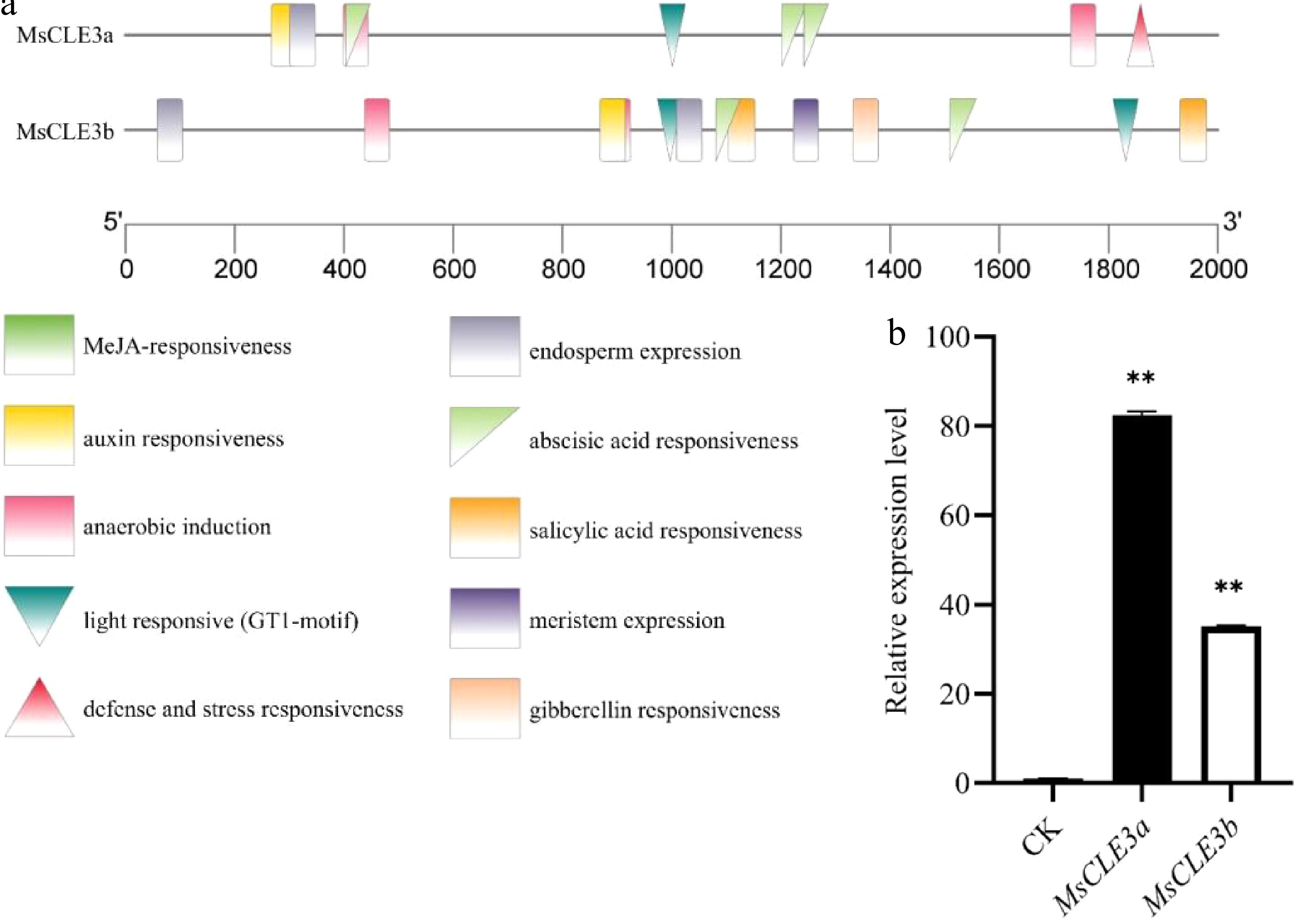
Figure 1.
Promoter analysis and salt-responsive expression patterns of MsCLE3 genes in alfalfa. (a) Graphical representation of the promoter sequences of MsCLE3a and MsCLE3b. Cis-regulatory elements were predicted via the PlantCARE database, confirming the presence of the salt stress-related GT1 motif in both promoters. (b) qRT-PCR validation of MsCLE3a and MsCLE3b transcript levels in response to NaCl treatment. Gene expression was normalized to the reference gene MsACTIN2, and the relative expression in the control group (CK) was defined as 1. Bars represent the mean ± standard deviation (SD) from three independent biological replicates. Significant differences between the treatment and control groups are indicated as *p < 0.05, **p < 0.01 (t-test).
To further investigate the response of MsCLE3 genes to salt stress in alfalfa, we examined their expression patterns under NaCl treatment. qRT-PCR analysis revealed that the expression levels of MsCLE3a and MsCLE3b were significantly upregulated by more than 80-fold and 30-fold, respectively, under salt stress (Fig. 1b). These results indicate that both MsCLE3 genes are highly responsive to salt stress, with MsCLE3a playing a major role in this response.
MsCLE3a negatively regulates photosynthesis in alfalfa under salt stress
-
The upregulation of MsCLE3a expression under salt conditions suggests that this gene may play a critical role in the regulation of salt stress tolerance in alfalfa. To analyze the biological function of MsCLE3a under salt stress, a previously generated mscle3a mutant, created via clustered regularly interspaced short palindromic repeat (CRISPR)/CRISPR-associated protein 9 (Cas9)-mediated knockout, was utilized. Under normal growth conditions, no phenotypic differences were observed between the WT and the mscle3a mutant. However, after salt stress treatment, WT plants exhibited pronounced symptoms, including leaf wilting, yellowing, and apex bending, whereas the mscle3a mutant showed only mild leaf wilting and maintained upright apices (Fig. 2a). Moreover, under salt stress, the plant height, root length, and fresh weight of the mscle3a mutant was significantly greater than those of the WT (Fig. 2b–d). These results suggest that MsCLE3a negatively regulates alfalfa's resistance to salt stress.
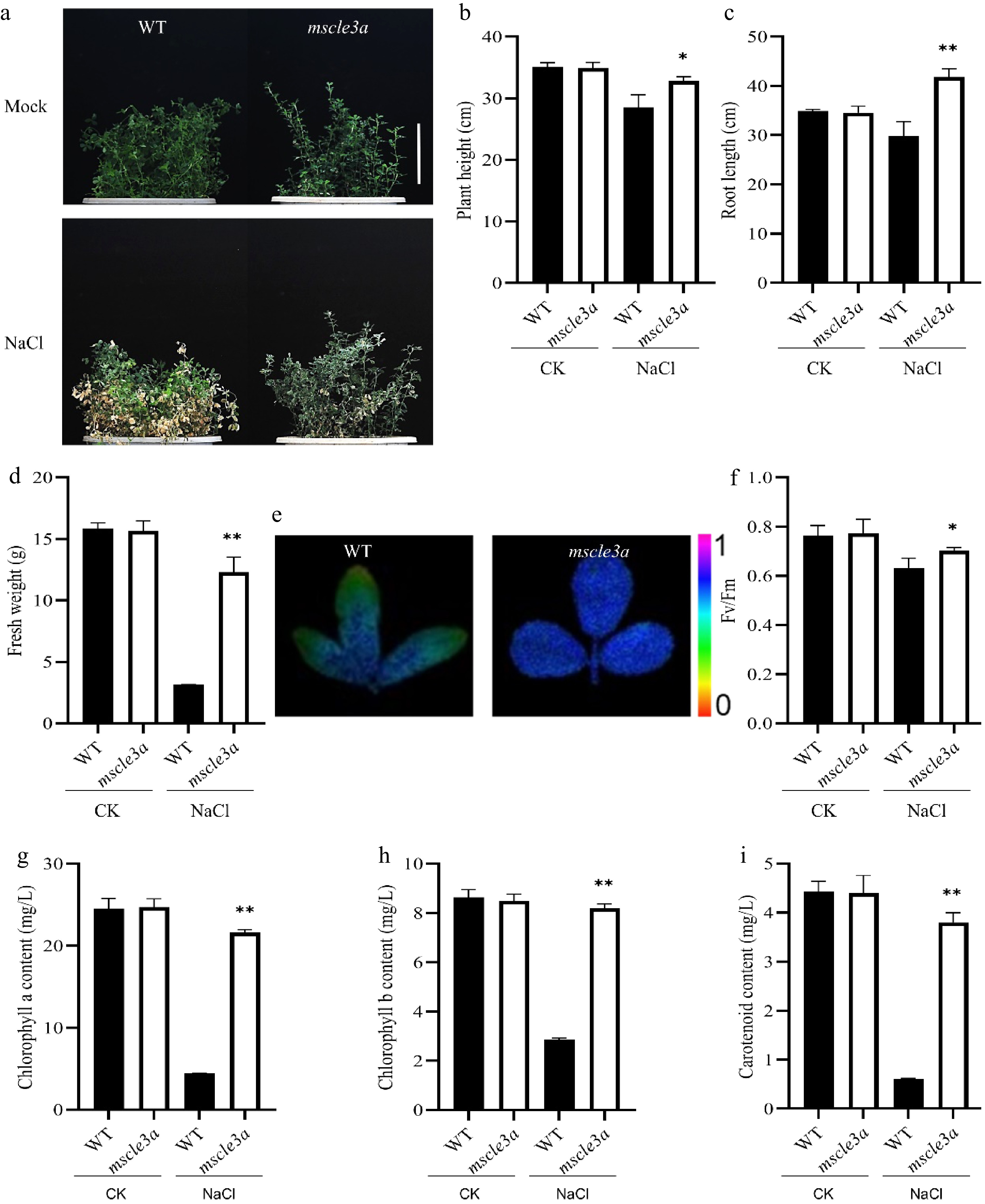
Figure 2.
The mscle3a mutant of alfalfa has enhanced salt stress tolerance. (a) Phenotype of rooted cuttings of WT and mscle3a mutant alfalfa before and after salt stress treatment. The mutant exhibited stronger salt tolerance. Bar = 10 cm. For (b)–(d) and (f)–(i), data were obtained from both WT and the mutant under control (CK) and NaCl conditions. (b) Plant height. (c) Root length. (d) Fresh weight. (e) Chlorophyll fluorescence imaging under NaCl treatment (purple: highest Fv/Fm; red: lowest). (f) Fv/Fm values. (g) Chlorophyll a content. (h) Chlorophyll b content. (i) Carotenoid content. Bars represent the mean ± SD from three independent biological replicates. Significant differences between treatment and control are indicated by * p < 0.05, ** p < 0.01 (t-test).
Salt stress is known to disrupt photosynthetic homeostasis, primarily by reducing stomatal conductance, and the Fv/Fm ratio has been widely used to evaluate photosynthetic efficiency under biotic and abiotic stresses. To further investigate the role of MsCLE3a in alfalfa's salt stress response, we measured a series of photosynthesis-related physiological parameters. The results showed that the Fv/Fm ratio of the mscle3a mutant was significantly higher than that of the WT under salt stress and showed no significant difference compared with the CK (Fig. 2e, f). In addition, the contents of chlorophyll a, chlorophyll b, and carotenoids in the mscle3a mutant were significantly higher than those in the WT under salt stress (Fig. 2g–i). Collectively, these findings suggest that the mscle3a mutant maintains relatively normal photosynthetic performance by mitigating salt stress-induced photosynthetic damage.
MsCLE3a negatively regulates the antioxidant system in alfalfa under salt stress
-
Salt stress disrupts membrane integrity, leading to electrolyte leakage and the excessive accumulation of ROS. Key indicators of this stress-induced cellular damage include H2O2, O2−, MDA content, and electrolyte leakage. Histochemical staining with DAB and NBT revealed lower accumulation of H2O2 and O2− in the mscle3a mutant compared with the WT under salt stress (Fig. 3a, b). Quantitative analysis of O2− and H2O2 further confirmed this observation. (Fig. 3c, d). Moreover, under salt stress conditions, the mscle3a mutant exhibited significantly lower MDA content compared with the WT (Fig. 3e). In contrast, CAT, SOD, and APX activities were significantly higher in the mscle3a mutant (Fig. 3f–h). Consistently, electrolyte leakage in the mscle3a mutant was also significantly reduced in the mscle3a mutant (Fig. 3i). These results collectively indicate that MsCLE3a negatively regulates the antioxidant system in alfalfa under salt stress conditions.
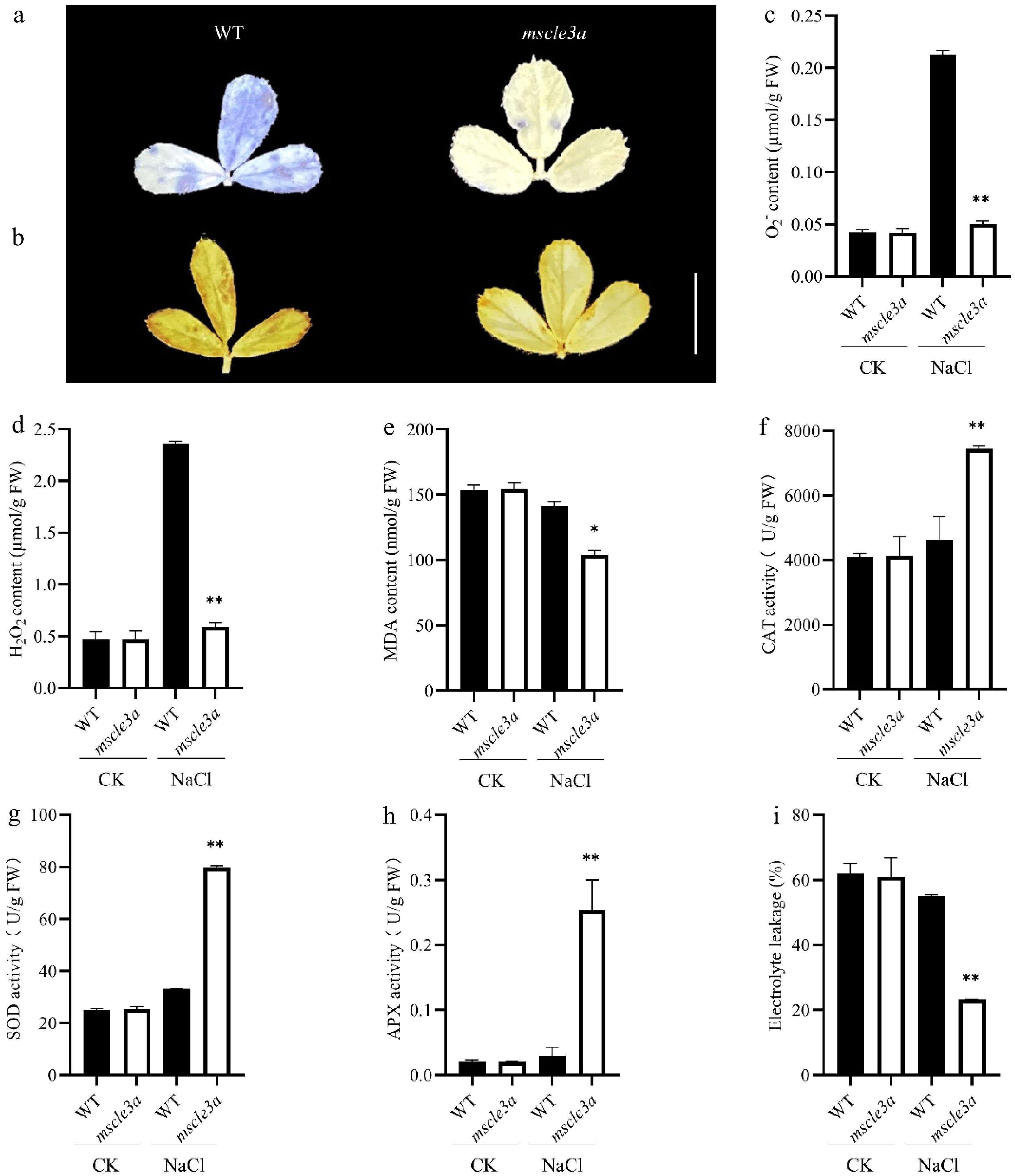
Figure 3.
ROS accumulation, antioxidant enzyme activities, and electrolyte leakage in alfalfa under salt stress. (a) NBT staining of the WT and mscle3a mutant under NaCl treatment for detecting O2−; deeper blue indicates higher O2− content. (b) DAB staining of the WT and mscle3a mutant under NaCl treatment for detecting H2O2; deeper brown indicates higher H2O2 content. Bar = 1 cm. For (c)–(i), data were obtained from both the WT and the mutant under CK and NaCl conditions. (c) O2− content. (d) H2O2 content. (e) MDA content. (f) CAT activity. (g) SOD activity. (h) APX activity. (i) Electrolyte leakage. Bars represent the mean ± SD from three independent biological replicates. Significant differences between the treatment and the control are indicated as * p < 0.05 and ** p < 0.01 (t-test).
The mscle3a mutant of alfalfa enhances salt tolerance by increasing flavonoid biosynthesis
-
To further elucidate the regulatory mechanism of MsCLE3a in alfalfa; salt tolerance, RNA-seq was performed on WT and mscle3a mutant plants. KEGG pathway enrichment analysis revealed that the upregulated differentially expressed genes (DEGs) were highly enriched in the "Flavonoid biosynthesis" pathway (Fig. 4a, b), which plays a crucial role in flavonoid production. This pathway was associated with 11 DEGs, all of which exhibited significantly elevated expression levels in the mscle3a mutant compared with WT plants (Fig. 4c). To further validate the expression patterns of genes involved in flavonoid biosynthesis, six DEGs were selected for qRT-PCR analysis. The results confirmed that key biosynthetic genes, including MsFLS and MsF3'Hc, were significantly upregulated in the mscle3a mutant (Fig. 5a–f), which was consistent with the transcriptomic data. Moreover, the flavonoid content in the mscle3a mutant was significantly higher than that in WT plants after salt treatment (Fig. 5g). These findings collectively suggest that MsCLE3a modulates salt stress tolerance, at least partly, by negatively regulating flavonoid biosynthesis.
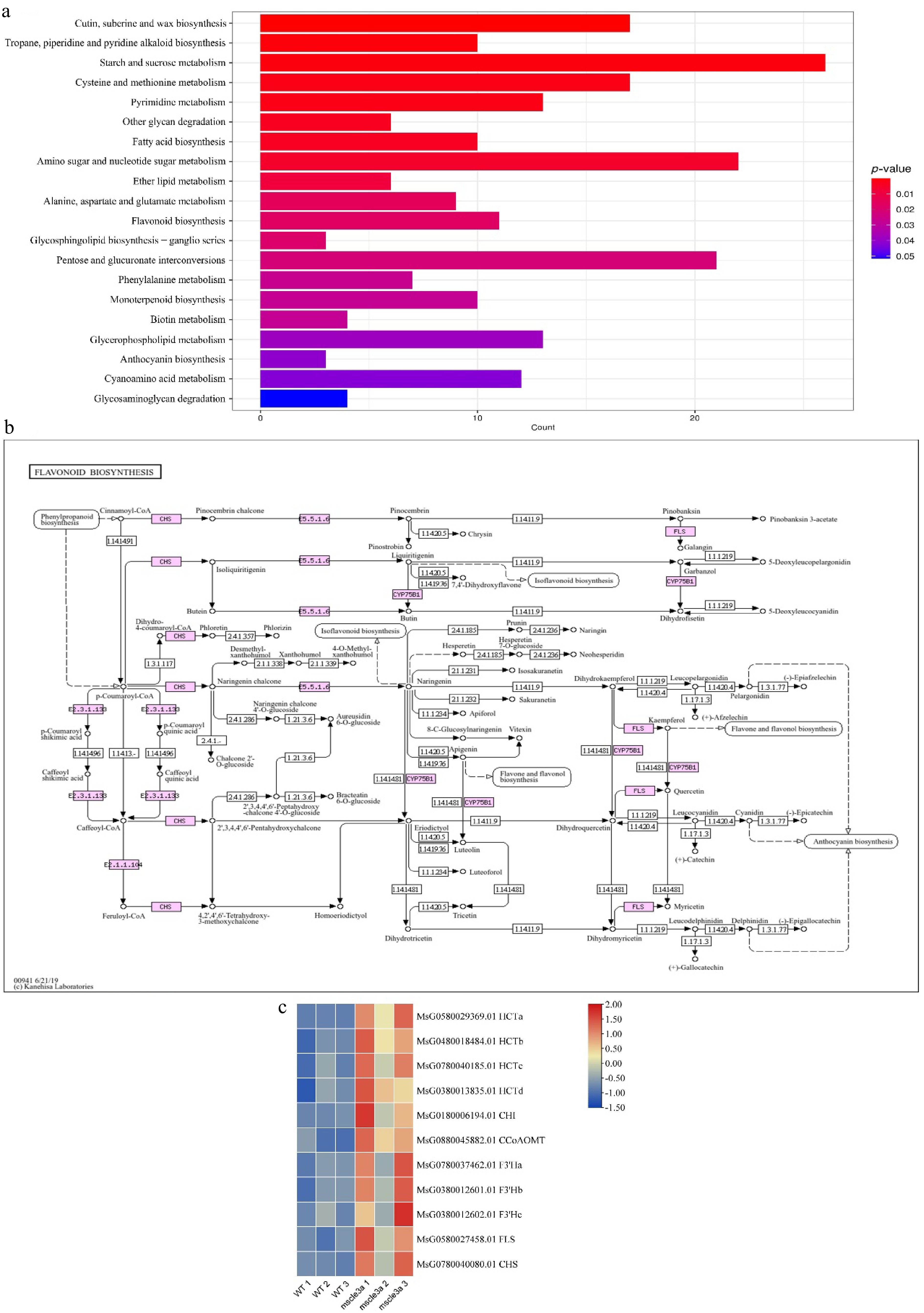
Figure 4.
Transcriptomic analyses. Upregulated DEGs are enriched in the flavonoid biosynthesis pathway. (a) Bar graph showing the upregulated DEGs enriched in KEGG pathways. (b) The flavonoid biosynthesis pathway (map00941). (c) Heatmap displaying the expression of DEGs involved in the flavonoid biosynthesis pathway. The color scale indicates high (red) and low (blue) expression levels based on fragments per kilobase of sequence per million mapped reads.
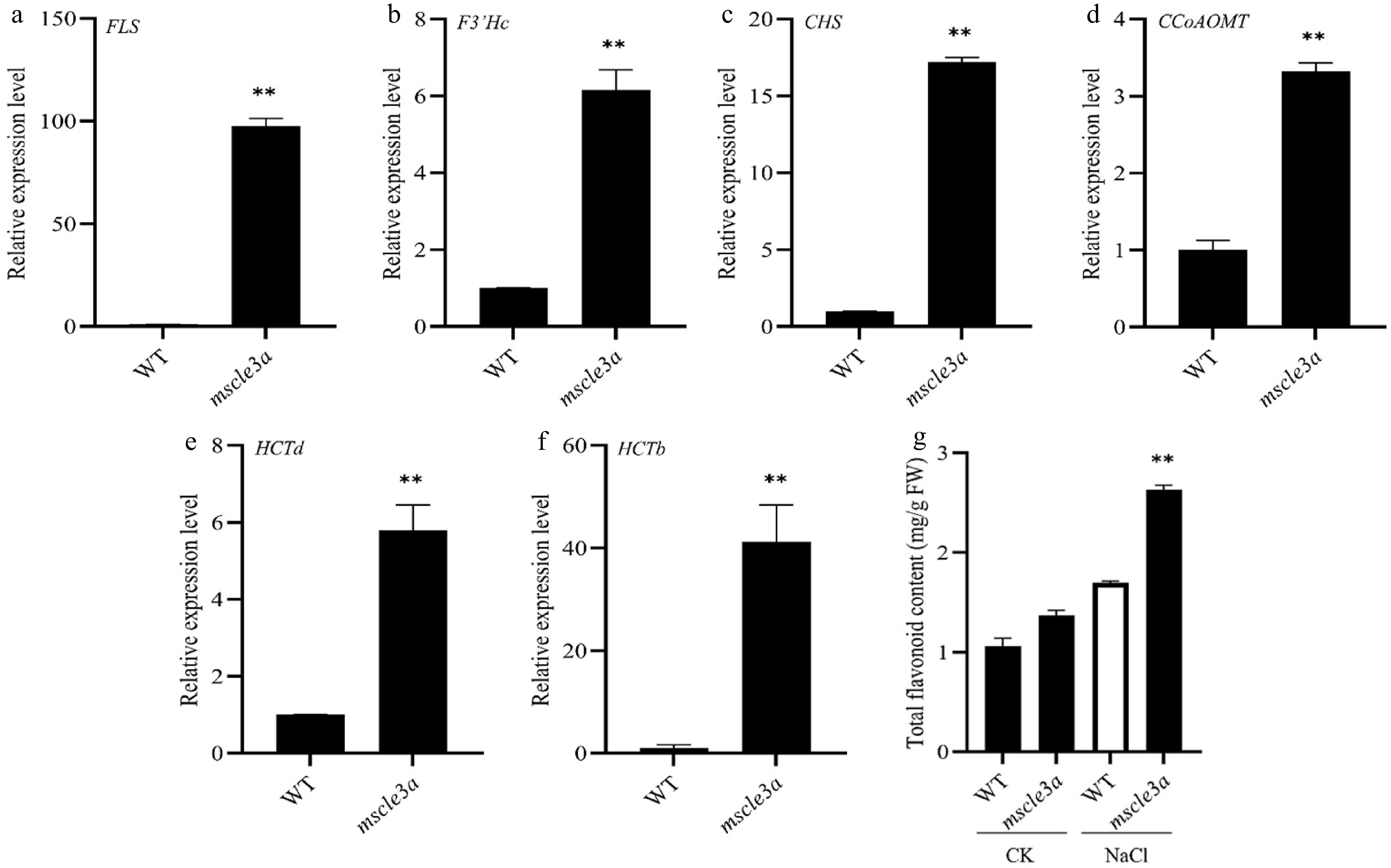
Figure 5.
Role of flavonoid biosynthesis genes in the mscle3a mutant. (a)–(f) qRT-PCR analysis of the expression of flavonoid biosynthesis genes in the WT and mscle3a mutant plants. Expression levels of individual genes were determined as follows: (a) FLS, (b) F3′Hc, (c) CHS, (d) CCoAOMT, (e) HCTd, and (f) HCTb. Gene expression was normalized to the reference gene MsACTIN2, and the relative expression in the WT was set to 1. (g) Flavonoid content in the WT and mscle3a mutant under CK and NaCl conditions. Bars represent the mean ± SD from three independent biological replicates. Significant differences between the treatment and control are indicated as *p < 0.05, **p < 0.01 (t-test). Leaf tissues were collected after continuous treatment with 300 mM NaCl for 20 d.
-
Soil salinization is a major abiotic stress factor limiting the yield and quality of forage crops such as alfalfa[41,42]. Elucidating the molecular regulatory mechanisms underlying alfalfa's salt tolerance is therefore of great significance for breeding salt-tolerant varieties via genetic engineering approaches. In this study, we demonstrated that the MsCLE3a gene negatively regulates alfalfa's salt tolerance by modulating flavonoid biosynthesis, which provides novel insights into the functional role of CLE3 in plants' salt stress responses.
CLE peptide hormones are widely known for their roles in regulating plant growth and development, such as maintaining SAM homeostasis and modulating root development. Recent studies have indicated that some members of the CLE family are involved in abiotic stress response processes[43]. For instance, MdCLE6/21 and MdCLE18 in apple (Malus domestica) are induced under high-temperature conditions, whereas cold stress enhances the expression levels of MdCLE6/21, MdCLE10, and MdCLE16 in apple seedlings[44]. In A. thaliana, AtCLE9 not only responds to high-temperature stress but also enhances plants' resistance to drought stress by inducing leaf stomatal closure[45]. In addition, AtCLE9, AtCLE5, AtCLE14, and AtCLE44 are also responsive to salt stress[45,46]. Members of other gene families also possess dual functions in modulating plants' growth and development and stress responses. Under normal growth conditions, LBD15 regulates the expression of WUSCHEL (WUS), participates in SAM development, and shapes plant architecture. Under drought stress, LBD15 is involved in ABI4-mediated ABA signaling, promoting stomatal closure and preventing water loss. Such switching between growth–development and stress responses enables plants to better adapt and survive within fluctuating environments[36]. Despite these advances, the function of CLE3 in abiotic stress responses remains largely unclear. Promoter analysis in this study revealed that both MsCLE3a and its homolog MsCLE3b contain salt-responsive cis-acting elements in their promoter regions (Fig. 1a). The qRT-PCR results also indicated that the expression of MsCLE3a was upregulated by more than 80-fold under salt stress, which was substantially higher than that of MsCLE3b, suggesting that MsCLE3a plays a predominant role in the salt stress response of alfalfa (Fig. 1b). Phenotypic analysis further confirmed that the mscle3a knockout mutant exhibited superior growth performance compared with WT plants under salt stress, as evidenced by its significantly increased plant height, root length, and fresh weight (Fig. 2a–d). It is well established that WUS activates the transcription of CLE3, and the CLE3 peptide, upon binding to the CLV1/CLV2 receptor complex, in turn represses the expression of WUS, thus constituting a negative feedback loop that maintains stem cells' homeostasis[28]. When plants are subjected to salt stress, they initiate stress defense responses by attenuating vegetative growth. The upregulation of CLE3 may represent a self-protective negative feedback mechanism in plants that constrains meristem activity by repressing WUS, shifting the balance from vegetative growth toward stress responses. Conversely, mscle3a knockout plants exhibit enhanced salt stress tolerance, indicating that MsCLE3a functions as a salt-stress-inducible negative regulator in alfalfa. This study expands the current understanding of CLE3 genes' function demonstrating that in addition to regulating plant growth and development, CLE3 genes also participate in the modulation of plants' adaptation to environmental stresses.
The photosynthetic system's stability and efficient ROS scavenging capacity are core physiological traits enabling plants to cope with salt stress[35,47]. In this study, the mscle3a mutant maintained higher Fv/Fm values and chlorophyll content than WT plants under salt stress, indicating that knockout of MsCLE3a mitigates salt-induced damage to the photosynthetic apparatus (Fig. 2e–i). Meanwhile, the mutant showed lower accumulation of ROS (H2O2 and O2−) and MDA, along with higher activities of antioxidant enzymes including CAT, SOD, and APX (Fig. 3a–h). These findings suggest that MsCLE3a negatively regulates the antioxidant system of alfalfa under salt stress, which is consistent with the physiological characteristics commonly observed in salt-tolerant plants[48,49]. Notably, the enhancement of photosynthetic and antioxidant capacities observed in the mutant laid a physiological foundation for improving salt tolerance.
As important specialized metabolites, flavonoids play a crucial role in plants' tolerance to abiotic stresses by scavenging ROS and protecting cell membranes from oxidative damage[50,51]. Previous studies have confirmed that the overexpression of flavonoid biosynthesis-related genes such as FLS and CHS can improve salt tolerance in plants including A. thaliana and alfalfa[23,24]. Transcriptomic analysis in this study showed that the significantly upregulated DEGs in mscle3a mutant were enriched in the flavonoid biosynthesis pathway (Fig. 4a–c). qRT-PCR validation further confirmed that the expression levels of key genes involved in this pathway, such as MsFLS and MsF3'Hc, were significantly upregulated (Fig. 5a–f). Consistently, the flavonoid content in the mutant was significantly higher than that in WT plants under salt stress (Fig. 5g). These results indicate that the enhanced salt tolerance of the mscle3a mutant is closely associated with the activation of the flavonoid biosynthesis pathway. Salt stress induces the upregulation of MsCLE3a, which, through the receptor-mediated signaling pathway, represses the downstream core stem cell transcription factor WUS. Previous studies in Nicotiana benthamiana have demonstrated that ZmWUS can activate the phenylpropanoid biosynthesis pathway responsible for flavonoid synthesis, thereby promoting flavonoid accumulation[52]. Knockout of MsCLE3a relieves the transcriptional repression of WUS, leading to sustained high expression of WUS, which, in turn, drives the overall upregulation of the flavonoid biosynthesis pathway. This is fully consistent with the transcriptomic enrichment results and the salt-tolerant phenotype of the mutants observed in this study. Flavonoids can directly scavenge excess ROS accumulated under salt stress, thereby alleviating membrane lipid peroxidation and maintaining cell membranes' integrity, which also explains the lower MDA content and reduced electrolyte leakage rate in the mutant. In addition, flavonoids may protect the photosynthetic system by mitigating oxidative damage, which helps the mutant to maintain stable photosynthetic efficiency under salt stress. Collectively, this study reveals the molecular mechanism by which MsCLE3a negatively regulates alfalfa's salt tolerance through inhibiting flavonoid biosynthesis, thereby establishing a functional link between the CLE signaling pathway and flavonoid-mediated stress responses.
Notably, our previous study demonstrated that MsCLE3a regulates the leaf petiole angle of alfalfa, a key agronomic trait affecting plants' architecture and light use efficiency[37]. Combined with the results of this study, MsCLE3a has dual functions in regulating both plant growth and development, as well as stress responses, implying that it may be involved in coordinating the balance between growth and salt tolerance in alfalfa. However, the specific molecular mechanism by which MsCLE3a modulates flavonoid biosynthesis remains to be explored. Future research should focus on screening the downstream target genes of MsCLE3a to elucidate the specific molecular mechanism underlying MsCLE3a-mediated regulation of flavonoid biosynthesis. In addition, field trials are required to evaluate the salt tolerance and agronomic traits of the mscle3a mutant under natural saline–alkaline conditions, thereby providing a theoretical basis for the application of MsCLE3a in molecular breeding of alfalfa. In conclusion, this study confirms that MsCLE3a negatively regulates salt tolerance in alfalfa by inhibiting flavonoid biosynthesis, thus providing a key target gene for breeding salt-tolerant alfalfa cultivars. This research enriches the current understanding of the CLE3 gene's function in plant abiotic stress responses and lays a foundation for further exploration of the coordinated regulatory mechanisms underlying plant growth and stress tolerance.
-
This study reveals that MsCLE3a functions as a major negative regulator of salt tolerance in alfalfa. Among two CLE3 paralogs, MsCLE3a is drastically induced over 80-fold by salt stress and carries conserved salt-responsive cis-elements in its promoter. CRISPR/Cas9-mediated knockout of MsCLE3a produces no developmental defects under normal conditions but substantially improves plant growth, photosynthetic stability, antioxidant activity and membrane integrity under high salinity, accompanied by lowered reactive oxygen species and malondialdehyde accumulation. Transcriptome and metabolite analyses demonstrate that the mutant's salt resilience relies on activated flavonoid biosynthesis: core flavonoid structural genes are markedly upregulated, leading to elevated total flavonoid contents that eliminate salt-triggered oxidative damage. This work expands CLE3's function from meristem development to abiotic stress modulation and builds a novel connection between CLE peptide signalling and flavonoid stress defence. MsCLE3a serves as a valuable genome-editing target for breeding salt-tolerant alfalfa, with further field trials and molecular cascade dissection warranted.
-
The authors confirm their contributions to this study as follows: experiments design and results analysis: Sun X, Duan Y; participating in most of the experiments: Li H, Li C; writing the manuscript: Li H, Pedro G; the project conception, plan, and supervision: Duan Y, Sun X. All authors discussed the results, provided feedback on the manuscript, and approved the final version of the manuscript.
-
The raw RNA-sequencing data reported in this paper have been deposited in the Genome Sequence Archive (GSA) of the National Genomics Data Center, under the accession number CRA025285. All other data generated or analyzed during this study are included in this published article and its supplementary information files.
-
The authors declare that they have no conflict of interest.
-
accompanies this paper online at: https://doi.org/10.48130/grares-0026-0022.
- Supplementary Table S1 The primer sequences of qRT-PCR.
- Copyright: © 2026 by the author(s). Published by Maximum Academic Press, Fayetteville, GA. This article is an open access article distributed under Creative Commons Attribution License (CC BY 4.0), visit https://creativecommons.org/licenses/by/4.0/.
-
About this article
Cite this article
Li H, Li C, Pedro GC, Duan Y, Sun X. 2026. Functional loss of MsCLE3a improves salt tolerance in alfalfa by regulating flavonoid biosynthesis. Grass Research 6: e029 doi: 10.48130/grares-0026-0022 

Functional loss of MsCLE3a improves salt tolerance in alfalfa by regulating flavonoid biosynthesis
- Received: 03 May 2026
- Revised: 11 July 2026
- Accepted: 24 July 2026
- Published online: 09 October 2026
Abstract: Soil salinization severely restricts the productivity of alfalfa (Medicago sativa L.), one of the most economically valuable forage crops worldwide. In this study, we investigated the function and regulatory mechanism of MsCLE3a in mediating salt tolerance in alfalfa. Promoter sequence analysis identified conserved salt-responsive cis-acting elements in MsCLE3a and its homolog MsCLE3b, with MsCLE3a showing more than an 80-fold upregulation under salt stress, indicative of its predominant role in the salt stress response. Physiological assays demonstrated that the mscle3a knockout mutant exhibited superior growth performance, higher photosynthetic efficiency, and enhanced antioxidant capacity compared with wild-type plants under salt stress conditions. Furthermore, transcriptome profiling combined with metabolite quantification revealed that the enhanced salt tolerance of the mutant was tightly associated with the activation of the flavonoid biosynthesis pathway and the subsequent flavonoid accumulation. Collectively, our findings indicate that MsCLE3a negatively regulates alfalfa's salt tolerance in association with reduced flavonoid accumulation, thereby providing a promising target for breeding salt-tolerant alfalfa cultivars.
-
Key words:
- CRISPR/Cas9 /
- Medicago sativa /
- MsCLE3a /
- Salt stress tolerance /
- Flavonoid biosynthesis