











-
Rice is one of the most important staple food crops worldwide. It provides sustenance to the majority of people and plays a vital role in ensuring food security, and supporting the livelihoods of local communities[1]. Rice is cultivated in a wide range of ecosystems ranging from uplands to submerged areas, especially those having with high humidity, warm and prolonged sunlight, and a considerable amount of water supply. Therefore, tropical regions contribute significantlly to global rice production[2,3]. Asia is the largest producer and consumer of rice[4], with South Asian countries like India, Bangladesh, Nepal, and China contributing significantly in terms of varietal diversity, production, and consumption[5,6].
Among the rice-cultivating countries in South Asia, Nepal also has extensive rice cultivation, spanning from lowland Tarai to the mid-hills across the country[1]. Some of the accessions like Jumli Marshi has been found to be grown up to an altitude of 3,050 meters above sea level (masl). Approximately 1.47 million hectares of land in Nepal is occupied by rice cultivation[7], which accounts for over 50% of the total calories consumed by the population[8,9]. Nepal has thousands of rice landraces that are adapted to the country's diverse microclimatic zones[10,11]. As reported, there are about 8,389 rice accessions in Nepal[12,13], and among them, 2,500 are reported as the landraces[12]. These landraces are integral to the sociocultural life of local farmers in the country[14].
Rice landraces exhibit rich natural variation in morpho-agronomic traits. These have evolved over centuries to adapt to specific ecological conditions in the farmers' field with specific traits such as pest resistance, drought tolerance, and adaptability to a wide range of climatic variations[5,15]. The diversity of landraces provides valuable resources for crop breeding, enhancing genetic resilience, and adaptation to local conditions besides their contribution to nutritional, socio-economic, and cultural benefits[16]. Additionally, they can provide a better genetic pool for future rice improvement[17−19].
Although landrace is of great significance for the selection of rice varieties under harsh environments and the acquisition of parents in breeding work[20], they are at risk of extinction due to the replacement by improved varieties[10,14]. The abandonment of utilizing landraces[15] has been the cause leading to genetic erosion. Several rice landraces have already become extinct in Nepal, and many others are currently endangered due to factors such as the widespread adoption of hybrids, so-called improved varieties, and changing agricultural practices[21]. This can have far-reaching consequences for the future, resulting in the depletion of genetic resources and valuable traits essential for crop resilience and adaptation[10]. Limited documentation, characterization, and awareness of the traits of rice landraces in Nepal have contributed to their neglect by local farmers. Increasing trends of less prioritization of landraces by local farmers leads to the decline of valuable traditional rice cultivars. To address this issue, more attention should be given to the promotion and conservation of such valuable genetic resources[10].
The conservation of traditional rice landraces is essential for maintaining agricultural biodiversity[22]. International frameworks, such as the International Treaty on Plant Genetic Resources for Food and Agriculture (ITPGRFA), underscore the importance of preserving these genetic resources, advocating for their conservation and sustainable use. Similarly, the Convention on Biological Diversity[23] promotes the protection of agricultural biodiversity, recognizing the need to safeguard traditional crop varieties that are integral to the cultural and ecological fabric of farming communities. Despite these global commitments, local-level assessments of rice landraces remain scarce, particularly in rural areas of middle hills, where traditional farming practices are still prevalent but face significant challenges.
While studies have estimated the presence of numerous rice landraces in Nepal[13,24], their actual distribution and the specific conditions under which they thrive have not been thoroughly explored at the community level. Recent research by Lamichhane et al.[7] draws attention to the alarming trend of declining rice self-sufficiency in Nepal, noting that rice production is becoming increasingly insufficient to meet the needs of the population. This trend, driven by factors such as population growth, migration, and the encroachment of high-yielding varieties threatens the sustainability of rice farming in Nepal. In this context, this study has been focused on one village (Kramdi), where rice cultivation has prevailed for generations in the Syangja District of Gandaki Province, Nepal. The main question of the present study was: What is the current state of rice cultivation, production, and its challenges? Such assessment can help illuminate the specific dynamics at play in the mid-hills, offering a clearer picture of how indigenous rice varieties are being managed, and potentially providing a roadmap for conservation strategies tailored to a local context.
-
The study was conducted in Kramdi village, located in Phedikhola Rural Municipality in the Syangja district, Gandaki Province, Nepal (Fig. 1). The study area lies in a hilly subtropical region with dry winters and warm summers. It has a mean annual temperature of 14.5 °C and the annual rainfall is 1,589.5 mm[25]. The elevation ranges from 1,250 to 1,000 masl. The Rural Municipality has an area of 57 km2 and the total population of 10,899 resides within 3,165 households (censusnepal.cbs.gov.np). In the Kramdi village, there are 47 households (this does not include the households who have temporarily migrated to nearby cities).
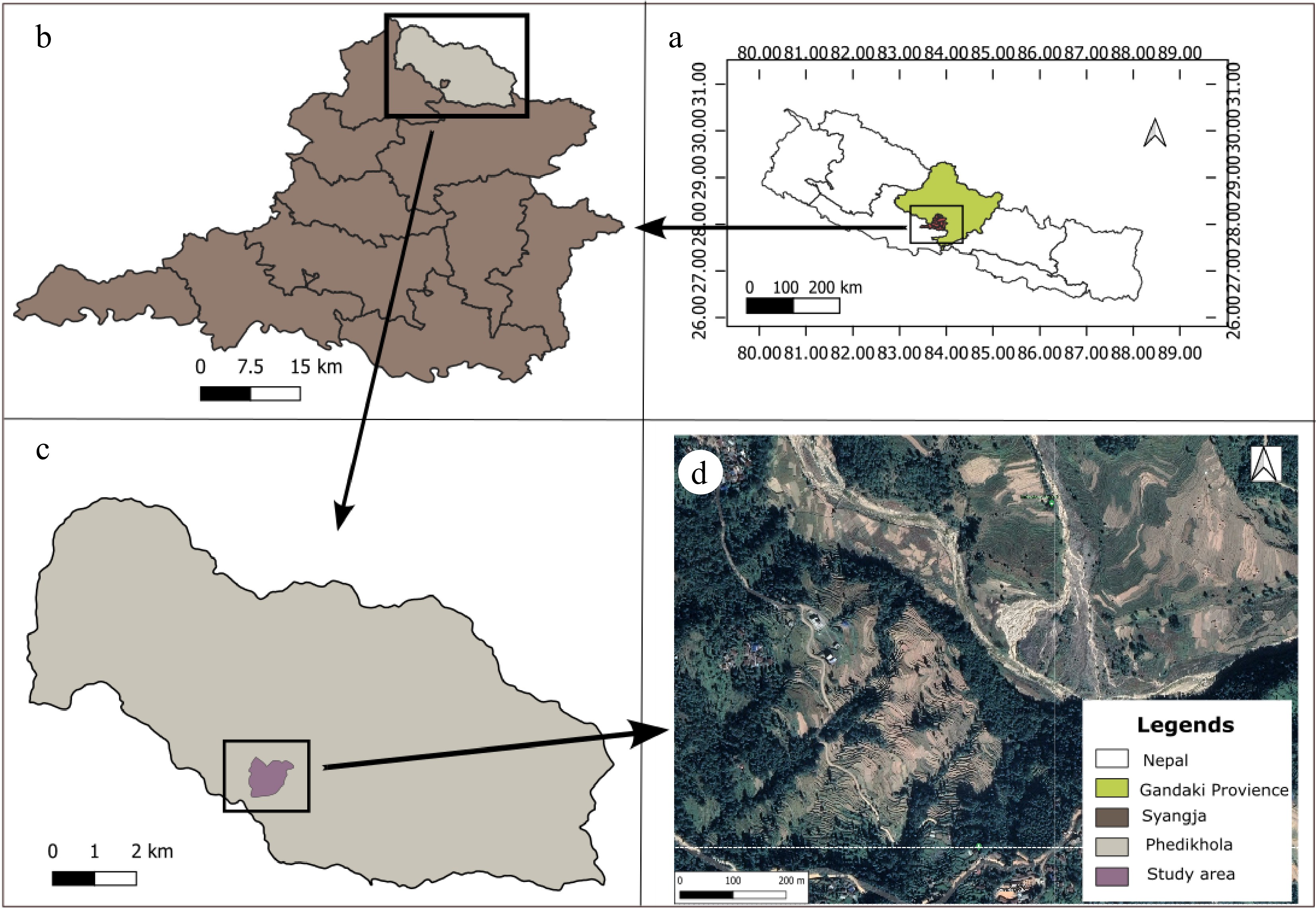
Figure 1.
(a) Map of Nepal showing Gandaki Province and Syangja district. (b) Map of Syangja district showing Phedikhola Rural Municipality. (c) Phedikhola Rural Municipality showing Kramdi village. (d) Satellite view of study area (Google hybrid, Qgis, accessed on 12/04/2022).
Field survey
-
To understand the current state of rice farming in a Kramdi village, a questionnaire survey, and focused group discussion (FGD) were carried out during December 2021 and June 2022. The questionnaire used was semi-structured and focused on topics such as the types of rice cultivated, the areas of cultivation, production levels, and perceptions on changes in rice production in the region. The household heads of the village participated in the interview. Two FGDs were carried out, each having 10 individuals, with a gender balance and a range of ages.
Farmers were asked about the land area for rice cultivation and production. The rice cultivated area mentioned by the farmers was recorded in local units 'hal' which is equals to two Ropani (0.05087 ha) (
https://dos.gov.np/tools/unit ). The rice production unit as mentioned by the farmers was 'muri' during harvest, which was converted into a kilogram unit (1 muri = 52.5 kg) (www.sizes.com/units/murhi.htm ) for consistency and standardization in weight measurement.Statistical analysis
-
One-way analysis of variance (ANOVA) was used to compare productivity among the rice accessions. Chi-square test was performed to assess the association between the choice of local farmers with landraces and introduced varieties of rice as well as gender with the use of rice varieties. The software R studio was used for statistical analysis[26].
The Shannon-Wiener Index (H') was used to measure species diversity in a community[27]. It takes into account both the number of varieties and the evenness of their distribution. It is calculated using the following formula:
$ H'=-\sum(p_i \cdot \ln (p_i)) $ where, H′ = Shannon-Wiener Index (Diversity Index); pi = represents the proportion of farmers growing each variety, calculated as:
$ p_{i}=\frac{n_{i}}{N} $ where, ni is the number of farmers growing the variety and N is the total number of farmers. ln(pi) = logarithm of the proportion pi
-
From 47 households, only five households (10.63%) were not involved in rice farming. This indicates that a relatively high percentage of households in the study area are involved in rice farming (89.36% of surveyed households). Joshi et al.[12] has reported that approximately 70% of households in Nepal are involved in rice farming for their daily needs. However, 89% of households were engaged in farming, due to the persistence of subsistence agriculture and traditional agricultural practices in the area. The households that were not involved in farming mainly consisted of elderly residents or families with only one or two members currently living in the village.
Rice farming practices
-
The farmers in the study area have been practicing rice cultivation for many generations. According to the farmers, the traditional method of rice cultivation involves ploughing the field using oxen. The fields are weeded twice, once after a month of rice plantation, and again just before flowering. The rice is harvested from October to November, and the farmers thresh the rice themselves using oxen, the process is locally called 'Dain'. In recent years, some farmers have started using rotavators instead of oxen for ploughing, and the Municipality has provided subsidies to encourage this technology shift.
Adhikari[28] conducted a study on rice nursery-raising methods in Nepal, highlighting the prevalence of both wet and dry bed nurseries. Additionally, alternative methods, including dapog, modified dapog, bubble tray, and modified mat nursery, were reported in the broader Nepalese context. However, it is noteworthy that within our specific study area, only two methods of nursery preparation, namely dry ('Dhule-biu') and wet ('Hile-biu') bed nurseries, have been observed. No introduction or adoption of other improved methods has been documented in the study area as per our investigation, only traditional nursery practices were found. During the process of seed sowing, the seeds are soaked in water overnight.
A comprehensive examination of rice cultivation systems in Nepal, as documented by Bhandari et al.[29] revealed various approaches, such as winter rice, spring rice (referred to as Chaite Dhan in our study area), early rice, upland rice, main season rice (also known as Ashare-dhan in our study area), and Kharuwan. In our study we found only the prevalence of main season rice (Ashare Dhan), but in the past, this was not the case, there was bi-annual rice cultivation, known as 'Chaite Dhan' and 'Ashare Dhan'. In Ashare Dhan, the process included sowing seeds in a nursery around May or June, transplanting seedlings in June or July, and irrigating fields from nearby springs or rivers.
Varietal diversity
-
In the study area, a total of 11 rice varieties were found to be prevalent, including eight landraces and three improved varieties (Table 1). Six varieties were also recalled by farmers as having been cultivated in the past but no longer in use. The eight landraces are 'Pahale', 'Khole-jarpani', 'Gola', 'Gudura', 'Mansara', 'Gurdi', 'Kalo-anadi', and 'Pakhe-jarpani'. The three improved varieties are 'Bikase-3', 'Radha-7', and 'Kafal-tade'. The six varieties that are no longer cultivated in the study area are 'Aaga', 'Thimaha', 'Rbijado', 'Kode-Gudura', 'Koili-Dhan', and 'Marshi'. Song et al.[30] reported that local people maintain the diversity of landraces through traditional knowledge, folk seed systems, and sociocultural practices, selecting multiple landraces based on seed traits and environmental adaptability to ensure resilience and staggered harvests. The Shannon-Wiener Index (H') is found to be 1.76 (Table 2), which indicates that though the richness is relatively high, the distribution of these varieties is not even. This means that although several rice varieties are being used, a few varieties are likely dominating the area, and some are less common. This is evident by the fact that 'Gola' is preferred by 73% and 'khole-jarpani' by 34% while many varieties were only 4% (Table 2).
Table 1. List of existing varieties and those cultivated in the past but no longer cultivated.
Existing variety Varieties no longer cultivated
(extinct from studied locality)Landraces Improved Pahale Bikase-3 Aaga Khole-Jarpani Radha-7 Thimaha Gola Kafal Tade Rbijado Gudura Kode-Gudura Mansara Koili-Dhan Gurdi Marshi Kalo-Anadi Pakhe-Jarpani Table 2. Rice variety preference for cultivation in the study area and varietal diversity.
Varieties Frequency pi ln(pi) −pi ×
ln(pi)Household
(%)Bikase-3 2 0.02532 −3.6763 0.09307 4.26 Gudura 2 0.02532 −3.6763 0.09307 4.26 Gurdi 2 0.02532 −3.6763 0.09307 4.26 Kafal Tade 2 0.02532 −3.6763 0.09307 4.26 Pakhe Jarpani 2 0.02532 −3.6763 0.09307 4.26 Radha-7 2 0.02532 −3.6763 0.09307 4.26 Kalo Anadi 3 0.03797 −3.2708 0.12421 6.38 Mansara 3 0.03797 −3.2708 0.12421 6.38 Gola 11 0.13924 −1.9716 0.27452 23.4 Khole-Jarpani 15 0.18987 −1.6614 0.31546 31.91 Pahele 35 0.44304 −0.8141 0.36068 74.47 Shannon_winner diversity 1.76 100 Mallick[31] and Gupta et al.[32] speculated that there are approximately 2,000 different landraces in Nepal. Later, Upreti et al.[11] collected 2,987 rice landraces from 72 districts in the country. Dhakal et al.[24] identified 'Mansara', 'Pahale', 'Kalo-annadi', 'Marshi', and 'Aaga' as the landraces in the Tahaun and Lamjung districts. Aaga and Marshi were lost from the study area (Table 1). Dhakal et al.[24] also reported the landraces 'Aaga' and 'Marshi' from the Rainas Municipality of Lamjung district, Gandaki Province, Nepal. Rijal et al.[10] identified 'Gurdi', 'Pahale', and 'Mansara' as landraces that were widely grown in Pokhara, a city near the study site. They also reported that 'Gola' and 'Pahale' were grown in favourable environments, while Gudura is grown in stress environments, and Gurdi has a wider range of environments in which it can be grown. They also stated that 'Mansara' is used in festivals and 'Gurdi' is used on special occasions, especially for guests.
Joshi[33] identified 48 rice varieties as endangered landraces in Nepal and 105 rice varieties as lost. Among them, 'Pahale' and 'Gudura' were listed as endangered varieties. However, in our study area, we observed that 'Gudura' is on the verge of extinction, while 'Pahale' is a popular variety (Table 1). Similarly, 'Thimaha' and 'Koili-dhan', which were lost in our study area, are also listed as lost varieties in Nepal[33]. 'Marshi' which is listed as one of the endangered varieties[33] is reported as a lost variety in the study area.
'Radha-7', 'Bikase-3', and 'Kafl-tade' are also reported as improved varieties present in the study area (Table 1). 'Radha-7' is an improved rice variety that is prevalent in the Pokhara which was released in Nepal in 1991[12]. The name of the variety 'Kafal-tade' resembles a landrace, however, according to the perceptions of farmers, it is an improved variety that was imported from the district headquarters of Syangja district.
Preference of variety
-
Among the 11 rice varieties prevalent in the study area, the most preferred variety was 'Pahale', with 74.47% of surveyed households cultivating it. This is followed by 'Khole-Jarpani' and 'Gola' which were also preferred among farmers in the study area (Table 2). Rijal et al.[10] claimed that 'Gola' is not preferred, but we observed that 'Gola' is one of the widely preferred varieties in our study area as a significant number of households were cultivating these varieties. According to chi square test, no association of the variety with gender was found (χ2 = 24.58, df = 22, p-value = 0.317) and there was no association between households using landraces and improved varieties (χ2 = 2.01, df = 1, p-value = 0.156). This indicates that the choice of rice varieties is not influenced by gender, and the decision to use landraces is not influenced by whether or not a household uses improved varieties.
Cultivated land area
-
The results of our study on rice farming in Karamdi village show that rice is being cultivated in 11.55 ha (Table 3). The most commonly cultivated variety 'Pahale', covers a total of 6.04 hectares followed by 'Gola' and 'Khole-Jarpani' (Table 3). The other varieties, such as 'Gudura', 'Gurdi', and 'Kalo-Anadi' are being cultivated on a smaller scale, each covering less than 3% of the total cultivated area (Table 3). This information indicates that the main focus of rice farming in the region is on the 'Pahele' variety, with a significant amount of land also dedicated to 'Gola' and 'Khole-Jarpani'.
Table 3. Rice cultivated land area, production, and yield of different varieties.
Name of variety No. of households Cultivated land area (ha) Total production (tons) Yield (tons/ha)
± SELandraces Gola 11 1.8288 3.2 1.824 ± 0.112 1.827 ± 0.008 Gudura 2 0.2032 0.498 2.454 ± 0.129 Gurdi 2 0.2032 0.525 2.583 ± 0 Kalo-Anadi 3 0.0254 0.0131 0.516 ± 0 Khole-Jarpani 15 2.286 4.41 1.831 ± 0.15 Mansara 3 0.1778 0.236 1.205 ± 0.172 Pahele 35 6.0452 11.76 1.973 ± 0.089 Pakhe-Jarpani 2 0.1016 0.052 0.775 ± 0.258 Improved Bikase-3 2 0.2032 0.525 2.842 ± 0.465 2.440 ± 0.090 Kafal Tade 2 0.2032 0.525 2.583 ± 0.103 Radha-7 2 0.254 0.472 1.894 ± 0.172 Total 47 11.5316 22.2161 1.862 ± 0.150 Our research in Karamdi' village aligns with existing literature on regional rice cultivation, revealing the dominance of 'Pahale', 'Gola', and 'Khole-Jarpani' varieties. This pattern is in line with the study of Bajracharya et al.[34] where they observed that only a few landraces (5%−17%) were commonly grown and in a large areas. These findings indicate a pattern of agricultural preferences and adaptability rooted in local ecological factors. This suggests that the preference for particular varieties is not unique to Karamdi, but rather reflects a recurring trend seen across different regions in Nepal.
Rice production
-
The total annual production of rice in the study area was approximately 22.2 tons (Table 3). On average, each household in the area produces 0.47 tons of rice per year. The rice production per household in our study area is far less than the rice production per household in Rauthat district which is 4.47 tons[35], this difference is attributed to topographic and agro-climatic differences. The highest amount of rice produced in the study area is of the 'Pahele' variety, followed by 'Khole-Jarpani', and 'Gola'. The average yield of rice was 1.86 ± 0.15 tons/ha, with improved varieties yielding higher (2.44 ± 0.09) t/ha than landraces (1.83 ± 0.01) on average (Table 3). This information provides insight into the current state of rice production in the region and can be useful for identifying potential areas for improvement and increasing overall yields. The total production of rice landraces is more than improved variety in the study area because more households were cultivating them (Table 3). However, ANOVA revealed that there is no significant difference in average production among the varieties (Table 4).
Table 4. Analysis of Variance (ANOVA) for production among rice varieties.
Df Sum of square Mean square F-value p-value Variety 10 9.12 0.8287 1.052 0.413 Residuals 63 49.62 0.7876 State of rice subsistence
-
The rice subsistence in the study area shows that a majority of households (63.83%) face insufficiency in their rice production. Of these, 14.89% and 27.66% reported having enough for less than 6 months and 6−9 months, respectively. A smaller number of households (21.28%) reported having enough rice for consumption for more than 9 months. On the other hand, 19.15% of households reported having sufficient rice to meet their needs for the whole year, and 6.38% reported having more than enough, allowing them to sell the surplus amount of rice in the market (Table 5). The findings concerning rice subsistence in our study area underscores a notable challenge in achieving self-sufficiency among households. This aligns with patterns observed by Choudhary et al.[36], who noted that paddy farmers achieve only 76% of their potential output in Nepal. Furthermore, the declining rice self-sufficiency ratio over time in Nepal[7,37] resonates with our results, indicating a broader trend of inadequacy in domestic rice production to meet local consumption demands. The discrepancy between rice production and consumption in our study area reflects the complexities faced by farmers across mid-hills and suggests a need for targeted strategies to enhance agricultural productivity and address the challenge of insufficient rice production.
Table 5. State of rice subsistence in the studied households.
State of rice subsistence No. of households % Fully insufficient (non-farming households) 5 10.64 Partially sufficient Enough for < 6 months 7 14.89 Enough for 6−9 months 13 27.66 Enough for > 9 months 10 21.28 Subtotal: 30 63.83 Sufficient Sufficient of family substance
(whole year)9 19.15 More than enough (selling) 3 6.38 Subtotal 12 25.53 Total 47 Reason for rice insufficiency in the study areas
-
The main reasons for the insufficiency of rice in the study area mentioned by the farmers include change in food culture (n = 30), soil erosion and flooding of productive rice fields (n = 19), lack of manpower (n = 26), and human-monkey conflict (n = 30) (Fig. 2). According to them, earlier people in the area used to consume millet, corn, and wheat, but nowadays most of them consume rice as their main staple food. This has led to an increase in demand for rice and a decrease in the availability of other grains, resulting in a situation of rice insufficiency. The study area has experienced significant soil erosion and flooding, which has reduced the amount of fertile land available for rice cultivation, according to the respondents. This has led to a decrease in the total area of rice cultivation and a decrease in the production of rice in the area. Similarly, many young people in the study area have left the village for higher education, foreign employment, or to seek employment in nearby cities. This has resulted in a lack of manpower to work in the rice fields, leading to a decrease in the production of rice. The study area has experienced significant conflict between humans and monkeys (Rheus macaques), which has led to the destruction of crops by the monkeys. This has led to the abandonment of fields and a decrease in the production of rice, as well as other agricultural activities.
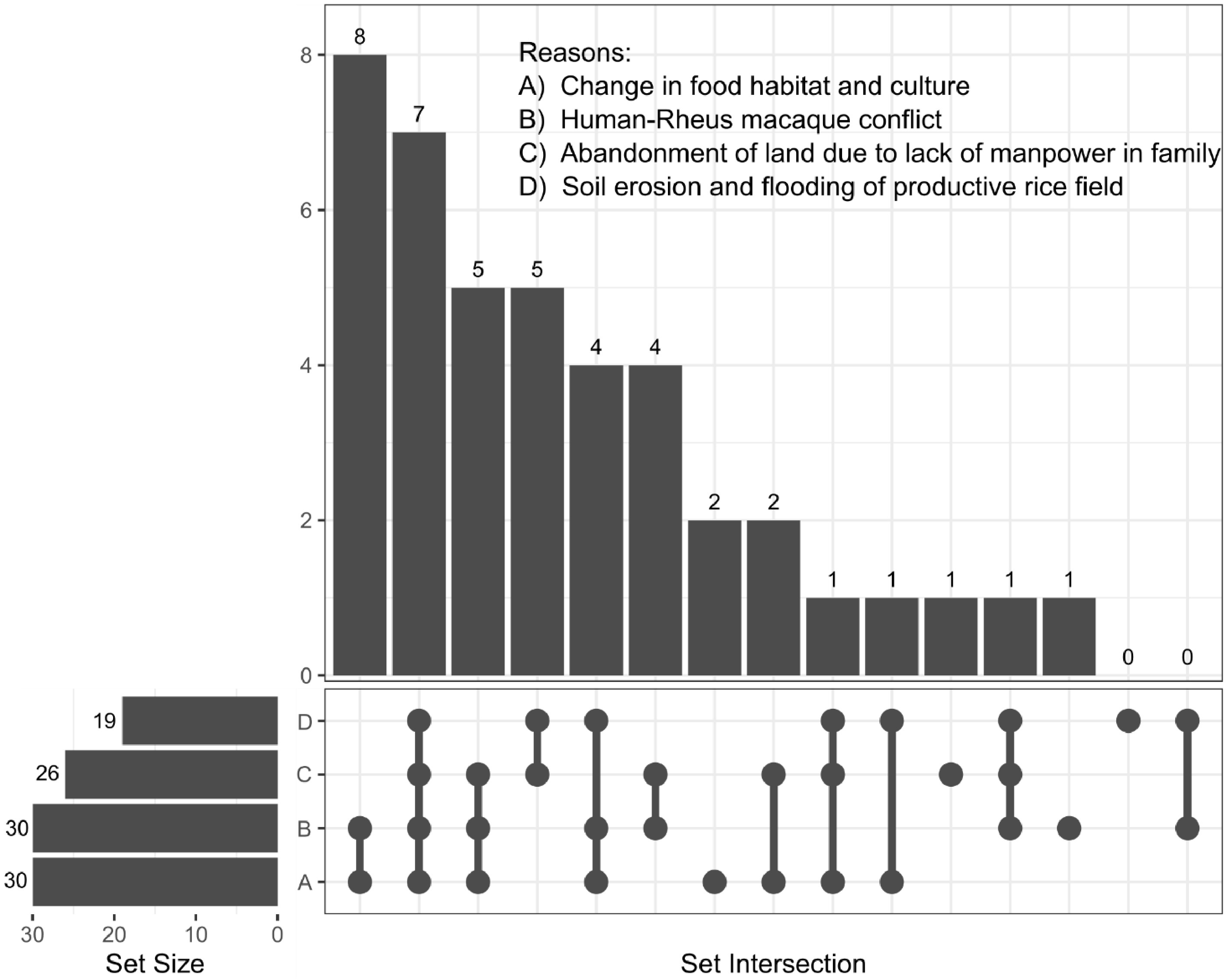
Figure 2.
Upset plot depicting the frequency of farmers citing reasons for rice insufficiency in the study area based on their perceptions. Only rice-growing households were surveyed for this question.
Rice production in Nepal has been affected by several factors, including climate change, and changes in socio-cultural aspects and food habits. About 44% of Nepal's land area contains suitable habitat for Rhesus macaques, with less than 8% of this habitat located in protected national parks[38]. The situation has reached a critical point in the hilly areas of the study site, and the local governments are concerned about it. However, no effective action has been taken so far. Further study is needed to evaluate the impact of the human-monkey conflict on food security and to develop strategies for managing it. Otherwise, it will continue to be a serious issue for food security in the area.
Some landraces are adapted to grow in areas with low nutrient levels, but the use of chemical fertilizers has caused their productivity to decline. This has led to a decrease in their cultivation in the study area. Overall, our study highlights the need for further research on the factors that contribute to the decline of landraces and the development of strategies to address these challenges.
Discrepancies between our study and the findings by Pant[39] on food insufficiency in Nepal bring forth noteworthy insights. While Pant[39] identified factors such as lack of irrigation, unavailability of modern agricultural inputs, poor market access, and absence of modern agricultural technology, our study in the local context unveils a different perspective among farmers in the study area (Fig. 2). These locally identified factors underscore the multifaceted nature of challenges faced by farmers, extending beyond the technological and infrastructural aspects emphasized in broader studies. This divergence highlights the necessity of context-specific interventions and underscores the importance of incorporating local perspectives in the design and implementation of strategies aimed at enhancing food security.
Rice import in the study area
-
The production of rice in the study area is currently inadequate to meet the needs of the population and as a result, households need to purchase additional rice from outside the area. This trend is expected to continue unless immediate action is taken to increase rice production. In a year, 47.75 quintals of rice are purchased by the villagers, at an average price of NRs. 1,800 per 25 kg. This amounts to a total annual cost of NRs. 343,800 for rice alone. On average, each household in the study area imports 101.6 kg of rice per year (Table 6). These findings highlight the need for the community to address the underlying causes of rice non-subsistence to reduce their reliance on rice imports.
Table 6. Status of rice import in the study area.
Total import Total household Total cost Average import per household 47.75 quintal 47 NRs. 343,800 101.6 kg A study by Tripathi et al.[37] found that under a scenario of high-income growth and high population growth, the demand for paddy rice in 2035 is estimated to be 10.26 million tons. This means that the required production of rice is estimated at 12.83 million tons, an increase of 185% from the current level. This finding is supported by the results of the present study, which show a need for increased rice production in the study area.
Studies have shown that rice is the major staple food in Nepal in terms of area, production, and food security for the people[16]. They also mention that Nepal is importing increasing amounts of rice to meet national demand, and the study area is facing the same problem. The present study provides further evidence of this trend and the need for effective interventions to increase rice production in the study area and reduce the reliance on imports. This is important for ensuring food security for the population and improving the overall sustainability of the rice farming system in the area.
The output of rice in Asia's main rice-growing nations has increased rapidly between 2004 and 2013[4], largely due to an increase in the amount of land dedicated to rice cultivation and increased investment in the sector. However, the perception of farmers in the study area is that the amount of land cultivated for rice has been decreasing due to a lack of manpower in families and the high cost of hiring agricultural labor. Farmers tend to only cultivate easily accessible land to minimize the cost of labor. This trend could lead to a decrease in rice production in the study area unless action is taken to address the challenges faced by farmers.
Rice and its use
-
Rice is a staple food in the study area and is used in a variety of ways. In addition to being eaten as a food, rice is also used in religious and cultural practices, such as the making of 'Homan' and 'Tika' ('Homan' involves the ceremonial burning of cereals mixed with ghee in a fire, while 'Tika' refers to the application of colored grains on the forehead, representing cultural or religious rituals). Rice husks are ground and used as feed for cattle, and straw is used to make rope and as feed for cattle. However, the use of straw ropes has declined in recent times, as they have been replaced by more durable and convenient plastic ropes. These various uses of rice demonstrate its importance in the culture and economy of the study area. The multifaceted uses of rice in our study area, align with broader documentation in Nepal[40]. While they note additional applications like fermentation and alcohol production, our study unveils unique cultural and religious uses, exemplified by the practices of 'Homan' and 'Tika'. This discrepancy emphasizes the regional diversity in the utilization of rice and suggests that the cultural significance of rice goes beyond its documented applications.
-
The findings of this study provide valuable insights into the current state of rice farming and cultivation in Kramdi village, Phedikhola Rural Municipality in the Syangja district, Gandaki Province of Nepal. Rice constitutes a major source of sustenance for the population in the area, but the production is not sufficient to meet the needs of the villagers. This situation poses a threat to food security in the area. The study area is rich in rice varietal diversity (11 rice varieties) with a landrace of eight varieties but some of these are at risk of extinction such as Mansara, and Gudura. Effective measures need to be taken to address this situation and ensure the sustainable use and conservation of the area's valuable genetic resources. This study provides valuable information on the current state of rice farming in mid-hill Nepal, which can help to ensure that appropriate conservation measures are being taken to enhance food security and support the sustainable use of the country's valuable genetic resources.
-
The authors confirm contribution to the paper as follows: study conception and design: Lamichhane N, Thapa LB; data collection: Lamichhane N; analysis and interpretation of results: Lamichhane N, Dhami U, Sharma S, Pokhrel CP, Thapa L, Yadav RKP; draft manuscript preparation: Lamichhane N, Dhami U, Sharma S, Pokhrel CP, Thapa L, Yadav RKP. All authors reviewed the results and approved the final version of the manuscript.
-
All data generated or analyzed during this study are included in this published article.
-
The authors express sincere gratitude to the local farmers who willingly participated in the questionnaire survey, focus group discussions, and assisted during field visits. Special thanks to the Central Department of Botany, Tribhuvan University, for their moral support and encouragement throughout the research process.
-
The authors declare that they have no conflict of interest.
- Copyright: © 2025 by the author(s). Published by Maximum Academic Press on behalf of Yunnan Agricultural University. This article is an open access article distributed under Creative Commons Attribution License (CC BY 4.0), visit https://creativecommons.org/licenses/by/4.0/.
-
About this article
Cite this article
Lamichhane N, Dhami U, Sharma S, Thapa LB, Pokhrel CP, et al. 2025. Farmers' perception on rice accessions in Kramdi Village of Syangja, Nepal: cultivation practices, production and challenges. Agrobiodiversity 2(1): 12−18 doi: 10.48130/abd-0025-0003 

Farmers' perception on rice accessions in Kramdi Village of Syangja, Nepal: cultivation practices, production and challenges
- Received: 14 September 2024
- Revised: 02 February 2025
- Accepted: 14 March 2025
- Published online: 28 March 2025
Abstract: Nepal has varieties of rice landraces due to its diverse topography and agroecosystems. This study assessed the rice accessions and cultivation practices with challenges faced by local farmers in the mid-hill village named Karamdi, located in Phedikhola-3, Syangja, Gandaki Province, Nepal, based on a questionnaire survey and a focus group discussion. A total of 11 rice accessions, including eight landraces and three improved were found in the study area. The most popular landraces were Pahale, Khole-Jarpani, and Gola. Annual rice production totals about 22.2 tons with a yield of 1.862 t/ha. However, according to the survey 63.83% of households report insufficient rice supply, due to changes in food culture, soil erosion, flooding, manpower shortages, and human-Rhesus macaque conflict. Villagers purchase 47.75 quintals of rice annually at NRs. 343,800. This research provides insights into rice cultivation and the challenges faced by farmers in Nepal's mid-hills.
-
Key words:
- Agrobiodiversity /
- Agroecosystems /
- Farmer's cultivars /
- Rice cultivars