












-
As a major staple crop in China, rice is conventionally cultivated under flooded conditions. Such farming systems not only consume substantial water resources but also emit considerable greenhouse gas (GHG), including carbon dioxide (CO2), methane (CH4), and nitrous oxide (N2O)[1]. Recent data indicate that GHG emissions from paddy fields contribute to roughly 48% of total agricultural GHG emissions, rendering paddy cultivation an important contributor to global climate change[2]. Therefore, exploring efficient and feasible pathways for GHG mitigation while ensuring rice yield and national food security has become a central challenge for achieving agricultural carbon neutrality. GHG fluxes from paddy ecosystems are regulated by both rice variety characteristics and field management practices[1,3]. Varietal differences in root exudate composition, radial oxygen loss, and rhizosphere microbial communities modulate soil CH4 and N2O production and consumption[3,4]. Common agricultural practices, such as water-regime management, crop rotation, and tillage, also exert profound influences on GHG emissions. Traditional continuous flooding forms a persistent anaerobic environment for methanogenic archaea, significantly boosting CH4 emissions[5]. By contrast, water-saving practices including alternate wetting-drying and intermittent irrigation reduce CH4 release through periodic adjustments of soil moisture[6]. Rice-based crop rotation optimizes GHG emission characteristics and lowers global warming potential (GWP)[7]. No-tillage and reduced-tillage practices indirectly alter GHG fluxes by improving soil structure and modulating carbon and nitrogen distribution[8]. Accordingly, combining high-yield low-emission rice cultivar selection with optimized field management is the optimal strategy for mitigating paddy-field GHG emissions, which is vital for advancing green and low-carbon agricultural development.
The next-generation dryland rice (NGDR) varieties (e.g., Dianheyou 615) are innovative hybrid rice cultivars with water-saving, drought-resistant, high-yielding, and high-quality grain traits, eliminating the reliance on flooded cultivation[9]. Their direct-seeding and rainfed cultivation system significantly reduces water and labor inputs while maintaining a high grain yield of 6–12 t·ha−1. These varieties have been widely popularized in 25 mountainous counties in Yunnan Province, covering a total planting area of 10,000 hectares. NGDR is mainly grown in mountain drylands at altitudes of 1,300–1,700 m with annual precipitation above 1,200 mm. As a critical geographic and climatic factor, altitude reshapes temperature, precipitation, and solar radiation, further altering edaphic properties, extracellular enzyme activities (EEAs), and microbial community structure. These shifts consequently regulate soil carbon and nitrogen cycling and GHG emissions[10]. Generally, temperature declines with increasing elevation and inhibits soil respiration, although this correlation is not strictly linear[11]. Soil organic carbon (SOC), a core driver of EEAs and GHG fluxes, is usually positively associated with altitude[10,12]. Elevation also strongly affects microbial biomass and activity, thereby indirectly regulating CO2 emissions[13]. It regulates CH4 fluxes by modifying soil moisture, aeration status, and microbial community composition[14], while N2O flux responses to elevation are typically nonlinear, closely associated with synergistic changes in nitrification/denitrification rates, nitrogen availability, and soil moisture[10]. Increased microbial gene abundance drives the mineralization of C, N, and P, accelerates soil organic matter (SOM) decomposition, thereby enhancing soil multifunctionality (SMF) and CH4 uptake capacity, alongside CO2 and N2O emission[15,16]. As a comprehensive index reflecting nutrient supply, material cycling, and environmental regulation, SMF is tightly coupled with GHG emissions[17]. Existing research on paddy SMF has largely focused on conventional continuously flooded paddies[18]. Nevertheless, in NGDR ecosystems along altitudinal gradients, how SMF responds to altitude, mediates GHG production, and interacts with GHG fluxes remains largely uncharacterised.
Southwest China features rugged mountain terrain with limited flat arable land and distinct altitudinal gradients, making it a major region for NGDR production. Elevational variation generates large spatial heterogeneity in field climate and soil conditions, constraining yield improvement and SMF stability for upland rice[19]. Elucidating the effects of NGDR cultivation on soil GHG emissions and SMF across elevational gradients, and identifying their driving factors, is essential for optimizing site-specific upland rice practices, enhancing soil ecological functions, and achieving synergistic development of food production with emission reduction and carbon sequestration. Accordingly, this study conducted field experiments with NGDR cultivar 'Dianheyou 615' at high and low altitudes. Soil GHG (CO2, N2O, CH4) emission fluxes were systematically measured, alongside analyses of edaphic factors, EEAs, microbial copy numbers, and SMF. We hypothesized that: (1) edaphic factors, EEAs and microbial abundance respond distinctly to elevation gradients; (2) GHG emissions exhibit discrepancies between high-altitude and low-altitude dry rice fields; (3) The core driving factors and underlying regulatory pathways of SMF and GHG emissions can be elucidated.
-
The experimental site was located in Lancang Lahu Autonomous County, Yunnan Province (22°33'21'' N, 99°55'55'' E). The area exhibits a southern subtropical mountain monsoon climate, characterised by pronounced wet and dry seasons, plentiful precipitation, abundant sunshine, mild winters, and cool summers. Local altitude ranges from 700 to 1,400 m, with an annual mean temperature of 19.2–20.0 °C and annual precipitation of approximately 1,563–1,624 mm, primarily concentrated during the rainy season from May to October. The rice variety 'Dianheyou 615' has a comprehensive drought-resistance rating of 2.5 (moderately strong drought tolerance) and a growth period of approximately 120 d. Its grain quality reaches the Grade II standard for high-quality japonica rice formulated by the Ministry of Agriculture and Rural Affairs.
For NGDR cultivation, seeds were first disinfected and then directly seeded using either a hand-push seeder or a large-scale direct-seeding machine. Sowing depth was maintained at 5–8 cm with three to five seeds per hill. Row spacing was 20–25 cm and plant spacing was 16 cm, yielding a planting density of 1.7–2.1 × 10⁴ hills per mu and a seeding rate of 30–37.5 kg·ha−1. Additionally, 15,000 kg·ha−1 of decomposed farmyard manure and 225–375 kg·ha−1 of NPK compound fertilizer were applied. NGDR sowing took place on 9 May, 2023, and harvesting was conducted on 16 October, 2023. Following planting, three replicate plots (10 m × 10 m) were established for high-altitude (1,470 m) and low-altitude (1,300 m). GHG and soil samples were collected every 3 d, yielding a total of 46 sampling campaigns. In total, 276 GHG samples and 276 soil samples were collected (3 replicates × 46 sampling campaigns × 2 altitudinal gradients).
Measurement of soil GHG fluxes
-
Soil GHG fluxes were measured in situ via the static chamber gas chromatography technique[20]. Each static chamber consisted of a cylindrical base (32 cm diameter × 15 cm height) and a removable chamber (30 cm diameter × 50 cm height). A U-shaped groove on the base secured the removable chamber, and a battery-powered micro-fan installed on the top of the chamber ensured internal air circulation[21]. On 1 May, 2023, chamber bases were embedded 10 cm deep into the soil. Subsequently, gas sampling was conducted between 9:00 and 11:00 a.m. The micro-fan was activated for 30 s after placing the chamber onto the base. Gas aliquots were then drawn at 0, 15, and 30 min. Samples were shielded from light during transport to the laboratory and analyzed within 72 h using an Agilent 4890 gas chromatograph.
Determination of edaphic factors, EEAs, and SMF
-
Soil temperature (ST) was measured in situ with a portable digital thermometer. Soil water content (SWC) was determined by oven-drying fresh soil at 100 °C for 24 h to constant weight. Soil pH was measured on a 1:5 (m/v) soil-water suspension with a glass-electrode pH meter after 30 min equilibration. Total nitrogen (TN; g·kg−1), total phosphorus (TP; g·kg−1), ammonium nitrogen (NH4+–N; mg·kg−1), and nitrate nitrogen (NO3––N; mg·kg−1) were determined using a continuous flow analyzer (Seal Auto Analyzer AA3, SEAL Analytical, Germany) following appropriate sample pretreatment. Total potassium (TK; g·kg−1) was measured by flame atomic absorption spectrophotometry (Labomed Inc., USA). Soil organic carbon (SOC; g·kg−1) was determined by the potassium dichromate (K2Cr2O7) oxidation method.
Seven EEAs involved in carbon (C), nitrogen (N), and phosphorus (P)-cycling were assayed using microplate fluorometry[22,23]. These included enzymes associated with C-cycling (β-1,4-glucosidase, BG; cellobiohydrolase, CB; α-glucosidase, AG; xylosidase, XYL), N-cycling (β-1,4-N-acetylglucosaminidase, NAG; leucine aminopeptidase, LAP), and P-cycling (acid phosphatase, AP). Fluorescent substrates based on 4-methylumbelliferone (MUB) or 7-amino-4-methylcoumarin (AMC) were employed. Briefly, fresh soil equivalent to 1 g dry weight was homogenized with 50 mL of 50 mmol·L−1 sodium acetate buffer (pH 5.0) in an ice bath for 2 min using a tissue homogenizer to prepare soil suspension. After dilution, 200 μL soil suspension was dispensed into 96-well black microplates, followed by the addition of 50 μL of the respective fluorescent substrate (βG and CB: 4-MUB-β-D-glucoside and 4-MUB-β-D-cellobioside, final concentration 500 μmol·L−1; LAP: L-leucine-7-amino-4-methylcoumarin, final concentration 200 μmol·L−1; AP: 4-MUB-phosphate, final concentration 500 μmol·L−1). Blanks (buffer + substrate), controls (soil suspension + buffer), and quench standards (MUB or AMC standard solutions) were included to correct for background interference and enable quantitative calibration. Microplates were incubated in darkness at 25 °C for specified durations (βG and AP: 4 h; CB: 12 h; LAP: 2 h). Fluorescence was then measured using a multifunction microplate reader (Tecan Infinite M200 Pro, Switzerland) at excitation and emission wavelengths of 365 and 450 nm, respectively. EEAs were expressed as nanomoles of fluorescent product released per gram of dry soil per hour (nmol·g−1·h−1)[24,25].
In total, 16 ecosystem-function indicators, including seven EEAs and nine edaphic variables, were assessed for SMF calculation. All indicators were normalised by Z-score transformation, and SMF was computed as the average of these standardised values (Supplementary Table S1).
DNA extraction and quantitative real-time PCR (qPCR) analysis
-
Soil genomic DNA was isolated from 0.5 g samples utilizing the Fast DNA Spin Kit for Soil (MP Biomedicals, USA). DNA integrity was verified via 1.0% agarose gel electrophoresis, while yield and purity were quantified using a NanoDrop 2000 spectrophotometer (Thermo Fisher Scientific, USA). Bacterial and fungal gene-copy numbers were quantified by qPCR with specific primer pairs: 338F (5'-ACT CCT ACG GGA GGC AGC AG-3') and 806R (5'-GGA CTA CHV GGG TWT CTA AT-3') for bacteria, and ITS1F (5'-CTT GGT CAT TTA GAG GAA GTA A-3') and ITS2R (5'-GCT GCG TTC TTC ATC GAT GC-3') for fungi[26]. All qPCR assays were performed on a LightCycler® 480 II Real-Time PCR System (Applied Biosystems, USA). Each 20 μL reaction contained 10 μL 2×SYBR® Green Premix Pro Taq HS qPCR kit, 0.5 μL each of forward and reverse primers (10 μmol·L−1), 1 μL DNA (50 ng·μL−1), and 8.0 μL ddH2O. The thermal-cycling conditions were as follows: initial denaturation at 95 °C for 3 min, followed by 40 cycles of denaturation at 95 °C for 10 s, annealing at 55 °C (bacteria) or 53 °C (fungi) for 30 s, and extension at 72 °C for 30 s. Standard curves were generated using 10-fold serial dilutions (10−1 to 10−7) of plasmid DNA containing the target gene fragments, yielding the equations Y = −3.493X + 41.376 (bacteria) and Y = −3.448X + 43.460 (fungi). All samples were analyzed in triplicate, and non-template controls were included in each run to exclude contamination. Amplification efficiencies for all target genes ranged from 90% to 110%, satisfying qPCR quality criteria. Gene copy numbers for bacteria and fungi were calculated based on the cycle threshold (Cq) values against the corresponding standard curves. Rather than specific functional genes, quantified 16S rRNA and ITS copy numbers served as proxies for total microbial abundance and biomass.
Statistical analysis
-
Statistical analyses and visualizations were performed using SPSS 26.0 (IBM Corporation, Armonk, NY, USA), R 4.3.1 (R Core Team, Vienna, Austria), and Origin 2021 (OriginLab Corporation, Northampton, MA, USA). Differences in edaphic properties, EEAs, microbial copy numbers, GHG fluxes, and SMF between the two altitudinal treatments were evaluated using an independent samples t-test. Spearman's correlation analysis was conducted to explore associations among GHG (CO2, N2O, CH4) emission fluxes, GWP, and edaphic factors, EEAs, microbial copy numbers, and SMF. Correlation heatmaps were plotted with the R package 'corrplot' (p < 0.05). Random forest modeling (R package 'randomForest') was applied to quantify the relative importance of environmental factors (edaphic factors, EEAs, and microbial copy numbers) for SMF.
We constructed an a priori initial theoretical structural equation modeling (SEM) framework prior to model fitting. Several paths in this model have been validated by previous studies (Supplementary Fig. S1). SEM was then conducted to elucidate the direct and indirect pathways linking edaphic properties, EEAs, copy numbers, SMF, and GHG emissions. Model fit was evaluated using the chi-square to degrees of freedom ratio (χ2/df < 3), p-value (> 0.05), goodness-of-fit index (GFI > 0.9), and root mean square error of approximation (RMSEA < 0.05). SEM construction and path decomposition were performed using Amos 26.0 software.
-
Under NGDR cultivation, cumulative fluxes at H-DR615 were 12.48 t·ha−1 for CO2, 3.53 kg·ha−1 for N2O, and −10.23 kg·ha−1 for CH4, respectively. For L-DR615, the corresponding fluxes reached 16.87 t·ha−1 (CO2), 3.05 kg·ha−1 (N2O), and 1.04 kg·ha−1 (CH4). Compared with L-DR615, H-DR615 reduced cumulative CO2 emissions by 26.03%, enhanced cumulative net CH4 by 110.18%, and increased cumulative N2O emissions by 15.53% (Fig. 1). Consequently, GWP reached 13.28 t CO2 -eq·ha−1 for H-DR615 vs 17.81 t CO2 -eq·ha−1 for L-DR615, representing a significant reduction of 25.45% under high-altitude conditions.
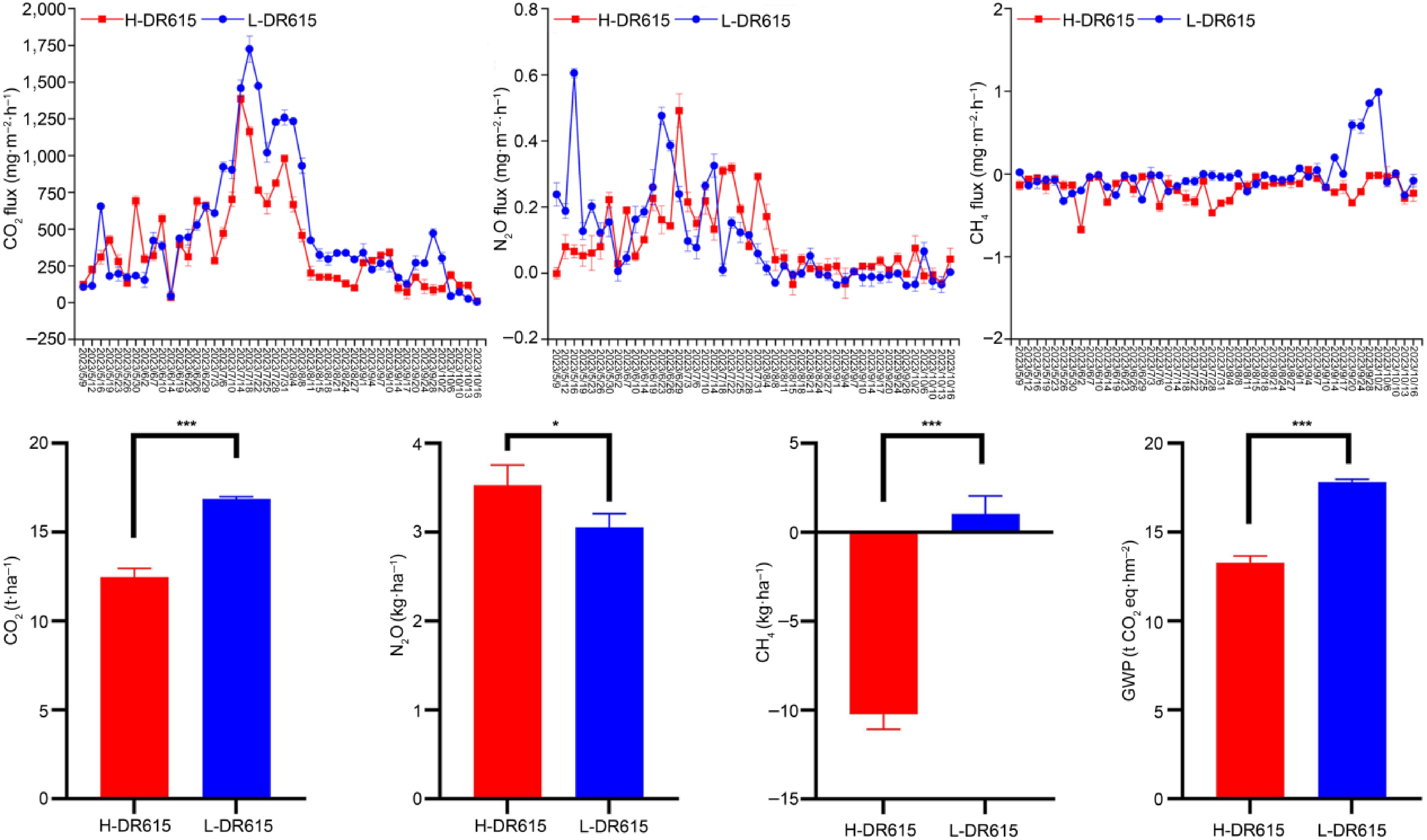
Figure 1.
Temporal dynamics of soil GHG emissions under NGDR cultivation at two altitudes (* p < 0.05, *** p < 0.001).
Changes in edaphic factors and EEAs
-
ST, pH, SWC, SOC, TN, TP, TK, NH4+–N, and NO3––N were 17−31 °C, 5.23–7.78, 5.18%–38.67%, 2.36–18.22 g·kg−1, 0.27–2.35 g·kg−1, 0.55–2.59 g·kg−1, 2.16–3.94 g·kg−1, 1.46–28.64 mg·kg−1, and 4.24–19.15 mg·kg−1, respectively. Compared with L-DR615, H-DR615 exhibited significant increases in SOC (34.95%), TN (32.16%), SWC (16.57%), TP (15.99%), ST (4.04%), and pH (2.51%). In contrast, NH4+–N, NO3––N, and TK were substantially reduced by 64.71%, 24.17%, and 10.67%, respectively (Fig. 2).
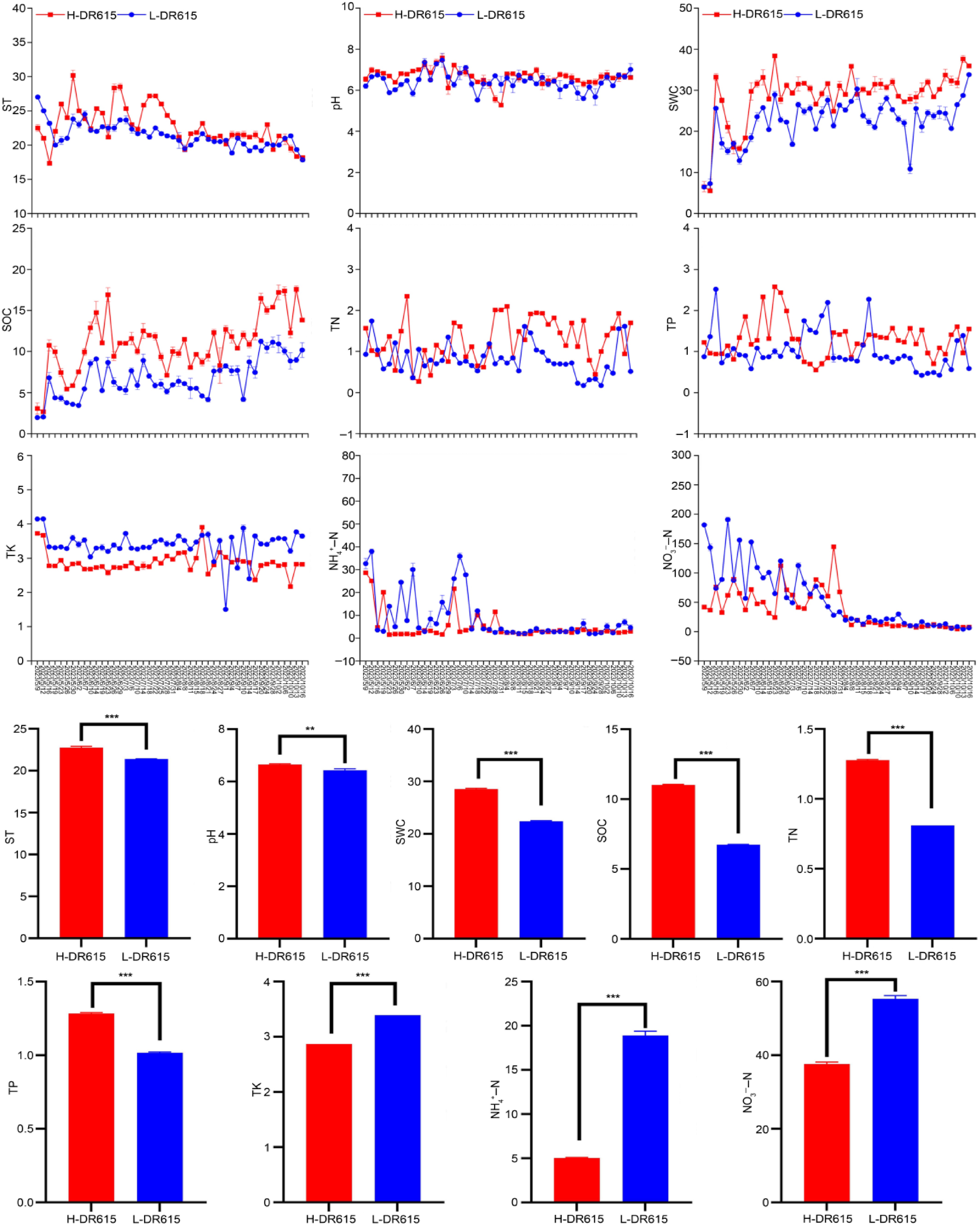
Figure 2.
Variation in edaphic properties under NGDR cultivation at two altitudes (** p < 0.01, *** p < 0.001).
Enzymatic activities involved in C-, N- and P- cycling ranged from 3.03 to 5.56, 1.41 to 5.17, and 4.59 to 7.07 nmol·g−1·h−1 respectively. The vector length and vector angle varied between 0.97–2.20 and 47.0–76.69, respectively. Compared with L-DR615, H-DR615 exhibited a 2.38% increase in P-cycling enzyme, whereas N- and C-cycling enzyme decreased by 10.90% and 1.43%, respectively (Fig. 3). Furthermore, the degree of C and P limitation was significantly enhanced in H-DR615, with increases of 11.11% and 5.84%, respectively. Neither elevation exhibited N limitation (Fig. 3).
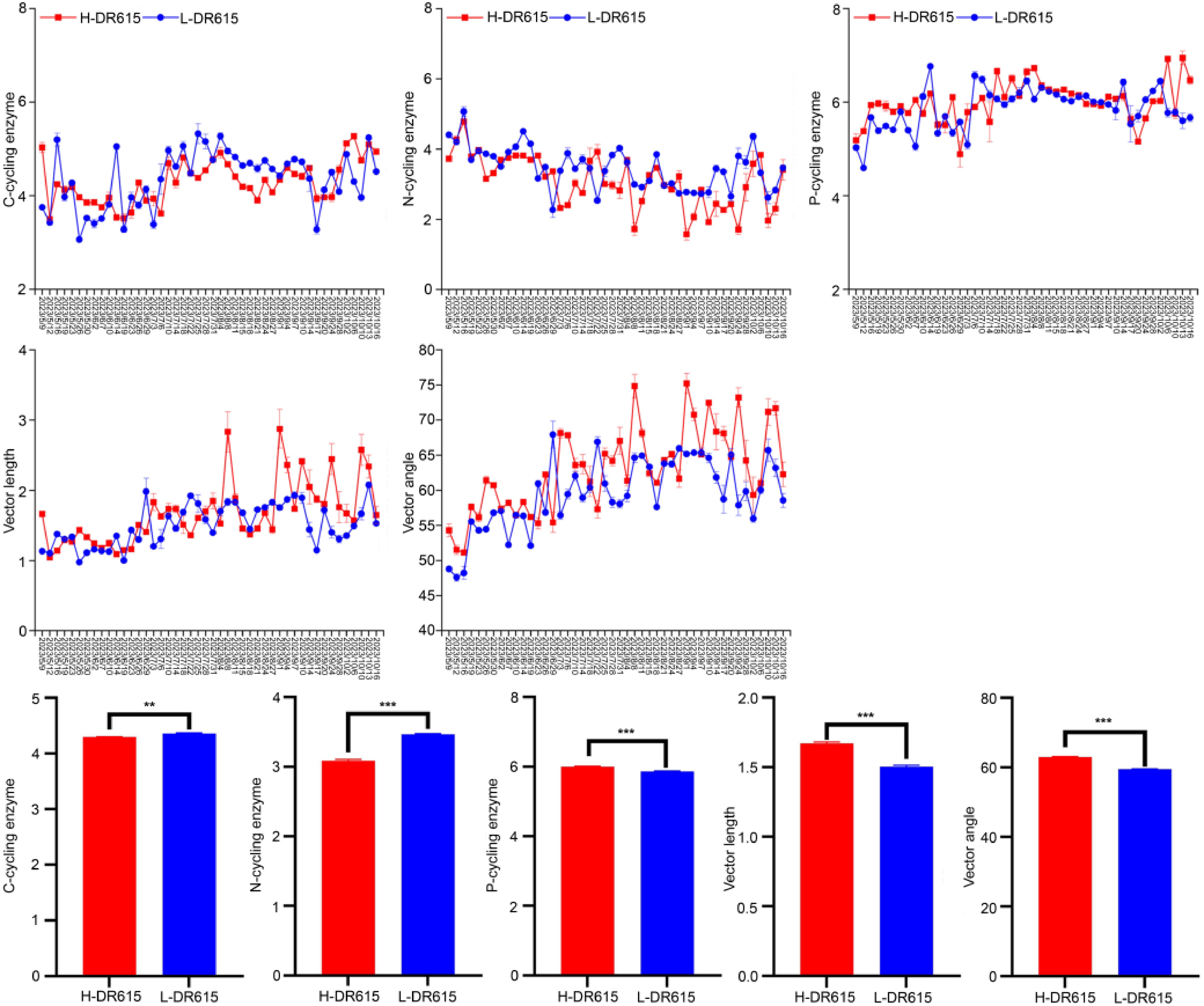
Figure 3.
Variation in EEAs under NGDR at two altitudes (** p < 0.01, *** p < 0.001).
SMF and key influencing factors
-
Calculated SMF indices were 0.59 for H-DR615 and 0.56 for L-DR615. Soil multifunctionality was significantly higher (+6.29%) under H-DR615 relative to L-DR615 (Fig. 4a). Random forest analysis indicated that SWC, SOC, TN, ST, TP and pH constituted the key predictors of SMF for H-DR615, and SWC possessed the greatest relative importance. For L-DR615, SMF was mainly governed by NO3––N, NH4+–N, TK, and C- and N-cycling enzyme, with NO3––N identified as the primary influencing factor (Fig. 4b).
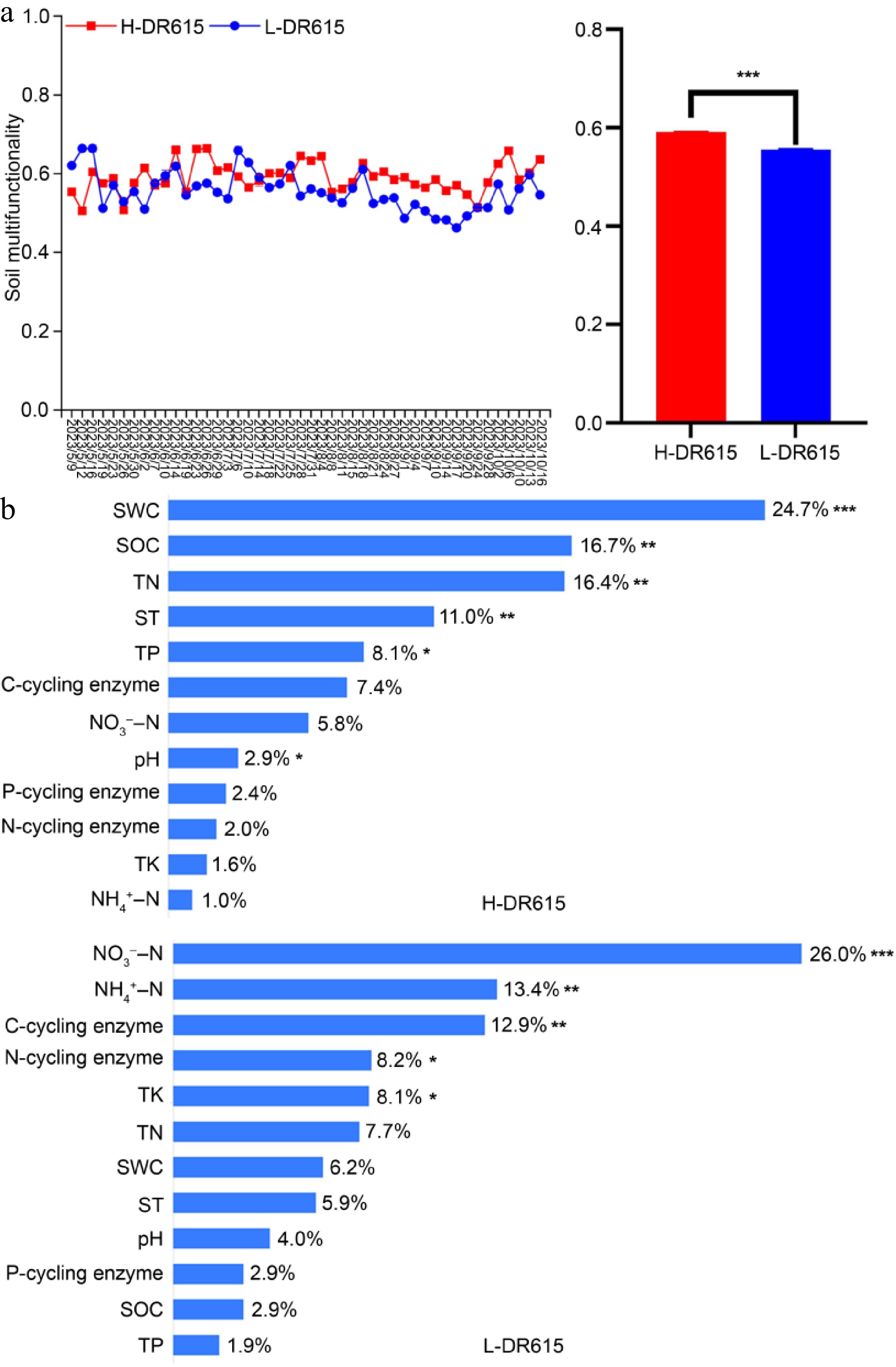
Figure 4.
Changes in (a) SMF and (b) influencing factors (* p < 0.05, ** p < 0.01, *** p < 0.001).
Changes in soil bacterial and fungal copy numbers
-
Bacterial copy numbers ranged from 3.79 × 10⁶ to 2.08 × 10⁹ across both treatments, while fungal copy numbers ranged from 1.81 × 10⁸ to 2.24 × 10⁹. Compared with L-DR615, H-DR615 significantly increased bacterial copy numbers by 38.0% and significantly reduced fungal copy numbers by 37.39% (Fig. 5).
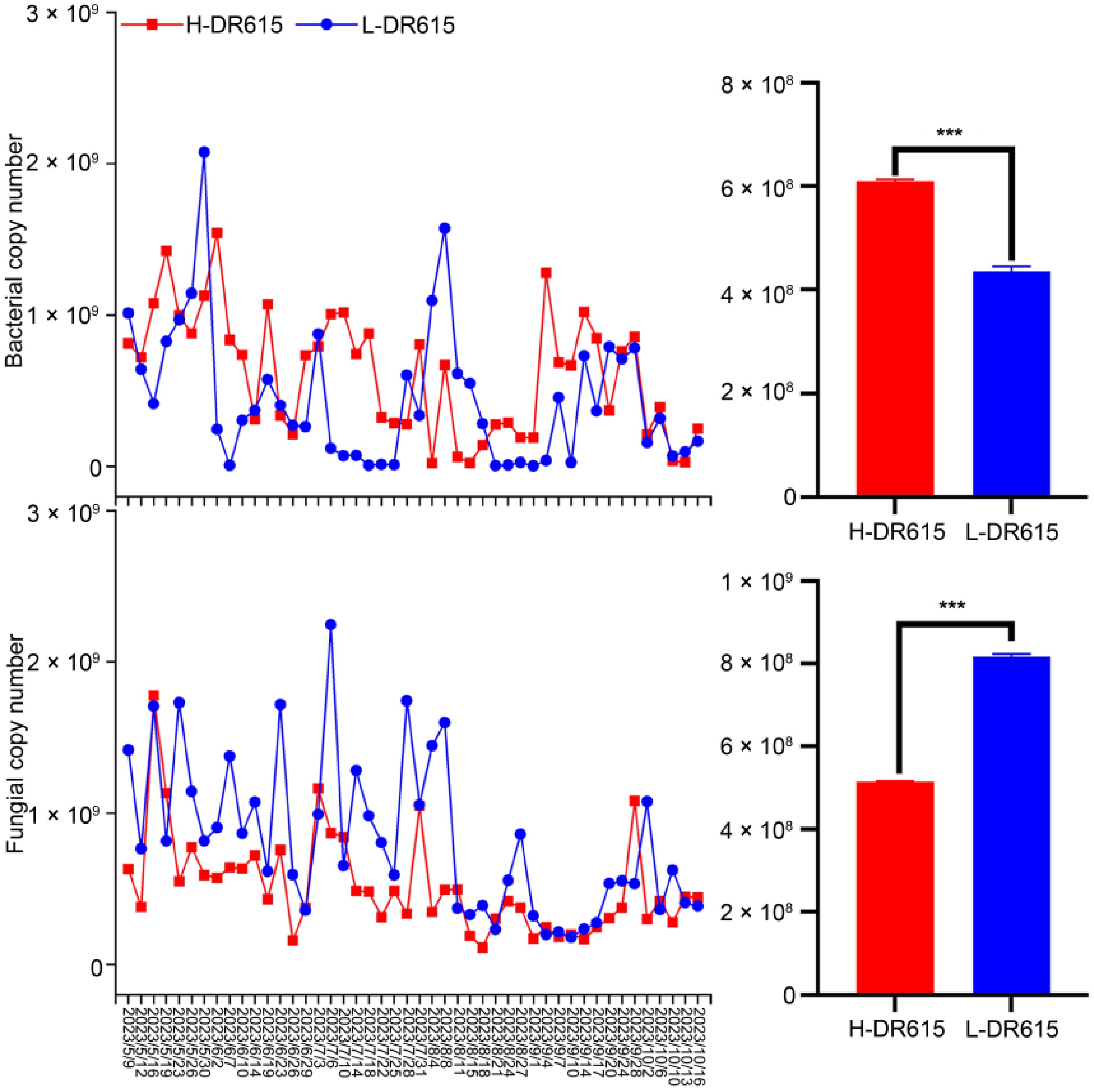
Figure 5.
Variations in soil bacterial and fungal copy numbers under two altitudinal treatments (*** p < 0.001).
Correlation and structural equation modeling analysis of GHG emissions
-
For both H-DR615 and L-DR615, GHG fluxes and GWP formed significant correlations with edaphic factors, EEAs, microbial copy numbers, and SMF (Fig. 6a). In H-DR615 soil, CO2 flux was significantly positively correlated with N-cycling enzyme activity but negatively correlated with ST and SMF. N2O flux was positively correlated with SOC, TP, and P-cycling enzyme activity. CH4 fluxes exhibited positive relationships with SWC and bacterial copy numbers. GWP was significantly positively correlated with N-cycling enzyme activity, while exhibiting significant negative correlations with ST, SWC, bacterial copy numbers, and SMF (Fig. 6a). In L-DR615 soil, CO2 flux had significant positive associations with TK and NO3––N, whereas it was negatively related to SOC. Bacterial gene copy abundance exerted a marked positive effect on N2O emissions. CH4 fluxes correlated positively with SOC and negatively with TK and NO3––N. Additionally, GWP was positively correlated with N-cycling enzyme activity and negatively correlated with SOC and P-cycling enzyme activity (Fig. 6a).
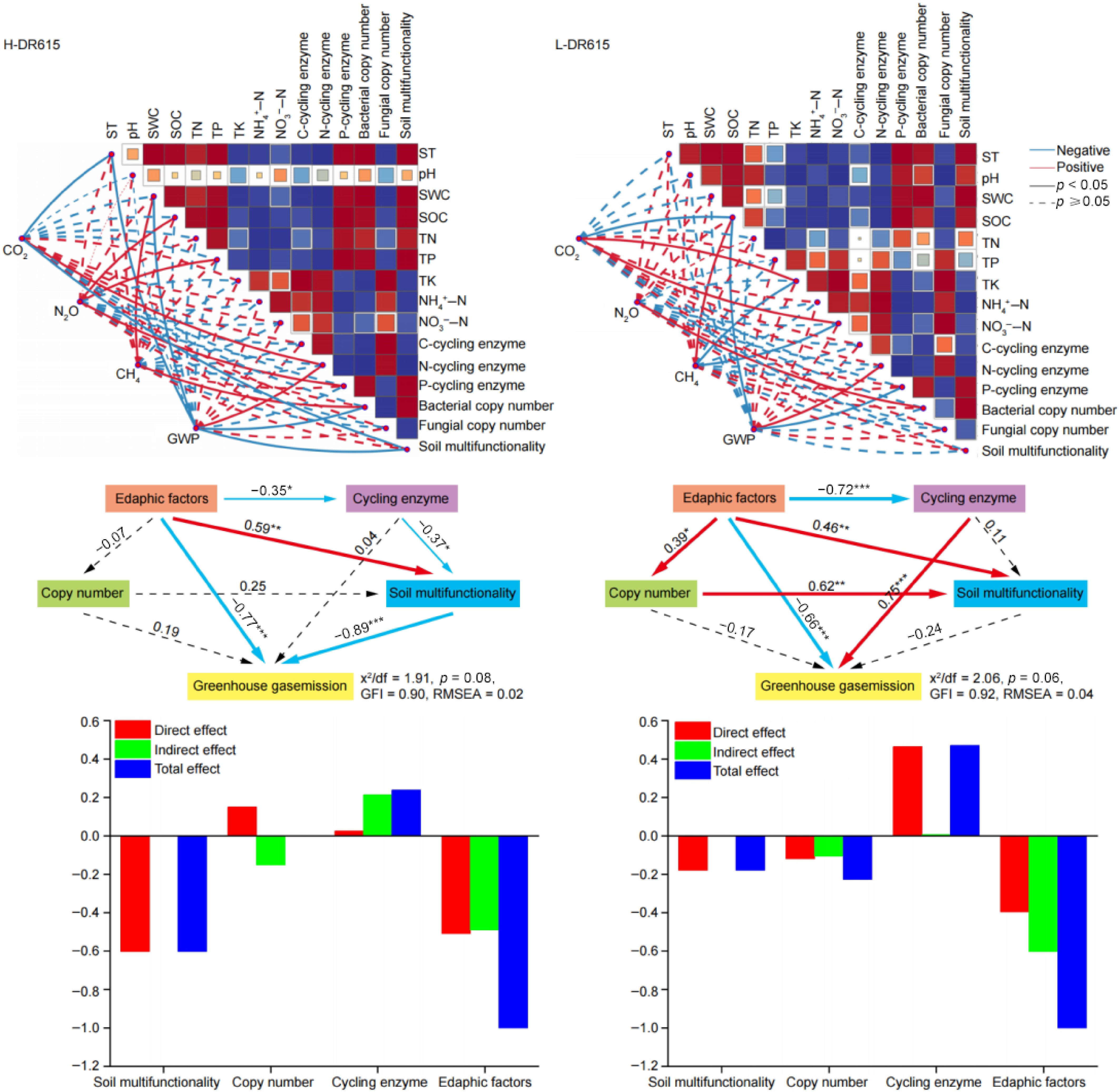
Figure 6.
(a) Spearman correlation heatmap, (b) structural equation modeling, and (c) standardized effect analysis. Red and blue arrows indicate significant positive and negative relationships, respectively (* p < 0.05, ** p < 0.01, *** p < 0.001).
SEM revealed distinct regulatory pathways for GHG between two altitudes (Fig. 6b). In H-DR615, edaphic factors and SMF directly influenced GHG (Fig. 6b). In L-DR615, edaphic factors and EEAs directly affected GHG (Fig. 6b). Standardized effect analysis further demonstrated that edaphic properties served as the predominant drivers of GHG fluxes for both H-DR615 and L-DR615 (Fig. 6c).
-
Altitudinal gradients significantly influenced the spatial distribution of edaphic factors by altering hydrothermal conditions. Consistent with Hypothesis 1, SOC, TN, and TP contents in H-DR615 soils increased by 34.95%, 32.16%, and 15.99%, respectively. This observation aligns with the positive relationship between elevation and SOC content documented by Bargali et al.[12]. Lower decomposition rates at higher altitudes reduced SOC losses, while C inputs under NGDR cultivation further enhanced soil C and N pools. Conversely, the significantly lower NH4+–N and NO3––N contents in H-DR615 soils may stem from enhanced plant nutrient uptake and intensified microbial immobilization under the high-altitude region. Elevation-driven shifts in EEAs reflected divergent patterns of nutrient cycling intensity. For H-DR615 soil, P-cycling enzyme activity increased by 2.38%, whereas C- and N-cycling enzyme activities decreased by 1.43% and 10.90%, respectively. Such patterns were closely related to the nutrient limitation status at high elevation. Vector analysis revealed 11.11% and 5.84% increases in C and P limitation magnitude. Increased P-cycling enzyme activity was inferred to be an adaptive regulation that eased P stress via boosting phosphorus bioavailability.[27]. Low-altitude soils possessed stronger catalytic capacity of C- and N-acquiring enzymes, driving accelerated carbon and nitrogen transformation rates; this trend was consistent with the higher CO2 emission fluxes measured in the low-altitude plots. Additionally, compared with L-DR615 soils, H-DR615 soils displayed a 38.0% increment in bacterial abundance and a 37.39% decline in fungal gene copies. Such contrasting shifts in bacterial and fungal abundances were likely driven by improved soil aeration and altered carbon substrate availability at higher altitudes. Bacteria are generally better adapted to aerobic conditions and possess stronger capabilities for decomposing complex SOC, whereas fungi tend to favor the relatively anaerobic, nitrogen-rich microenvironment characteristic of low-elevation regions[28,29]. The positive correlation between increased bacterial abundance and enhanced CH4 uptake suggests that an enriched bacterial community (methanotrophs) greatly strengthened soil CH4 uptake capacity[30].
Regulatory effects of elevational heterogeneity on GHG emissions
-
Altitude, as a critical geographic and climatic factor, significantly altered GHG emissions from NGDR fields by reshaping the soil microenvironment. These results fully support Hypothesis 2: CO2 emission flux in H-DR615 was significantly reduced by 26.03% compared with L-DR615 soil, accompanied by a 25.45% decrease in GWP. These reductions are largely attributable to lower soil temperature at high elevation, which slows the decomposition of carbon substrates[11]. Cooler high-altitude regions suppressed heterotrophic microbial respiration, reducing CO2 emission during SOC mineralization. Concurrently, the 34.95% higher SOC content under H-DR615 strengthened soil carbon sink capacity and further lowered CO2 emission potential.
Altitude exerted particularly strong impacts on CH4 emissions. H-DR615 soil exhibited strong CH4 uptake (–10.23 kg·ha−1), whereas L-DR615 soil showed weak CH4 emission (1.04 kg·ha−1). This observation is consistent with previous reports by Mashamaite et al.[14]. Lower SWC at high-altitude improved soil aeration, promoting the proliferation and activity of methanotrophic bacteria while suppressing anaerobic methanogenic archaea[10], which produced the 110.18% higher net CH4 uptake under H-DR615. In contrast, higher SWC at low altitude created localized anaerobic microenvironments that favored methanogenesis, resulting in CH4 emission. Notably, N2O emission flux increased by 15.53% in H-DR615 relative to L-DR615. This phenomenon may be associated with the elevated SOC and TN and P-cycling enzyme activity in H-DR615 soils[14]. Significant positive correlations between N2O production and SOC, TP, as well as P-cycling enzymatic activities were validated via correlation analysis. The enriched C and N substrate availability under H-DR615 presumably fueled the metabolic activities of nitrifying and denitrifying microorganisms. Furthermore, the increased P-cycling enzyme activity may indirectly enhance N transformation-related microbial activity by facilitating P cycling[10]. Even with a slight rise in N2O release, the dramatic drop in CH4 net uptake/emission offset this increment considerably, ultimately yielding a markedly decreased GWP in the H-DR615 vs L-DR615. It further demonstrates that high-altitude NGDR cultivation delivers stronger GHG mitigation benefits.
Driving mechanisms of SMF and regulatory pathways of GHG emissions
-
SMF was significantly enhanced by 6.29% in H-DR615 compared with L-DR615. Random forest analysis identified SWC, SOC, and TN as the core driving factors of SMF under high-altitude conditions, consistent with the conclusion that edaphic factors are key regulators of SMF[17]. Favorable SWC and larger C and N pools in high-altitude soils underpin the coordinated improvement of multiple ecological functions, including nutrient supply and material cycling[31−33]. In contrast, SMF in L-DR615 was primarily regulated by available nutrients and EEAs, highlighting the heterogeneity in the driving mechanisms of SMF across elevational gradients[34−36].
Our initial SEM model, which quantified the direct impacts of edaphic factors on GHG emissions, yielded findings consistent with previous GHG research[37,38]. Importantly, the divergent mediating roles of SMF across high and low elevations represent a novel empirical finding of the present study. Edaphic factors and SMF served as the direct regulators of GHG emissions in H-DR615 soils, while edaphic factors and EEAs played the dominant role in controlling emissions in L-DR615 soils. This divergence likely stems from altitude-driven differences in soil microenvironment[39−42]. At high altitude, enhanced SMF integrates the synergistic effects of edaphic factors and EEAs, thereby indirectly modulating GHG emission processes[43−46]. At low altitude, EEAs, as direct catalysts of material cycling, exert a more pronounced direct regulatory influence on GHG production and emissions[10,41,47]. These mechanistic insights support the development of altitude-specific mitigation strategies[48]. In high-altitude regions, mitigation goals may be achieved through improving edaphic factors and enhancing SMF. In low-altitude zones, regulating edaphic factors and EEAs offers opportunities to optimise GHG-emission patterns.
-
Compared with L-DR615, H-DR615 significantly reduced cumulative CO2 emissions (12.48 t·ha−1, down 26.03%) and GWP (13.28 t CO2-eq·ha−1, −25.45%), enhanced net CH4 uptake (−10.23 kg·ha−1, +110.18%), and moderately increased N2O emissions (3.53 kg·ha−1, +15.53%), demonstrating an overall climate-change-mitigation effect. Meanwhile, SMF under H-DR615 was significantly higher (by 6.29%) relative to L-DR615, mainly driven by SWC, SOC, and TN. High-altitude cultivation increased bacterial gene copy numbers by 38.0% and reduced fungal copy numbers by 37.39%. Furthermore, edaphic factors and SMF served as the direct regulators of GHG emissions in H-DR615 soils, while edaphic factors and EEAs played the dominant role in controlling emissions in L-DR615 soils. In summary, high-altitude NGDR cultivation delivers superior GHG-mitigation benefits together with improved soil ecological functions. Our findings provide valuable references for dryland-rice production across comparable mountainous altitudinal gradients. Future research should optimise water and nutrient management strategies according to elevational characteristics to further promote synergies between ecological performance and productivity for NGDR systems.
-
The authors confirm their contributions to the paper as follows: study conception and design: Wang S, He X; sample collection: Hei J, Liu M, Shi R; data collection: Hei J, Liu M, Li J; draft manuscript preparation: Hei J, Liu M; manuscript revision and editing: Li J, Tuo Y, Shi R, Wang Z. All authors reviewed the results and approved the final version of the manuscript.
-
All data generated or analyzed during this study are included in this published article and its supplementary information files.
-
The authors declare that they have no conflict of interest.
-
accompanies this paper online at: https://doi.org/10.48130/abd-0026-0009.
- Supplementary Table S1 Temporal variations and average values of 16 ecosystem functions across different altitudes.
- Supplementary Fig. S1 A priori theoretical structural equation model prior to optimization. Red and blue arrows represent significant positive and negative paths, respectively (**p < 0.01, ***p < 0.001).
- Copyright: © 2026 by the author(s). Published by Maximum Academic Press on behalf of Yunnan Agricultural University. This article is an open access article distributed under Creative Commons Attribution License (CC BY 4.0), visit https://creativecommons.org/licenses/by/4.0/.
-
About this article
Cite this article
Hei J, Liu M, Li J, Tuo Y, Shi R, et al. 2026. Effects of next-generation dryland rice cultivation across altitudinal gradients on soil greenhouse gas emissions and soil multifunctionality. Agrobiodiversity 3(4): 115−124 doi: 10.48130/abd-0026-0009 

Effects of next-generation dryland rice cultivation across altitudinal gradients on soil greenhouse gas emissions and soil multifunctionality
- Received: 15 June 2026
- Revised: 25 August 2026
- Accepted: 27 August 2026
- Published online: 08 October 2026
Abstract: Next-generation dryland rice (NGDR) is a promising water-saving cultivation system adapted to rain-fed mountain agroecosystems. Nevertheless, how altitudinal variation modulates soil greenhouse gas (GHG) fluxes and soil multifunctionality (SMF) remains poorly understood. In this study, we conducted field experiments with the NGDR cultivar 'Dianheyou 615' at high-altitude (H-DR615, 1,470 m) and low-altitude (L-DR615, 1,300 m) sites in Yunnan, China. We measured soil CO2, N2O, and CH4 fluxes to calculate the global warming potential (GWP), alongside edaphic properties, extracellular enzyme activities (EEAs), bacterial and fungal gene copy numbers, and SMF. Our results revealed that H-DR615 reduced cumulative CO2 emissions and GWP by 26.03% and 25.45% relative to L-DR615, while increasing cumulative N2O emissions by 15.53% and net CH4 uptake by 110.18%. SMF increased by 6.29% at H-DR615, primarily driven by soil organic carbon, soil water content, and total nitrogen. Bacterial and fungal gene copy numbers increased by 38.0% and decreased by 37.39% in H-DR615, respectively. Structural equation modelling further indicated that edaphic factors and SMF directly regulated soil GHG emissions under H-DR615. Collectively, H-DR615 mitigates climate-warming potential while enhancing SMF. This study provides empirical references for altitude-tailored management of NGDR and supports synergistic GHG reduction and soil ecological restoration in mountain agricultural systems.